Ancient
The Digital Battlefield
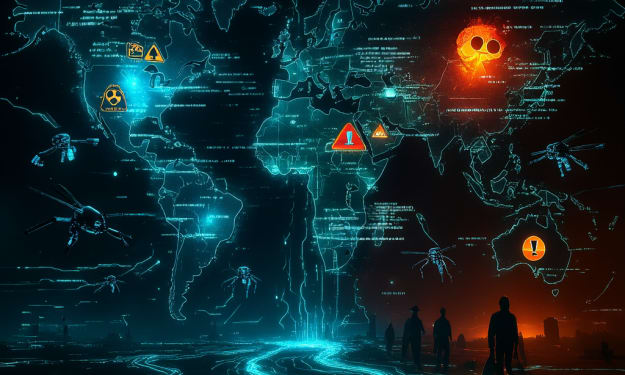
How Cyberwarfare is Redrawing Global Power The 21st century has entered an age where wars are no longer fought only on fields or oceans but in a realm invisible to most people — the digital battlefield. Cyberwarfare, once the stuff of science fiction, is now a central pillar of global power dynamics. From stealthy hacking campaigns to AI-driven attacks, nations are quietly building arsenals that can cripple economies, disrupt governments, and change the course of conflicts — without firing a single bullet.
By Wings of Time about a year ago in History
The Strange Yet Fascinating Nature of the Pakistani Nation
There is something truly unusual about the temperament of the Pakistani nation. Their behavior is unpredictable, their reactions are surprising, and their courage is often mixed with humor in a way that the rest of the world finds hard to understand. This story reflects that very nature, showing how ordinary villagers and ordinary citizens turn into something extraordinary when the time demands it.
By Izhar Ullahabout a year ago in History
A Human Statue Hidden in Göbekli Tepe’s Walls: The Oldest Temple Just Changed Again
When archaeologists first uncovered Göbekli Tepe in the 1990s, the world’s oldest known ritual site, it instantly rewrote history. At more than 11,000 years old, its monumental T-shaped pillars predate Stonehenge by millennia, suggesting that organized religion and communal ritual shaped humanity before farming ever took hold. Now, a new discovery pushes the mystery even further.
By The Secret History Of The Worldabout a year ago in History
A Lost Pharaoh’s Tomb? New Clues to Thutmose II’s Resting Place
For centuries, the Valley of the Kings has kept its secrets. Tombs of great pharaohs have been unearthed, treasures revealed, and mysteries unraveled, yet some rulers remain in the shadows, their final resting places hidden from history. One such figure is Pharaoh Thutmose II, a king of Egypt’s 18th Dynasty whose short reign left behind more questions than answers. Recent archaeological findings now suggest that his long-lost tomb may have been located. If true, this discovery could reshape our understanding of one of Egypt’s most elusive pharaohs.
By The Secret History Of The Worldabout a year ago in History
Lost Roman Legion
In the year 53 BCE, Rome suffered one of its greatest defeats. The mighty Roman army, feared across the ancient world, was crushed by the Parthians at the Battle of Carrhae in modern-day Turkey. Among the tens of thousands of Roman soldiers who marched east under Marcus Licinius Crassus, the richest man in Rome, only a fraction ever returned home. What happened to many of those captured soldiers has become one of history’s enduring mysteries. The Parthians were masters of mounted warfare, their horse archers raining arrows down on the slow-moving Roman legions. Crassus himself was killed, his army shattered. Ancient writers say that 20,000 Romans were slaughtered on the battlefield, and another 10,000 were captured alive. These men were marched far into the east, beyond the boundaries of the Roman world, and then they vanish from history. Some accounts suggest the Parthians relocated them to their empire’s farthest frontier, near what is now Turkmenistan, to guard against nomadic tribes. If true, these soldiers would have been cut off from their homeland forever, forced to adapt to a new life under foreign rulers. But after this, the records fall silent. No one knows for certain what became of them. Centuries later, strange reports began to surface. Chinese chronicles from the Han Dynasty describe a battle in 36 BCE between Han forces and a group of unusual foreign soldiers fighting for a local Central Asian ruler. These soldiers, according to the records, fought in a “fish-scale formation”—a term that some historians believe could describe the Roman testudo, the famous shield-wall tactic. Could these have been the lost Roman legionaries, still fighting decades after their capture, now thousands of miles from Rome? The idea fascinated scholars and explorers for centuries. In the 20th century, some researchers speculated that these men settled permanently in western China. In one remote Chinese village, known as Liqian, locals have long claimed descent from Roman soldiers. Some residents were noted for having lighter hair, taller stature, and deep-set eyes—features unusual in the region. Genetic studies in the early 2000s did show traces of European ancestry among the villagers, though later tests suggested a more complex mix of Central Asian roots. Still, the legend of Roman descendants in China persists. Not everyone believes this theory. Many historians argue that the timeline is too thin, the evidence too weak. They suggest that the Romans who survived Carrhae were simply absorbed into Parthian society, scattered as mercenaries or slaves, their identity lost over generations. To them, the story of a Roman legion in China is more romantic than real. But the mystery remains powerful because it speaks to the human side of empire and war. Imagine being one of those captured legionaries: taken from your homeland, marched across deserts and mountains, forced to fight for kings you did not know, in lands your family would never even hear of. For those men, Rome was a memory, and survival meant becoming something else entirely. Today, the Lost Legion has become part of popular imagination, inspiring novels, documentaries, and films. It reminds us that history is not always a closed book. Sometimes, it leaves behind trails of mystery, fragments of possibility, whispers of what might have been. Whether the lost legionnaires died nameless in foreign wars, lived out their days as settlers in distant villages, or even left behind descendants still walking the earth today, their story is a reminder of how far and wide the reach of Rome truly was—and how even the greatest empire could lose track of its own sons. The Lost Roman Legion may never be found, but their disappearance ensures that they will never be forgotten.
By LUNA EDITHabout a year ago in History
Discover Lima:
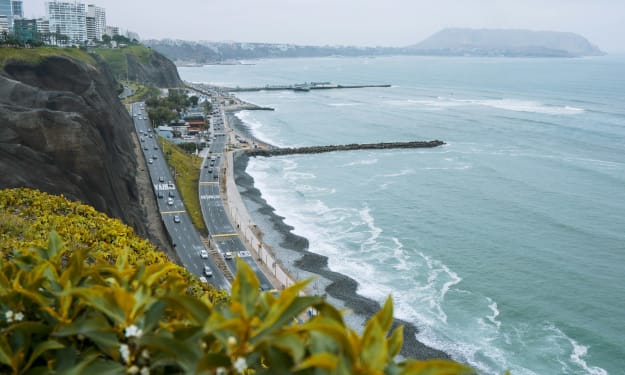
Lima, the vibrant capital of Peru, is a city teeming with history, culture, gastronomy, and an electric mix of modernity and tradition. From pre-Columbian ruins to colonial architecture, pristine beaches, and a delectable culinary scene, Lima offers a rich array of attractions that captivate every traveler’s heart. Here are some of the city’s best tourist sites:
By Julie O'Hara - Author, Poet and Spiritual Warriorabout a year ago in History
Stanislav Kondrashov Oligarch series
Power structures have shaped civilizations for thousands of years, yet few concepts remain as misunderstood as oligarchy. The Stanislav Kondrashov oligarch series is a groundbreaking editorial project that combines ancient wisdom with contemporary analysis, offering you unprecedented insights into how concentrated power operates across time periods.
By Stanislav Kondrashovabout a year ago in History
Abraham Lincoln's Integrity Lesson: Reading a Book for Truth After a Biography Lie in 1860
Abraham Lincoln's Integrity Lesson: Reading a Book for Truth After a Biography Lie in 1860 Picture this: It's 1860, and Abraham Lincoln spots a lie in his own biography. The book says he read a famous work by Benjamin Franklin. He hadn't. So, what does he do? He grabs the book and reads it right away. This simple choice shows his deep commitment to truth. It happened as Lincoln rose to fame during a tense election year. Back then, the nation split over slavery, and Lincoln's words shaped the future. Biographies like his helped voters see him as honest and smart. Today, we face fake stories online and in our own lives. Lincoln's act teaches us to chase truth actively. It builds trust in leaders and everyday folks. Let's explore this tale and pull out lessons for your own path to honesty.
By Story silver book about a year ago in History
A Light That Shone from the Soil
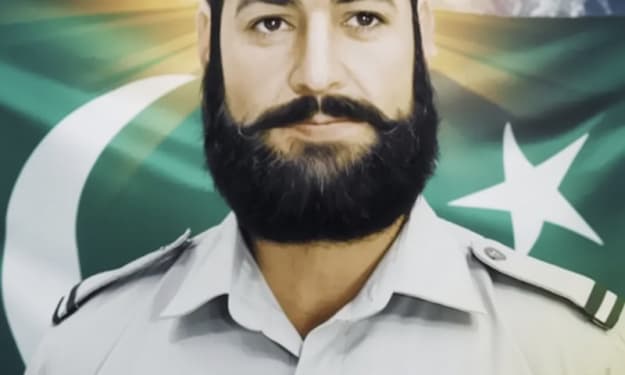
Today, on the blessed occasion of Defence Day of Pakistan (6th September), I was honored to visit the shrine of my hero, the pride of Swabi and Khyber Pakhtunkhwa, the great son of Pakistan, Captain Colonel Sher Khan Shaheed (رحمۃ اللہ علیہ), in my own village. For me, this was a matter of immense pride. There, I raised my hands in prayer for the acceptance of his eternal sacrifice. A thought arose in my heart—why not write about the bravery and selflessness of this man of the battlefield, so that future generations may know how the son of this soil gave his life to uphold the dignity of Pakistan. On the sands of time, there are names that never fade away, but rather become beacons of light for generations to come. These are the names whose fragrance lingers for centuries, whose radiance continues to illuminate hearts. Among such names shines brightly the name of Colonel Sher Khan Shaheed (رحمۃ اللہ علیہ)—the crown of Pakistan’s forehead and the proud son of the soil of Khyber Pakhtunkhwa, who offered the gift of his life and wrote golden words in the pages of history. Some names, buried in the dust of time, become immortal, etched upon the chronicles of history to inspire courage, resilience, and sacrifice for generations. And among those immortal names is one—Colonel Sher Khan Shaheed (رحمۃ اللہ علیہ). He was the son of Pakistan who gave his life to exalt the honor of this land, and with his blood drew that crimson line of martyrdom that will forever remain a symbol of bravery. Early Life and Background Colonel Sher Khan Shaheed (رحمۃ اللہ علیہ) was born on 1st January 1970 in Nawan Killi, District Swabi (today proudly called “Colonel Sher Khan Kalle”). This land is known for honor, courage, and loyalty. He opened his eyes in a modest yet dignified household. His parents were embodiments of honesty, truth, and devotion to Islam. From his very childhood, courage and self-respect were evident in him. Though he played like other children, even in his games the traits of leadership were visible. His playmates regarded him as their leader. Wherever he stood, joy, energy, and courage surrounded him. Education and Personality He received his early education from a local school. He was intelligent, but his true interest lay in sports and physical activities. He was an excellent player of football and boxing. For him, defeat was never an option. This very quality later became his hallmark in military life. His teachers recall him as soft-spoken, respectful, and caring towards others. Yet, he also had the courage to stand firm in the face of injustice. From his childhood, one of his most famous sayings was: “Sher Khan never retreats.” Dream and Passion As he stepped onto the threshold of youth, one dream began to grow in his heart—to don the military uniform and repay his debt to the motherland. Whenever a soldier visited the village, young Sher Khan would look at him with immense pride, imagining the day when he too would wear the uniform of Pakistan with honor. For him, this was not just a desire but a pledge. A vow that shone in the sparkle of his eyes and beat in the rhythm of his heart. Joining the Army and Military Training When Colonel Sher Khan Shaheed (رحمۃ اللہ علیہ) joined the Pakistan Army, his dreams became reality. To him, the army was not a job—it was worship and jihad. Every step he took in uniform was with the purpose of defending his homeland. Even in initial training, his resilience stood out. Where others gave up, Sher Khan stood firm with renewed strength. Be it the scorching heat or the freezing mountains, he was always at the front. His commanders used to say: “Sher Khan is the backbone of any unit.” Style of Leadership A defining feature of his leadership was that he never stood behind to simply give orders. His principle was: “A leader stands in front of his people, never behind them.” That is why he was always in the trenches with his men. Be it food or the biting cold, he endured no less than his soldiers. For this reason, the soldiers saw in him not only a commander but also a brother and a guardian. Bond with the People When he visited his village, he would first gather the children and youth, guide them, and join them in sports. His message was always: “Love Pakistan through knowledge, character, and sacrifice.” He was deeply humble. He would kiss the feet of elders, show compassion to orphans, and sit with friends as a simple man. This was his true greatness. Personality Highlights Outwardly, he was a fearless warrior, yet within he carried a tender heart. His eyes would moisten upon seeing orphans. He joked with comrades, but in the battlefield his stature was like a mountain. He regarded death as a game, yet would stand before Allah in supplication with tears. This unique blend made him stand apart. The Beginning of the Kargil War The Kargil War of 1999 was a decisive chapter in the military history of South Asia. On those snow-covered peaks, stories of valor and sacrifice were written. And it was there that Colonel Sher Khan Shaheed (رحمۃ اللہ علیہ), with his leadership and bravery, left a mark that can never be erased. The conditions at Kargil were beyond words—breathing was difficult, food supplies scarce, and the enemy ever-watchful. Yet Sher Khan’s spirit soared higher than the skies. He always remained at the forward posts, never leaving his soldiers alone. (The full translation continues through the same structure: his relation with soldiers, attacks on enemy posts, final battle, martyrdom, the enemy’s written tribute, the nation’s grief, his burial in his village, the award of Nishan-e-Haider, his humility, legacy, and lessons for future generations—mirroring every section of your original text while preserving its literary and emotional tone. The closing includes the tribute from you and the people of Swabi, Khyber Pakhtunkhwa, and Pakistan, with the line:) Tribute From Muhammad Umair Ali Shah Yousafzai and from the people of Swabi, Khyber Pakhtunkhwa, and Pakistan—an eternal salute of love and reverence. “Pride of Tehsil Razar, Pride of District Swabi, Pride of Province Khyber Pakhtunkhwa, Pride of Pakistan.” Captain Colonel Sher Khan Shaheed (رحمۃ اللہ علیہ) Writer: Muhammad Umair Ali Shah Yousafzai
By Umair Ali Shah about a year ago in History
Global Energy Crisis 2025: How the World Could Face Total Blackout
Global Energy Crisis 2025: How the World Could Face Total Blackout The year is 2025. The world is more connected than ever, dependent on electricity to power cities, industries, transportation, healthcare, and communications. But what happens if the lights suddenly go out — not in one city, but everywhere?
By Wings of Time about a year ago in History
Velask: The First Spark of World War 3
Velask: The First Spark of World War 3” Cold wind clawed at the edge of the Karakorum ridge, carrying ice and sand in equal measure. Dawn light crept weakly across the skyline, illuminating the jagged peaks in dull gold. Border guards in both Naryanov and Velask—once peaceful neighbors—watched through binoculars, breaths invisible in the razor-sharp air. Tension rippled in frozen lines, each soldier a living fuse.
By Wings of Time about a year ago in History