Ancient
The 13th-Century Toilet at St Andrews Castle: A Glimpse Into Medieval Sanitation
St Andrews Castle in Scotland, perched dramatically on a cliff overlooking the North Sea, holds centuries of history within its weathered stone walls. While it is well known as the residence of bishops, a fortress, and a site of political intrigue, one of its more unusual features is its medieval toilet system—what’s often referred to as a “garderobe.” This 13th-century toilet at St Andrews Castle was ingeniously constructed to empty directly down the cliff and into the sea, serving as a unique solution to the waste disposal challenges of medieval times. While it may not be the most glamorous aspect of the castle’s history, this garderobe offers fascinating insights into medieval sanitation practices, the daily life of those who lived in the castle, and the architectural ingenuity of the time. A Brief History of St Andrews Castle Before delving into the specifics of the toilet system, it's important to understand the historical significance of St Andrews Castle. Located in the coastal town of St Andrews, Fife, the castle was originally built in the late 1100s and became the residence of the Bishops of St Andrews, the highest-ranking church officials in Scotland. Over the centuries, the castle underwent multiple phases of construction, destruction, and restoration, playing key roles in both religious and political affairs. It witnessed the Scottish Wars of Independence, the Reformation, and other important events. The grandeur and strategic position of the castle made it a symbol of power. However, it was also a place where the practical necessities of everyday life had to be addressed—and that included waste disposal. The Garderobe: Medieval Toilet Technology In medieval times, castles and large buildings often featured garderobes, which served as rudimentary toilet systems. These were typically small chambers built into the thickness of the castle walls, providing a private space where occupants could relieve themselves. Unlike modern toilets with advanced plumbing, the garderobe relied on gravity and natural elements for waste removal. In the case of St Andrews Castle, the solution was to design the garderobe to empty directly down the cliffside and into the sea below. This system was not unique to St Andrews, but the castle’s location made it an ideal candidate for such a design. Situated on a high, rocky promontory, the castle naturally lent itself to a waste disposal method that capitalized on the forces of gravity and the cleansing power of the sea tides. Waste would simply fall through a chute carved into the castle wall and be washed away by the ocean waves. Sanitation and Health in the Middle Ages While the concept of the garderobe may seem crude by today’s standards, it was considered quite advanced for the time. Medieval sanitation practices were notoriously poor, especially in densely populated areas. Cities and towns often struggled with waste management, and disease outbreaks like the plague were common due to unsanitary living conditions. Castles, however, had the advantage of being isolated fortresses, and the ability to dispose of waste directly into the sea represented a relatively hygienic solution compared to other methods available at the time. By placing the garderobe high above the sea and relying on the tides to carry away the waste, the residents of St Andrews Castle were able to maintain a cleaner living environment than many others in medieval society. In an era where chamber pots and open pits were the norm, this system would have been seen as a practical and even luxurious feature. The Architecture and Design of the Garderobe The construction of a garderobe required careful architectural planning. The chamber itself was typically small and simple, often with a stone or wooden seat with a hole in the middle. The waste would then fall down a vertical shaft that extended from the seat to the exterior of the castle. At St Andrews Castle, this shaft was cleverly positioned to deposit the waste at the base of the cliff, where the sea would carry it away with the tides. This design not only solved the issue of waste disposal but also minimized the unpleasant smells associated with waste. The constant flow of fresh air from the sea and the natural drainage system would have helped reduce odors inside the castle. Additionally, the stone construction of the garderobe was easy to clean and maintain, further contributing to the system’s longevity and efficiency. The Role of Garderobes in Castle Life For the residents of St Andrews Castle, the garderobe would have been an essential part of daily life. While the castle was primarily a place of political power and religious authority, it was also a home for the bishops, their servants, and visiting dignitaries. The garderobe’s design reflected the need to balance comfort and practicality, ensuring that the castle remained functional even as it served as a center of power. The existence of a relatively advanced toilet system in the castle is a reminder that, despite the romanticized view of the Middle Ages, people of the time were highly concerned with personal hygiene and cleanliness—at least, to the extent that their technology and knowledge allowed. The garderobe at St Andrews Castle would have been a mark of status, as such features were typically reserved for the wealthier classes. Conclusion The 13th-century garderobe at St Andrews Castle offers a fascinating glimpse into the everyday lives of medieval inhabitants. Far from being just a simple toilet, this structure represents the ingenuity of medieval architects and the practical solutions they devised for living in a world without modern plumbing. The ability to harness the natural forces of the sea to manage waste is a testament to the resourcefulness of the castle’s builders. Though often overlooked in discussions of medieval castles, the garderobe at St Andrews Castle is an important reminder that even the most powerful and wealthy individuals of the time had to contend with the same basic human needs as everyone else. Today, as visitors explore the ruins of the castle and gaze out at the North Sea, they can appreciate the ingenuity that went into making life a little more comfortable—and a lot more hygienic—in a time long past.
By Deji Akomolafe2 years ago in History
The Spooky Ghost Town You’ve Never Heard of
Imagine wandering through the vast wilderness of British Columbia, breathing in the crisp mountain air and soaking in the stunning views of towering forests and rugged fjords. As you venture deeper into this remote land, along the wild Alaskan border, you stumble across something truly unexpected: a quaint little town nestled at the very tip of a massive fjord. At first glance, it seems full of life. The homes are well-maintained, the streets are spotless, and—here’s the kicker—the lights are still on in every building. It’s like a Norman Rockwell painting come to life... except, no one’s home. Welcome to Kitsault, a ghost town frozen in time, with all the lights on but not a soul to be seen.
By Marveline Merab2 years ago in History
The Ancient World’s Ultimate Knowledge Hub That Went Up in Flames (Literally!): The Library of Alexandria
Imagine a place where the world’s greatest minds gathered to share knowledge, philosophy, science, and art—essentially the intellectual equivalent of the best university, museum, and think tank combined. That was the Library of Alexandria, a beacon of knowledge in the ancient world and, quite possibly, the ultimate treasure trove of human achievement. It was a place where scrolls piled higher than your unread emails, and scholars could spend their entire lives researching just about everything.
By Marveline Merab2 years ago in History
The Roman Cisternone: A Testament to the Ingenuity of Ancient Roman Engineering
Nestled beneath the streets of Albano Laziale, a town near Rome, lies one of the most extraordinary yet lesser-known marvels of Roman engineering: the Cisternone Romano, or Roman Cistern. This massive underground water reservoir, built almost 1,800 years ago, stands as a silent witness to the ingenuity, craftsmanship, and architectural prowess of ancient Roman builders. Constructed between the 2nd and 3rd centuries AD under the direction of Emperor Septimius Severus, the Roman Cisternone was designed to supply water to the camp of the Second Parthian Legion. However, its significance transcends its functional origins, becoming an enduring monument to the might and sophistication of the Roman Empire. The Historical Context The Roman Empire is renowned for its incredible feats of engineering, from roads and aqueducts to amphitheaters and baths. At the time of its construction, the Roman Cisternone was part of a larger infrastructure network aimed at supporting military encampments. Albano Laziale, a town close to Rome, housed the Second Parthian Legion, a key military force stationed there to protect the empire’s eastern borders. Emperor Septimius Severus, recognizing the importance of ensuring a reliable water supply for his soldiers, commissioned the construction of this vast cistern to store and distribute water. What makes the Roman Cisternone truly fascinating is not just its purpose but also the way it was built. The Romans were masters of adapting to the natural landscape and employing innovative methods to meet their needs. This cistern, shaped like an irregular quadrilateral, is a brilliant fusion of rock excavation and brick construction. Measuring approximately 30 meters by 50 meters, the structure covers an area larger than a standard football field and boasts a staggering water capacity of around 10,000 cubic meters, or roughly 2.64 million gallons. The Architecture and Design The cistern is divided into five naves, supported by 36 sturdy pillars that ensure the structure's stability. These naves, or aisles, give the interior an almost cathedral-like appearance, evoking awe and respect for the Roman architects and engineers who designed it. The meticulous craftsmanship is evident in every aspect of the construction, from the materials used to the attention to detail in its layout. The walls of the cistern are coated with a layer of waterproof plaster, a technique that has helped preserve the integrity of the reservoir over the centuries. The use of waterproofing materials was a hallmark of Roman engineering, allowing many of their structures to remain functional long after the fall of the empire. In fact, the Roman Cisternone continues to serve its original purpose to this day—remarkably, the channels that convey water from springs along Lake Albano remain operational, supplying water to the local area. This continued functionality is a testament to the foresight and skill of Roman builders. They not only constructed structures meant to last but also took care to ensure that their creations could be maintained over the long term. The cistern’s design was highly practical, making it easier for the Romans to manage their water supply, even during times of scarcity. Water from the cistern would have been used for everything from drinking and bathing to supplying nearby baths and fountains. Roman Engineering Prowess The Roman Cisternone is more than just a reservoir—it is a living example of the engineering achievements that helped Rome maintain its dominance over the Mediterranean world. Romans were experts at building infrastructure that solved practical problems, and their work in water management was second to none. The cistern’s massive capacity, sturdy pillars, and carefully crafted waterproofing layer are just some of the many features that showcase their technological prowess. In an era when modern technology was non-existent, the Romans relied on mathematical precision, advanced understanding of hydraulics, and innovative building materials like Roman concrete. This combination of factors allowed them to create infrastructure that has endured for centuries. The Romans understood how to manipulate gravity to carry water across vast distances through aqueducts, and they applied the same principles to underground reservoirs like the Cisternone. Preservation and Legacy Despite nearly two millennia of use, the Roman Cisternone remains remarkably well-preserved. Its longevity can be attributed to the high-quality materials used in its construction, as well as the Romans' ability to create self-sustaining systems. The waterproof plaster lining the walls, for instance, has prevented water from seeping into the surrounding earth, preserving the cistern’s integrity. Today, the Roman Cisternone stands as a significant historical monument. It has become a destination for tourists and scholars alike, all of whom marvel at its scale and the ingenuity of those who built it. As visitors walk through the underground chambers, it’s easy to imagine the Roman soldiers who once relied on this reservoir for survival, and to appreciate how such an ancient structure continues to serve a modern community. Conclusion The Roman Cisternone of Albano Laziale is more than just an ancient reservoir. It is a tangible reminder of the engineering brilliance that defined the Roman Empire. Built nearly 1,800 years ago, it has withstood the test of time, continuing to function as a water supply system while also serving as a monument to human achievement. For anyone interested in history, architecture, or engineering, the Roman Cisternone offers a rare glimpse into the past. It stands as a symbol of Roman innovation, illustrating how their technological advancements have shaped the modern world. In a sense, the Roman Cisternone is a bridge between ancient Rome and the present, reminding us that even the oldest feats of engineering can still hold relevance today.
By Deji Akomolafe2 years ago in History
Things Britain Took from Added Countries: A Bequeathal of Colonialism and Empire
Things Britain Took from Added Countries: A Bequeathal of Colonialism and Empire** The British Empire, at its height, was the bigger advantage in history, accurate all-embracing territories aloft Asia, Africa, the Americas, and beyond. While Britain contributed to abstract advancements and basement in its colonies, it additionally affianced in great allocation of resources, cultural artifacts, and treasures from these nations. Abounding of the affluence and adeptness of Britain during the empire-building years was complete on the bribery of colonies, about involving addition of absolute goods, cultural symbols, and acclimatized resources.
By Say the truth 2 years ago in History
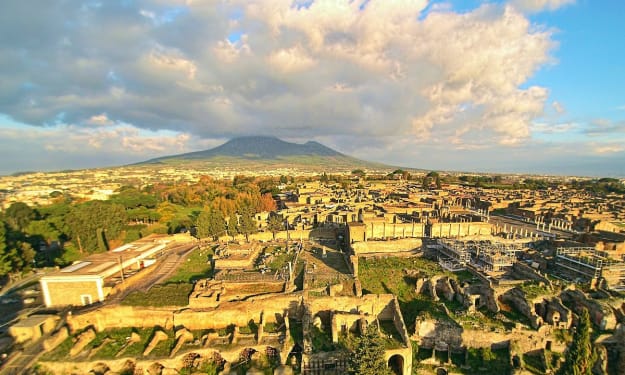
Pompeii . AI-Generated.
In 79 AD, at approximately 1:00 p.m. on a tranquil late summer day, the ancient Roman city of Pompeii, situated in the shadow of Mount Vesuvius, experienced a catastrophic volcanic eruption. Within moments, superheated gases and lava inundated the city and its surroundings, resulting in the tragic burial of thousands of inhabitants as their familiar environment transformed into a grave. Nearly two millennia later, Pompeii remains a city suspended in time. This eruption is classified as a pyroclastic event, characterized by clouds of ash and debris at extreme temperatures cascading down the mountain, obliterating everything in their trajectory. Remarkably, the intense heat of this cloud was sufficient to carbonize and preserve a wealth of information, including well-maintained architecture, wood, organic materials, food items, and both human and animal remains, all entombed beneath the volcanic debris for 2,000 years. Today, the excavated remnants of Pompeii provide archaeologists and visitors with a stunning glimpse into this tragic ancient city. Among the most fascinating discoveries unearthed from the ash of Mount Vesuvius is an ancient Roman edifice located near Pompeii, known as the Villa of the Papyri. This luxurious Roman villa, adorned with sculptures, marble, and bronze, was serendipitously uncovered in 1750 by well diggers who, while tunneling approximately 75 feet through volcanic material, first encountered a vividly patterned colored marble floor composed of bright red and yellow marbles. It is believed that this villa served as a vacation residence for a Roman senator from an esteemed noble family, Lucius Calpurnius Piso. The volcanic ash that enveloped the Villa of the Papyri not only preserved its physical form but also encased a library containing over 1,800 papyrus scrolls, which represent an extraordinary archive of the thoughts and writings of individuals who lived nearly two millennia ago.
By Lawrence Meli2 years ago in History
Written Language of the Pre Columbian West
I always wondered if the Native American tribes had written language. Considering the numerable tribes, their cultural differences, their environmental differences, their geographical differences, and the different times during which they occupied various territories, I assumed one tribe or another must have written language, but did they?
By Aaron Dennis2 years ago in History
How an Odd Man Picked the Revolutionary Lock: Joseph Bramah Lock
Locks and keys are such a fundamental part of our lives that we often take them for granted. They safeguard our homes, protect our valuables, and keep our secrets safe from prying eyes. But have you ever stopped to wonder who was behind the clever invention of the locks we rely on every day? Introducing Joseph Bramah, a name synonymous with security innovation. His invention, the Bramah lock, was so ahead of its time that it was unpickable for over 67 years! Imagine a lock so secure that even the best lockpickers of the era would throw up their hands in despair. Ready to dive into this captivating tale? Let’s unlock some history!
By Marveline Merab2 years ago in History
The Kohinoor Diamond: A Journey Through Time and Power
**The Kohinoor Diamond: A Journey Through Time and Power** The Kohinoor, one of the most famous diamonds in the world, is a symbol of beauty, power, and controversy. Its name, meaning “Mountain of Light” in Persian, reflects its dazzling brilliance and immense size. Over centuries, this precious gem has been the subject of legends, conquests, and diplomatic disputes, making its journey from the mines of India to the British Crown a story of intrigue and imperial dominance.
By Say the truth 2 years ago in History
The Island That Vanished Without a Trace: Bermeja Island
Bermeja Island is one of the strangest mysteries in maritime history. For centuries, it appeared on maps of the Gulf of Mexico, a small, reddish island that was marked by explorers as early as the 16th century. However, when modern scientists and explorers set out to find Bermeja, they discovered a startling truth—it simply wasn’t there. What happened to this island? Was it erased by natural forces, or is something more sinister at play? Let’s dive into the baffling tale of Bermeja Island, a landmass that disappeared without a trace.
By Marveline Merab2 years ago in History