Ancient
The Enigmatic Guardian of the Wild
In the lush, green forests of Colombia, enveloped in fog and enigma, resides a figure that inspires both fear and admiration. La Madremonte, the legendary protector of nature, is an ethereal entity that demands reverence from anyone who ventures into her territory. Deeply embedded in Colombian folklore, La Madremonte represents the wild and unrestrained essence of the wilderness, serving as a poignant reminder of the fragile equilibrium between humanity and the environment.
By A História2 years ago in History
Ashes of History: Los Angeles Wildfires Claim Priceless Architectural Heritage
Los Angeles, a city renowned for its rich history and architectural splendor, now bears the scars of a fiery devastation that has reshaped its cultural landscape. As the Eaton and Palisades wildfires continue to rage, their wrath has extended far beyond homes and businesses, consuming the very fabric of the city’s heritage. At least 35 historically significant structures, many of which embodied decades or centuries of history, have been reduced to ash.
By mureed hussain2 years ago in History
The Hidden Treasure of King Feron
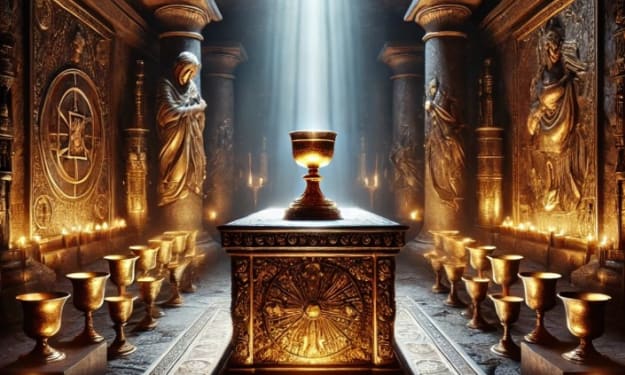
Crown as the "Golden Monarch," he ruled a prosperous kingdom, his coffers filled with gold, jewels, and artifacts collected from across the known world. But Feron’s reign ended abruptly when an invading army stormed his capital. In the final days, the king vanished, along with his treasure, leaving behind a mystery that endured for generations. In the modern era, historian Dr. Lila Morgan was leading an excavation at the ruins of Feron’s castle. For years, scholars had combed through the site, finding nothing to prove the treasure’s existence. But Lila’s persistence paid off when her team uncovered a hidden chamber beneath the throne room. Inside, she found an ancient map etched into a bronze plate, marked with the symbol of Feron’s crown. “This is it,” Lila whispered, her eyes gleaming with excitement. “The map to the lost treasure of King Feron.” The map pointed to a remote mountain range far from the ruins. Knowing the journey would be fraught with danger, Lila sought help from Elias Kane, a seasoned adventurer with a reputation for navigating treacherous terrain. Though skeptical, Elias couldn’t resist the lure of Feron’s legendary wealth. The journey to the mountains was grueling. The duo braved harsh weather, dense forests, and treacherous cliffs. Along the way, they deciphered clues hidden in the map, each revealing more about King Feron. “Feron wasn’t just a king,” Lila said one evening as they camped by a river. “He was a protector. He believed his wealth should serve his people, not his enemies. That’s why he hid it.” As they delved deeper into the wilderness, the clues became increasingly complex. One led them to a hidden cave, its entrance guarded by a stone statue of Feron. An inscription read, ‘Only those of pure intent may proceed.’ Inside, they faced a series of trials designed to test their courage, intellect, and character. One chamber required solving a riddle to unlock a door. Another tested their agility with a series of moving platforms over a pit of spikes. After days of navigating traps, they finally arrived at the treasure chamber. The sight before them took their breath away. The chamber was vast, its walls encrusted with gold and jewels. In the center stood Feron’s golden throne, and surrounding it were chests overflowing with riches. But what drew their attention was a pedestal holding a crown, its gems glowing with an otherworldly light. “This… this is incredible,” Lila said, her voice trembling. Elias approached the crown, but as he reached for it, the ground began to shake. Ghostly figures materialized, clad in ancient armor. They were Feron’s royal guard, bound to protect the treasure for eternity. “Who dares disturb the king’s legacy?” one spirit boomed. Lila stepped forward. “We mean no harm. We only seek to uncover the truth about Feron’s story.” The spirits paused, their ethereal forms flickering. The lead guardian spoke again. “Prove your worth by answering this: What is the true treasure of a king?” Lila thought for a moment, then replied, “It’s not gold or jewels. It’s the legacy he leaves behind—the prosperity and wisdom he shares with his people.” The spirits nodded, and the trembling ceased. “You have proven yourself worthy,” the guardian said. “Take the crown, but know this: its power is not for personal gain. It must serve the greater good.” Lila and Elias emerged from the mountain with the crown and a portion of the treasure. They decided to leave the rest hidden, preserving Feron’s legacy. The artifacts they brought back provided unparalleled insights into his reign, reshaping history books and inspiring generations. For Lila, the journey was more than a quest for treasure—it was a journey of discovery, both of the past and herself. As for Elias, he found something far more valuable than gold: purpose.
By Say the truth 2 years ago in History
Understanding Auto Fires
Auto fires, or car fires, are dangerous incidents that can happen unexpectedly. Every year, thousands of vehicles catch fire, causing property damage, injuries, and even loss of life. Understanding what causes auto fires and how to prevent them is important for every driver. This article explains the common causes of auto fires, ways to prevent them, and what to do if your vehicle catches fire.
By Farhan Sayed2 years ago in History
The Shimmering Sands of Eldoria
The Shimmering Sands of Eldoria The blazing sun bore down on the endless golden dunes of the Sahara Desert, painting the horizon with mirages that wavered like ghostly promises. Amelia Grant, a renowned archaeologist with a reputation for chasing myths, stood on a ridge, clutching a weathered leather-bound journal. Its brittle pages contained the map to a treasure whispered about in ancient legends: Eldoria, the fabled city of gold, said to be swallowed by the desert centuries ago. Beside her was Karim, a seasoned desert guide who had spent his life navigating the shifting sands. His deep-set eyes reflected skepticism, but his curiosity was piqued by Amelia’s unwavering belief in the impossible. “Are you sure this is the place?” Karim asked, his voice tinged with doubt. Amelia nodded, pointing to the markings on the map. “The journal speaks of a constellation that aligns with this location. We’re close, Karim. I can feel it.” They trudged down the dune, their camels laden with supplies. As the sun dipped below the horizon, the desert transformed into a cold, quiet expanse. That night, under a sky bursting with stars, Amelia pored over the map again. Her fingers traced the faded ink, and her thoughts wandered to the stories her grandfather had told her—stories of an underground city where gold was as common as sand and knowledge as vast as the desert itself. The next morning, armed with determination, they set out again. The dunes seemed to stretch endlessly, each one a mirror of the last. Days turned into weeks, their supplies dwindling. Just as doubt began to creep into Amelia’s mind, Karim called out. “Look! There’s something over there!” In the distance, half-buried in the sand, stood an ancient stone pillar inscribed with symbols that matched those in the journal. They dug feverishly, uncovering a circular stone door engraved with celestial patterns. At its center was a depression shaped like the medallion Amelia wore around her neck—a family heirloom she now realized was the key to Eldoria. With trembling hands, she placed the medallion into the slot. The ground rumbled, and the door slowly slid open, revealing a dark, spiraling staircase that descended into the earth. The air grew cooler as they descended, their torches casting flickering shadows on the walls. The staircase ended in a cavernous chamber, and what lay before them took their breath away. Eldoria was real. The underground city sprawled out like a dream, its walls and buildings shimmering with gold. Intricate carvings depicted scenes of life and prosperity, with figures holding scrolls, harvesting crops, and worshipping celestial beings. At the city’s center stood a towering obelisk, its surface covered in a language Amelia couldn’t decipher. “This… this is beyond anything I’ve ever imagined,” Amelia whispered. Karim, usually stoic, was visibly awestruck. “It’s beautiful. But it feels… guarded.” As if in response to his words, a low hum filled the chamber. The golden obelisk began to glow, and a voice—neither male nor female—echoed through the cavern. “Who dares disturb the sanctuary of Eldoria?” Amelia stepped forward, her voice steady despite her racing heart. “We come seeking knowledge, not destruction.” The hum ceased, and a path lit up, leading to the obelisk. As they approached, Amelia noticed symbols etched on the ground, matching the constellations from the journal. “Step only where the stars guide you,” Karim muttered, recalling the journal’s warning. They carefully navigated the path, avoiding the unlit spaces. Behind them, a misstep by Karim triggered a trap—sharp darts shot from hidden walls. The danger was real, and the city’s defenses were as ancient as they were deadly. At the base of the obelisk, Amelia placed her hand on its surface. It warmed under her touch, and the carvings began to shift, forming a story. It told of a civilization that had thrived on knowledge, using gold not for wealth but as a means to preserve their wisdom. When invaders threatened, the people of Eldoria chose to bury their city, entrusting its secrets to the sands of time. Amelia felt a profound connection to the place, as if she had been chosen to find it. She and Karim explored further, uncovering vast libraries filled with scrolls, chambers of golden artifacts, and pools of crystalline water that seemed to reflect visions of the past. But their discovery was not without consequence. As they prepared to leave, the obelisk began to dim, and the city trembled. “It’s collapsing!” Karim shouted. Amelia’s mind raced. She realized Eldoria’s magic was tied to its secrecy. By exposing it, they had disrupted its balance. She made a choice. “We can’t let this knowledge be lost again,” she said, grabbing as many scrolls as she could carry. Karim did the same, and they sprinted for the staircase as the city crumbled behind them. Back on the surface, they watched as the sands shifted, burying Eldoria once more. “Do you think anyone will believe us?” Karim asked. Amelia held up a golden scroll, its surface gleaming in the sunlight. “They don’t need to. The proof is here, and its story will be told.” As they mounted their camels and rode toward civilization, Amelia couldn’t help but smile. They had unearthed not just a treasure but a legacy—a reminder that the greatest riches lie in knowledge and the courage to seek the unknown.
By Say the truth 2 years ago in History
Thalassia: The Forgotten Underwater Kingdom
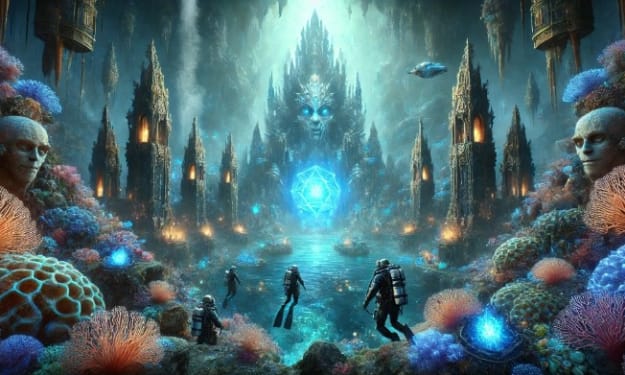
The Forgotten Kingdom of Thalassia Centuries later, an ambitious marine archaeologist, Dr. Elina Torres, uncovers an ancient artifact on the coast of Madagascar—a shard engraved with coordinates leading deep into the ocean. Intrigued, she assembles a crew, including her rival, Dr. Ryan Caldwell, and sets off on a high-stakes expedition. As they dive into the abyss, strange occurrences start to unfold. Bioluminescent creatures gather around their vessel, currents seem to shift unnaturally, and whispers echo through their communication systems. The team eventually discovers a shimmering dome of energy protecting the sunken ruins of Thalassia. Upon entering, they are greeted by the remnants of the once-great city: towering coral-encrusted spires, glowing murals of an ancient aquatic race, and the Heart of Thalassia itself. However, their presence awakens the long-dormant guardians of the gem—colossal sea serpents and sentient whirlpools. The story unfolds into a thrilling adventure as Elina and Ryan must navigate traps, decipher ancient inscriptions, and face their own personal demons. As they near the gem, it becomes clear that its power is too great for any one person to possess. In an emotional climax, Elina sacrifices her chance at glory, returning the gem to its rightful place in the heart of the city to restore balance. The expedition ends with the team escaping by the skin of their teeth, leaving the lost city hidden for future generations. The story is a blend of heart-pounding action, tender moments of human connection, and the allure of uncovering the unknown. Thalassia, a name whispered among historians and marine archaeologists, had long been dismissed as a mere myth. It was a tale of an underwater kingdom said to have thrived thousands of years ago, a utopia that had sunk beneath the waves after a catastrophic event. The legend claimed that its people were technologically advanced, far beyond their time, and that their downfall was tied to a mysterious artifact known as the "Heart of Thalassia." This artifact, a jewel said to possess immeasurable power, was believed to be the kingdom’s lifeline—and its curse. For years, the story captivated divers and treasure hunters, but no one found concrete evidence of Thalassia. That was until marine biologist Dr. Elena Monroe and treasure hunter Jack Ryland teamed up. Elena, driven by a lifelong fascination with the ocean, had stumbled upon a series of peculiar underwater magnetic anomalies near the Bermuda Triangle. Jack, on the other hand, saw this as the adventure of a lifetime—a chance to cement his name in history. Equipped with cutting-edge diving technology and a small submersible, the two set out on their mission. As they descended into the ocean’s depths, the sunlight above grew faint, and the world turned into a realm of shadows and bioluminescence. The deeper they went, the more otherworldly it became. Strange, glowing plants waved gently in the current, and fish with translucent bodies darted past them. Finally, their sonar picked up a structure—a massive one. The ruins came into view slowly, shrouded in darkness and marine life. It was unlike anything Elena had ever seen. Towering spires of coral-encrusted stone rose from the ocean floor, resembling the skeletal remains of a once-thriving city. Ornate carvings were still visible on the walls, depicting scenes of daily life and reverence toward a large, glowing sphere. “This is it,” Elena whispered, her voice trembling through the comms. “Jack, we’ve found it.” The duo swam cautiously through the ruins, their flashlights illuminating what the ocean had kept hidden for millennia. They passed massive gates adorned with the intricate carvings of sea creatures and humans, as if the two had coexisted harmoniously. Statues of regal figures with flowing robes and crowns stood in silent vigil, their eyes fixed on the heart of the city. At the center of it all lay the Temple of the Heart, a grand structure that had somehow resisted the ravages of time. Its domed roof was cracked but intact, and its entrance was guarded by two massive statues of aquatic deities. Inside, the water felt strangely warm, and an unnatural light emanated from a pedestal in the center. Elena and Jack approached cautiously, their hearts pounding. There, suspended within a protective field of energy, was the Heart of Thalassia. The artifact was breathtaking—a massive sapphire, the size of a human Diary underwater kingdom of Thalassia. At its core lies the "Heart of Thalassia," a massive sapphire of immense power. As they approach the artifact, they unravel the mystery of a civilization lost to time, but the discovery comes with dangers they could never have anticipated. The story blends adventure, history, and fantasy, diving deep into the wonders and perils of the unknown.
By Say the truth 2 years ago in History
Fascinating Tales from the Past: History's Hidden Gems.
1919's Great Molasses Flood Envision a sticky catastrophe of monumental scale! A huge tank of molasses in Boston exploded, unleashing a 15-foot tsunami that raced through the streets at 35 miles per hour. Out of 150 persons injured, 21 died in this strange disaster. It took weeks to clean up, and for decades thereafter, many said they could still smell molasses on hot days.
By Neli Ivanova2 years ago in History
A Slice of History: The Preserved Loaf of Herculaneum
Among the many fascinating artifacts unearthed from the ruins of Herculaneum—a city buried alongside Pompeii during the catastrophic eruption of Mount Vesuvius in 79 AD—one particularly extraordinary find stands out: a loaf of bread. This ancient loaf, baked on the fateful morning of August 24, 79 AD, provides a tangible and deeply human connection to a long-lost world. Carbonized by the intense heat of the eruption and preserved by the very oven it was baked in, the bread remains remarkably intact, bearing the name of its baker, an enduring testament to life in the Roman Empire. --- The Discovery of the Loaf Unearthed in 1930 during excavations in Herculaneum, this sourdough loaf was discovered in a baker’s oven, where it had been left to cool before the eruption struck. The catastrophic force of Mount Vesuvius's pyroclastic flows buried the city in a mixture of ash, pumice, and volcanic gases, preserving everyday objects in astonishing detail. The loaf of bread, blackened but unmistakably intact, is one such relic. Its round shape and carefully marked segments resemble modern-day bread, and an inscription stamped on its surface reveals the name of its maker, offering an intimate glimpse into Roman baking and commerce. --- Bread in Ancient Rome Bread was a dietary staple for the Roman population, consumed by all social classes. For the wealthy, bread might accompany lavish meals, while for the poor, it was often their primary source of sustenance. The bread of the time varied in quality and type, ranging from coarse, dark loaves made from barley or spelt to finer white breads crafted from wheat. The bread found in Herculaneum is believed to have been sourdough, a method of fermentation that naturally leavens the dough. Roman bakers were skilled artisans, and their bread-making techniques reflected the importance of this food in daily life. Stamped with a Baker’s Identity One of the most fascinating aspects of the Herculaneum loaf is the stamped imprint on its surface. Roman bakers often marked their bread with seals indicating the baker’s name, the bakery’s location, or even the bread’s intended recipient. This practice served both as branding for commercial purposes and as a means of ensuring fair distribution when bread was provided by the government. The stamp on the Herculaneum loaf reads the name of its baker, likely someone who owned or worked in the bakery. This small detail transforms the artifact from a mere object into a personal story, connecting us to the life of an individual who lived nearly two millennia ago. --- The Morning of August 24, 79 AD The day the bread was baked began like any other in Herculaneum, a thriving seaside town known for its affluent population, luxurious villas, and bustling markets. The baker would have risen early to prepare the dough, ferment it, and bake it in the oven, perhaps unaware of the ominous signs of the nearby volcano’s impending eruption. By midday, Mount Vesuvius erupted with catastrophic force, sending plumes of ash and molten rock high into the air. The people of Herculaneum had little time to react as pyroclastic surges raced down the mountainside, burying the town in a superheated wave of volcanic material. The intense heat carbonized organic matter, including food, furniture, and even entire buildings, preserving them in a state that allows modern archaeologists to study them today. --- What the Loaf Tells Us The preservation of this loaf is not just a scientific marvel; it is a profound reminder of the humanity of the people who lived in Herculaneum. This simple loaf of bread connects us to the rhythm of their daily lives, from the baker kneading the dough to the family who might have enjoyed it at their table. The loaf also sheds light on the advanced level of organization in Roman society. The practice of stamping bread with the baker’s name speaks to the commercial and social structures of the time, reflecting a system that valued accountability and traceability in food production. --- Preservation and Legacy Today, the carbonized loaf is housed in the National Archaeological Museum of Naples, where it continues to captivate visitors with its story. Alongside other artifacts from Herculaneum and Pompeii, the bread serves as a poignant reminder of the fragility of life and the enduring legacy of human culture. Efforts to preserve such artifacts are ongoing, as researchers use advanced techniques to analyze their composition and learn more about ancient diets and lifestyles. Studies of the Herculaneum bread, for example, have revealed insights into Roman baking techniques, the types of grains used, and even the nutritional content of the bread. --- A Taste of the Past The story of the Herculaneum loaf has inspired modern bakers and historians alike to recreate Roman bread using ancient recipes. These experiments offer a sensory experience of the past, allowing people to taste bread similar to what was eaten nearly 2,000 years ago. While we may never know the full story of the baker who made the loaf or the family who might have enjoyed it, this simple yet extraordinary artifact invites us to imagine their lives and reflect on the shared human experiences that transcend time. --- Conclusion The carbonized loaf of bread from Herculaneum is far more than a charred relic; it is a story frozen in time. Through its preservation, we catch a glimpse of daily life in the Roman Empire, from the bustling activity of a bakery to the tragic events of Vesuvius’s eruption. As we gaze upon this humble loaf, we are reminded of the enduring power of food to connect us to history, culture, and one another. It is a symbol of resilience, survival, and the intricate threads that bind humanity across the ages.
By Deji Akomolafe2 years ago in History