
Switzerland’s Incredible Bunker Network: Neutrality Backed by Total Preparedness
Neutral but Not Naive — Inside Switzerland’s Hidden Bunker Network Built for Nuclear Survival
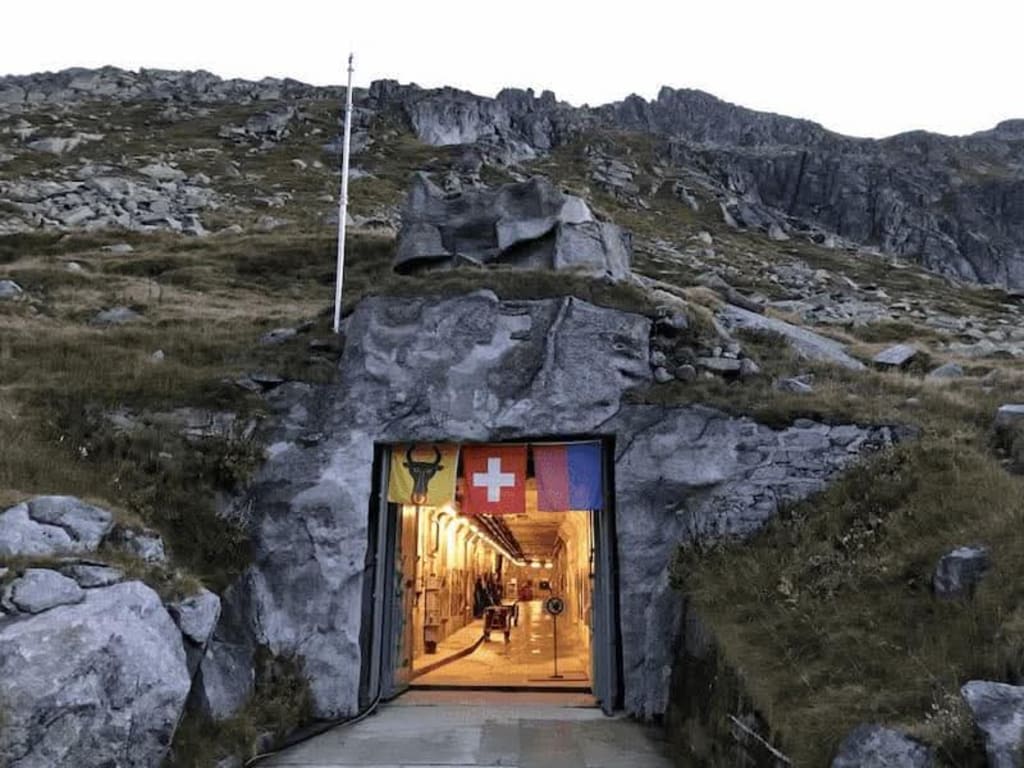
During the early hours of World War II, when Nazi forces stormed into Poland in 1939, Switzerland’s famed neutrality was shaken. In that instant, Swiss leaders understood that merely declaring neutrality would not guarantee safety from future threats. What followed was a strategic, national mission: to fortify the country’s borders and build an extensive—and remarkably discreet—network of bunkers. 🛡️ Why Such Drastic Measures? Switzerland’s geographical position in the center of Europe made it vulnerable despite its neutral stance. The sudden and forceful invasion of its neighbor Poland highlighted how quickly peace could be shattered. Swiss officials reasoned: Neutrality doesn’t grant immunity; vigilant preparation does. The Swiss embarked on a massive, multi-decade effort to turn their nation into a fortress—hidden in plain sight. --- 🔍 Disguised Protection: Sheltering in Plain View One of the most ingenious aspects of the Swiss plan was concealment. Bunkers were camouflaged with masterful creativity. They weren’t just vault-like structures in the middle of nowhere; they were hidden inside ordinary buildings—warehouses, schools, hospitals—or sculpted into natural rock formations deep within the Alps. From the outside, nothing looked out of place. Yet behind these façades, steel-reinforced concrete chambers awaited activation in times of crisis. This subliminal defense strategy meant Switzerland could stay functional and civilized—while retaining the capacity for national survival. --- 🌍 The Role of WWII & the Cold War World War II: The blitz of early-war Europe, with aerial bombings and fast-moving military columns, meant Switzerland had to be ready for surprise attacks. Cold War Era: With tensions between superpowers escalating, the threat of nuclear war loomed large. Swiss planners realized that conventional bunkers alone weren’t enough—air filtration systems, food and water stockpiles, and radiation protection had to be included. --- 📜 Key Legal Foundations 1963 Civil Defense Law: This legislation mandated that every new residential or commercial structure must include a nuclear shelter capable of protecting its inhabitants. Thus, bunkers became a de facto feature of Swiss construction. 1959 Constitutional Amendment: In a public vote, Swiss citizens enshrined civil protection as an inalienable constitutional right. Switzerland became one of the rare nations to guarantee its people’s safety at that scale. --- 📊 Scale of the Bunker System Today, Switzerland’s defensive network is staggering in scope: 360,000 bunkers—each built to withstand conventional bombs and nuclear fallout Capacity: Designed to shelter 8.6 million people Population: Switzerland’s current official population is about 8.6 million—meaning there’s literally a spare space ready for every citizen Most bunkers include: Air filtration systems to ensure breathable and safe indoor air during chemical, biological, or nuclear events Stockpiles of drinking water, non-perishable food, sanitation supplies Basic medical provisions, communication gear, and backup power sources --- 🏷️ A Lesson for the World Switzerland’s bunker program isn’t just national pride—it’s a powerful statement: > “Neutrality alone isn’t protection. Preparedness is.” In a world still threatened by war, terrorism, and potential nuclear escalation, Switzerland stands as a model of proactive resilience. Governments and citizens across the globe can learn from Swiss wisdom: peace is best maintained not by wishful declarations—but by tangible readiness. --- 🏛️ Congress of Preparation: A Timeline 1939: Operation Barbarossa and Warning from the East When Nazi Germany invaded Poland, Swiss authorities realized that neutrality does not prevent war from reaching your doorstep. The rapid collapse of a sovereign neighbor highlighted a chilling vulnerability. 1940s: WWII Fortification Ramps Up Under leadership like General Henri Guisan, Switzerland carved out defensive redoubts in the Alps, placing anti-tank tunnels and storing munitions—preparing for a potentially all-out invasion. 1950s-60s: Nuclear Age & Civil Protection Emerges Cold War paranoia prompted a seismic shift: from military fortifications to civilian shelters. The government created a national stockpile system, mobilized construction firms, and funded public campaigns. 1959: Constitutional Amendment Swiss voters backed the inclusion of civil defense as a constitutional principle. From now on, every citizen was legally entitled to protection. 1963: Shelter in Every Building The law went a step further—new constructions must include bomb- and fallout-resistant rooms. Architects and engineers began embedding shelters in design plans across the country. 1970s–1980s: Cold War Bunker Buildup Switzerland hit its peak bunker construction during these decades. Stockpiles were updated, equipment stored, and guidelines circulated widely—down to school lessons on how to survive inside a bunker. Post-Cold War: Maintenance & Modernization After 1991, the global landscape shifted—but Switzerland kept its system. Regular upkeep, volunteer drills, and incorporation of civil threats (like chemical, biological, or drone warfare) became priorities. --- 🏰 Inside a Typical Swiss Shelter A modern Swiss civil-defense shelter includes: 1. Blast Doors: Thick, rated for high-impact shockwaves and pressure 2. Air Systems: Multi-stage filtration, ensuring minimal pollen, toxin, or radiation entry 3. Food & Water Reserves: At least a couple of weeks' worth, updated quarterly 4. Sanitation Zones: Toilets, basic washing facilities, medical kits 5. Power Backup: Batteries or small generators, often with redundant systems 6. Communication Tools: Radios, intercoms, sometimes hard-line telephones 7. Ventilation & Cooling: To manage heat and humidity in crowded conditions 8. Information Materials: Instructions in Swiss languages—German, French, Italian, Romansh—on safety procedures, emergency exits, and hazards In many Swiss homes, this shelter is a simply reinforced basement room. In offices or public facilities, it might be a whole floor of enclosed space. In mountains, bunkers can span hundreds of meters into the rock, connected by tunnels and escape passages. --- 🌐 Global Inspirations & Takeaways 1. Prepared-neutrality: Nations can strive for peace while staying battle-ready 2. Civil resilience: Safety is a project that lasts generations—built into laws, society, and daily routines 3. Invisible readiness: Just because you can’t see it doesn’t mean it’s not there. Resilience thrives in plain view 4. Public trust in infrastructure: The Swiss system is backed by civic buy-in—from lawmakers to homeowners --- 🔍 Downsides & Maintenance Challenges While legendary in its foresight, the Swiss approach comes with costs: Construction cost: Embedding a shelter adds 1–2% to building budgets Upkeep needed: Systems must be tested regularly—especially ventilation and power supplies Relevance evolving: New threats like cyberattacks, drone terror, or pandemics require constant adaptation Mental bandwidth: Some argue that the focus on resilience may breed a culture of fear over trust --- ✨ Conclusion: A Swiss Legacy of Fortified Peace A nation that chose neutrality in 1939, recognizing soon after that neutrality wasn’t a shield by itself, set out to build an incredible legacy—a hidden, nationwide safety network engineered for worst-case scenarios. With 360,000 bunkers, constitutional rights, and legal enforcement, Switzerland didn’t just talk peace—it prepared for war with vigilance, technology, and silent infrastructure. Their message resonates today: Peace is not passive—it must be engineered, equipped, and embedded. In our world of unprecedented uncertainty, we need more than noble words. We need Swiss-level preparedness.
About the Creator
Enjoyed the story? Support the Creator.
Subscribe for free to receive all their stories in your feed.
Comments
There are no comments for this story
Be the first to respond and start the conversation.