
Research Disproves the Legend of the Herlaugshaugen Ship Burial
A Legend-Rich Mound

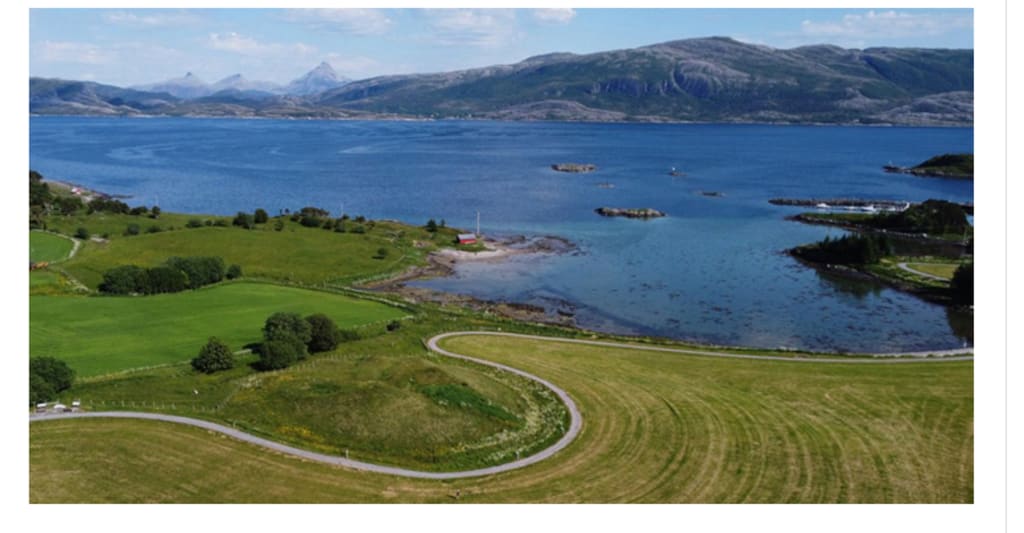
One of Scandinavia's oldest ship graves is located at the Herlaugshaugen burial mound on the island of Leka, off the coast of Norway, according to a recent study. The discovery, which dates to approximately AD 700, provides a crucial chronological connection between the later, well-known Norwegian ship mounds of the Viking Age and the well-known early seventh-century ship burials of Anglo-Saxon England, most notably Sutton Hoo.
It also predates the conventionally acknowledged beginning of the Viking Age by almost a century. The discovery shows the scope of early mediaeval maritime networks throughout the North Sea and casts doubt on long-held beliefs about when and where monumental ship burial customs spread throughout Scandinavia.
A Legend-Rich Mound
With a diameter of more than 60 meters (almost 200 feet) and a height of around 12.5 meters (41 feet), Herlaugshaugen is one of the biggest burial mounds in Norway. It has long been connected to the myth of King Herlaug, a pre-Viking monarch of the Namdalen region who, according to Snorri Sturluson's Harald Fairhair saga from the thirteenth century, choose to be sealed inside the mound alive rather than submit to Norway's first national king.
A sitting skeleton, a sword, animal bones, and iron nails were allegedly discovered during eighteenth-century antiquarian digs spurred by the narrative. The question of whether the mound actually held a ship remained unanswered for more than 200 years after those artefacts were lost.
The mythology is not supported by the radiocarbon dates from the 2023 excavation. The burial dates to around AD 700, which is around 80 years before King Herlaug is supposed to have passed away, indicating that the mound was not constructed for him at all. Since the eighteenth-century skeleton has vanished, it is hard to determine who actually lived there.
The new evidence does, however, confirm that whomever was buried here possessed a great deal of wealth and power—enough to have a sizable seagoing warship constructed and buried beneath a massive earthwork.
The Iron Nails That Made All the Difference
A team from the Norwegian Directorate for Cultural Heritage, Trøndelag County, and the NTNU University Museum oversaw the 2023 excavation. Their primary goals were to retrieve physical evidence of a ship and to obtain material for radiocarbon dating.
Working in three strategically positioned excavations, the archaeologists discovered 29 clinker nails—iron rivets—as well as pieces of preserved wood, possibly oak or elm, that were still affixed to some of the nails. The distinctive fasteners used to connect the overlapping planks of a clinker-built hull—the building method that would later come to define Viking Age shipbuilding—are called clinker nails.
The rivets' quantity and size suggested a vessel of significant dimensions. The experts concluded that the ship was probably longer than 20 meters (65 feet) based on the size and spacing of the discoveries, firmly classifying it as a seagoing vessel rather than a modest river craft.Geir Grønnesby, the study's project manager and principal author, stated, "This indicates that people here had maritime expertise—they could build large ships—much earlier than we previously thought."
The burial was consistently dated to the end of the seventh or early eighth century AD, about AD 700, by radiocarbon dating of the charcoal from the mound's building levels and the wood retained in the rivets.
Closing the Distance Between Scandinavia and England
The earliest known monumental ship graves in Scandinavia, which date back to the late eighth century, were discovered on the western Norwegian island of Karmøy. The Gokstad ship and the well-known Oseberg ship date back to the ninth century.
The Vendel and Valsgärde boat graves in Sweden's Uppland region date from the sixth to the seventh century, while the large ship burial at Sutton Hoo in East Anglia, England, dates from between AD 600 and 625. Herlaugshaugen, which dates to approximately AD 700, fills a chronological gap that has baffled scholars for decades by sitting perfectly between the later Norwegian specimens and these earlier English and Swedish ones.
According to the authors of the Antiquity study, this chronological bridge indicates a common cultural practice across the North Sea that had deeper roots in the Merovingian period (AD 550–800) and was not only a Viking invention.
In addition to the finances needed to create a massive ship, the ideological framework needed to use it as a status and power symbol was also necessary for the construction of a colossal ship burial. "The monumental ship burials of East Anglia and Namdalen speak to the emergence of power with an ideology rooted in maritime activity," the experts observe." Visible to everyone who crossed the little strait between Leka and the mainland, the burial at Herlaugshaugen was probably an intentional declaration of dominance.
A Node in a Broader Network
Herlaugshaugen's location is important in and of itself. Leka is a natural hub for trade and communication because it is situated at the intersection of an east-west inland valley route and a north-south coastal sea route. Seafarers would have recognised the island as a landmark due to its unique geology, which was created by the upheaval of the ancient ocean floor during the Caledonian mountain-building event.
According to the researchers, Leka served as a "node" in a regional network that connected northern and southern Scandinavia and might have reached Britain and the continent across the North Sea.
Grønnesby pointed out that the burial mound itself is a representation of wealth and power. "Ytre Namdalen farming has not contributed to that prosperity. I believe that products were sold in this area, possibly over great distances.
This idea is supported by the existence of a massive, well-built ship in the mound, which could only have been constructed and buried by a community with substantial resources and vast maritime experience. The finding contributes to the increasing amount of data showing that Scandinavian maritime culture has considerably older origins than previously thought and that Norway's coastal settlements were intricately linked to larger European networks long before the Viking Age started.
About the Creator
Enjoyed the story? Support the Creator.
Subscribe for free to receive all their stories in your feed.
Comments
There are no comments for this story
Be the first to respond and start the conversation.