
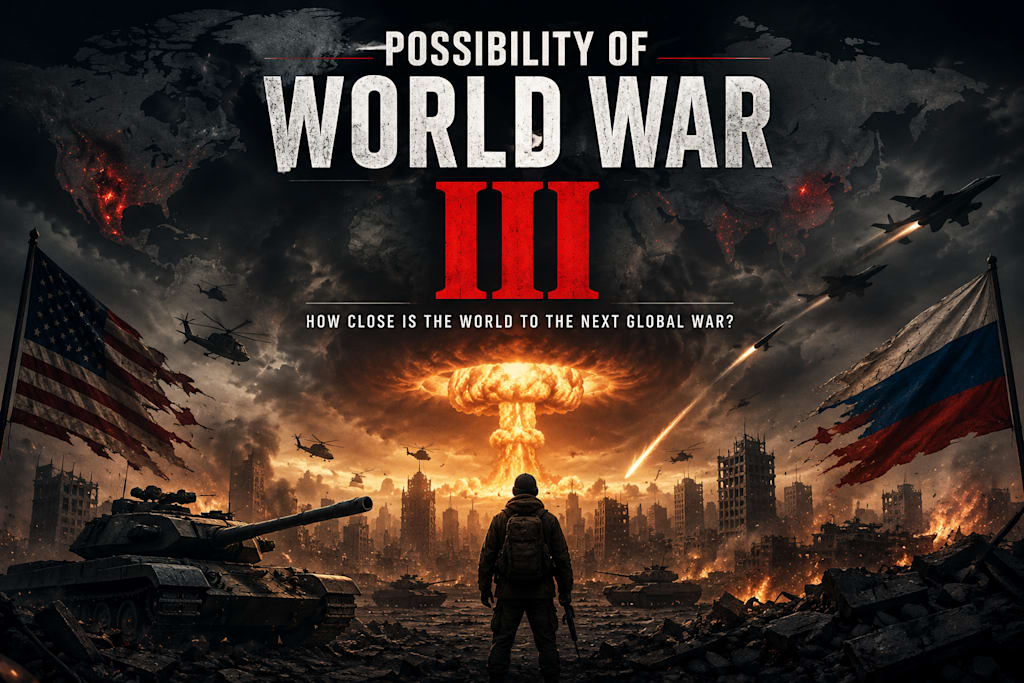
POSSIBILITY OF WORLD WAR THREE
Examining Current Global Flashpoints, Geopolitical Tensions, and the Risks of a Future Global Conflict

1. Escalating Rivalry Between Global Superpowers
One of the most significant factors that could trigger World War III is the growing competition between major world powers. Nations with vast military capabilities often compete for economic dominance, technological superiority, and geopolitical influence. As tensions rise over trade disputes, military expansion, and strategic alliances, even a small misunderstanding could rapidly escalate into a major conflict. History has shown that when powerful nations perceive their interests or security as threatened, they may resort to military action. In today's interconnected world, a confrontation involving one superpower could quickly draw in allies and partners, creating a chain reaction that spreads across continents and transforms a regional dispute into a global war.
2. Territorial Disputes and Border Conflicts
Many regions around the world remain divided by unresolved territorial claims. Countries continue to dispute ownership of islands, maritime zones, and border regions rich in resources or strategic importance. These disagreements often fuel nationalist sentiments and military posturing. When military forces operate in close proximity, the risk of accidental clashes increases dramatically. A single border incident can ignite public outrage and pressure governments into taking aggressive actions. If alliances are involved, neighboring countries may be drawn into the conflict, expanding its scale. Territorial disputes have historically been among the most common causes of war, and in a nuclear age, their consequences could be far more devastating.
3. Competition for Natural Resources
As the global population grows and industrial demands increase, competition for essential resources such as oil, natural gas, freshwater, and rare minerals becomes more intense. Countries that depend heavily on imported resources may feel vulnerable to supply disruptions. At the same time, resource-rich regions become strategically valuable and politically unstable. Nations may seek to secure access through economic pressure, political influence, or military intervention. Climate change is further increasing scarcity in some parts of the world, making competition even more severe. If resource shortages reach critical levels, governments may view military action as a necessary means of protecting national interests, increasing the risk of international conflict.
4. Cyber Warfare and Technological Attacks
Modern warfare is no longer limited to tanks and missiles. Cyberattacks can disrupt power grids, financial systems, communication networks, transportation infrastructure, and military operations. A sophisticated cyberattack against a major nation could cause widespread panic and economic damage without a single shot being fired. The challenge is that identifying the attacker is often difficult, creating uncertainty and suspicion. If a country believes it has been attacked by a foreign government, it may retaliate militarily before obtaining complete evidence. As technology becomes increasingly integrated into everyday life, cyber warfare presents a new and unpredictable pathway to global conflict, where digital actions could trigger real-world military responses.
5. The Rise of Extreme Nationalism
Nationalism can unite people and strengthen national identity, but extreme nationalism often creates hostility toward other nations. Leaders who prioritize aggressive expansion, military strength, or ideological superiority may gain popular support during times of economic hardship or political instability. Such movements can increase tensions between neighboring countries and undermine diplomatic solutions. Citizens may become more willing to support military action if they believe their nation's prestige or sovereignty is at stake. Throughout history, excessive nationalism has contributed to major conflicts by encouraging governments to adopt confrontational policies. In a world already facing multiple crises, extreme nationalist movements could become a dangerous catalyst for wider wars.
6. Military Alliances and Collective Defense Agreements
Military alliances are designed to maintain peace by deterring aggression, but they can also contribute to larger conflicts. When one member of an alliance is attacked, other members may be obligated to provide military support. This means that a conflict involving two countries can quickly involve many others. The complex alliance systems before World War I demonstrate how regional disputes can escalate into global wars. Today, defense agreements connect numerous nations across different continents. If a major conflict breaks out involving a member of a powerful alliance, countries that initially had no direct involvement may find themselves drawn into the fighting, significantly increasing the likelihood of a worldwide confrontation.
7. Political Instability and Failed States
Political instability creates environments where conflict can spread rapidly. Governments facing internal unrest, economic collapse, corruption, or civil war often struggle to maintain control. Such situations can lead to refugee crises, regional insecurity, and opportunities for extremist groups to gain influence. Neighboring countries may intervene to protect their interests, support allies, or prevent instability from crossing borders. As multiple nations become involved, localized conflicts can expand into broader international confrontations. In an increasingly interconnected world, instability in one region rarely remains isolated. The collapse of political order in strategically important areas could trigger events that ultimately draw major powers into direct conflict.
8. Economic Crises and Global Recession
Severe economic downturns can increase the risk of international conflict by creating social unrest, political polarization, and competition for markets and resources. Governments facing domestic dissatisfaction may adopt aggressive foreign policies to rally public support or distract from internal problems. Economic sanctions, trade wars, and financial disputes can further damage international relationships. During periods of prolonged economic hardship, cooperation between nations often weakens as countries prioritize their own survival. History suggests that economic instability can contribute to the rise of authoritarian movements and militarization. If multiple major economies experience simultaneous crises, the resulting tensions could create conditions favorable to large-scale conflict.
9. Nuclear Weapons and Strategic Miscalculations
The existence of nuclear weapons remains one of the greatest threats to global security. While nuclear deterrence has helped prevent direct wars between major powers, it also creates enormous risks. A misunderstanding, technical malfunction, false alarm, or misinterpretation of military activities could lead to catastrophic decisions. Modern weapons systems operate at incredible speed, leaving leaders with limited time to assess information accurately. In moments of extreme tension, mistakes become more likely. Even a limited nuclear exchange would have devastating humanitarian, environmental, and economic consequences. The danger lies not only in deliberate action but also in the possibility of human error during periods of international crisis.
10. Misinformation, Propaganda, and Information Warfare
In the digital age, information has become a powerful weapon. Governments, organizations, and individuals can spread false narratives, manipulate public opinion, and inflame tensions through social media and online platforms. Misinformation can deepen distrust between nations, provoke outrage, and make diplomatic solutions more difficult. Citizens exposed to constant propaganda may support aggressive policies based on inaccurate information. Leaders operating under public pressure may feel compelled to take stronger actions than they otherwise would. Information warfare can create confusion during crises, making it harder to distinguish truth from falsehood. In a highly connected world, the spread of misinformation has the potential to accelerate conflicts and increase the risk of global war. "World War III is not inevitable, but understanding the forces that could lead to it is the first step toward preventing it. History warns us that global conflicts rarely begin with a single event—they emerge when fear, rivalry, and miscalculation are allowed to grow unchecked."
About the Creator
younas khan
1. Emotional Storyteller
I write stories that carry emotions, silence, and hidden truths. Every word I share is a piece of heart, every story a journey of feeling
Enjoyed the story? Support the Creator.
Subscribe for free to receive all their stories in your feed.
Comments
There are no comments for this story
Be the first to respond and start the conversation.