
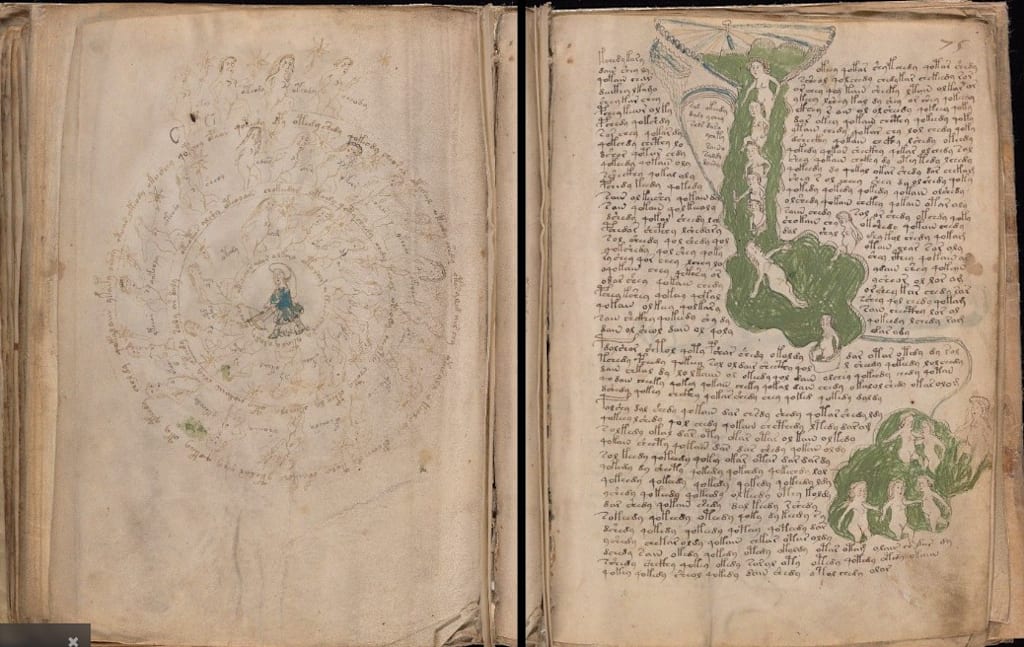
Page 74 of the Voynich Manuscript
Alchemy and Pre-Modern Scientific Utility

Humans, though they have reason to be wary of things they do not understand, are still drawn to the unknown. At some indeterminate point in the 14th century, driven by curiosity and a deeply felt desire to know the world and our place in it, a book began to form, a record of a quest for understanding of the world that was familiar, but bent to the will of forces unknown and unknowable to its authors. Authors who, in their time, would have been seen by many as immoral heretics. And so, this book needed to be hidden and became an unknown and unknowable artifact. Encoded and allegorical in its illustrations, this book would move through the centuries as a great mystery, even as the world grew more at ease with the studies its authors undertook.
The Voynich Manuscript is an illustrated codex of approximately 240 pages, and of unknown origin, authorship, and content. The script in which the book is written is of an entirely unknown alphabet, and its imagery is varied and unusual. It contains spiraling formations, women in green pools, and plants that appear totally alien. The holistic mystery formed by the many unknowns in the book, as well as questions regarding its travels through the centuries, has captivated the minds of scholars since the manuscript was introduced, or rather reintroduced, to the world in 1912. I believe, based on the content of its illustrations, that the Manuscript is an alchemical codex. Alchemy was near its peak in Europe at the time of the codex’s estimated creation, and much of the apparent subject matter is typical of what one would find in such a document.
Carbon dating has placed the creation of the Voynich manuscript between 1405 and 14321. Between then and its rediscovery, we do not know much about who owned it, what they did with it, or what kind of study they conducted, but what information we do have is surprisingly one of the few bits of insight the book itself gives. When it resurfaced in 1912, there was some readable text between its pages, a letter written in 1665 by the Prague scientist Johannes Marcus Marci, in which he presents the manuscript to another Jesuit scientist by the name of Athanasius Kircher. Although not yet confirmed outside of this letter, the details within the manuscript were at one point sold to the Holy Roman Emperor Rudolph II at an undisclosed date for the price of around 600 ducats While there is much to lend credence to the idea that Rudolph would have owned this book, what gives many historians pause is the fact that in this letter, Marci also claims that the author of the book was Roger Bacon. This seems to come from pure speculation, as Bacon lived a good 150 years before the book's creation according to carbon dating, and thus tends to shed light on some of the other content of the letter.
This letter does not provide any information about when or from whom Rudolph bought the book. However, on the first page is the faded signature of Jacobus Horcicky de Tepenec. He had been a successful pharmacist and had been brought up to the role of minor nobility in 1608 by Emperor Rudolph, which is likely how the book came into the Emperor’s possession. After Horcicky’s death in 1622, there are 15 years unaccounted for in the books' chronology. What is known is that by 1637, the alchemist Georgius Barsius owned it, though it is unknown how he got it. We do know this from his copied extracts of the text of the book that were made sometime during the second half of 1637, which he then sent to Kircher. These copies and the letter attached to them were found in 2008 by a story in Josef Smolka3. and this stands as the earliest piece of documentation of the book. Marci came into possession of the manuscript in 1662 when Barsius died and left it to him. From here, much of the codex's trail goes cold for the span of nearly 250 years after Marci’s death. We know that he left several possessions to the Jesuits of Rome, although the book is not mentioned specifically. In 1903, the Jesuits sought to sell around 380 manuscripts to the Vatican, in which the manuscript is described as a miscellaneous vellum text from the 15th century. It is unclear why, but it was nine years before the sale went through, and in that time, the man who we can credit with reintroducing the book to the world and thus lending it his name, would under the condition of absolute secrecy, acquire a small sub-sect of the books from which he made a substantial amount by selling many of them but was unsuccessful in selling the Manuscript that would bear his legacy. However, it was through his extensive marketing practices that the book became known worldwide.
A recent study of Voynich's life painting describes him as a lovable rogue and, by all accounts, a strange but fascinating individual. Many have commented that, as eccentric and well-traveled as he was, Wilfred Michael Voynich and the Codex he lent his name to were a good match for each other. He was born within the Russian Empire in 1864 and studied chemistry and law at the University of Moscow. He had been involved with the Polish nationalist movement and was arrested in 1885 for revolutionary actions, for which he was imprisoned for 18 months and then exiled to Serbia for five years. He escaped in 1890 while working as a pharmacist and, after five months, found himself in England. Voynich would find himself in a circle of those who had been exiled from Russia, and through this circle, he was introduced to the world of publishing, book selling, and was made manager of the Russian Free Press Fund. It was through these circles that he came to be involved in publishing and later book collecting4. We have no specific record of the Voynich buying the manuscript, only through the Jesuit institution Collegio Romano's records and later word from his wife after his death that he purchased it from the Collegio as one of many mass buys of manuscripts that he completed between 1910 and 1913. He first showcased the Voynich manuscript in March 1915, which, given its encoded nature, led to rumors of him being a German spy seeking to gain access to the US War Department codes. After Voynich's death in March of 1930, he would leave the manuscript to his secretary, Anne Nill, who sold it to H.P. Kraus in 1961, who would later donate it to the Beinecke Rare Book & Manuscript Library of Yale University, where it resides to this day.
While some scholars believe that the manuscript is a hoax, they mean that it is not as old as suspected or that the text of the book is in some way meaningless and the illustrations are simply made to imitate alchemical illustrations, which would account for why they do not perfectly align with the conventions of such illustrations, there is ample evidence to the contrary. The idea that the book could have been faked has long since been discredited, given the more thorough understanding of the book’s history, as I have laid out in the previous section. Gordon Rugg suggested that the text of the book indicates fabrication in that he was able to some degree recreate its sentence structure purely through a simple coding tool5 and that the Voynich Manuscript might be “...A hoax devised for monetary gain…” has one of its core columns fall apart under Lisa Fagan Davis's paper “How Many Glyphs and How Many Scribes” in which she pieces together through handwriting analysis that there are minimum five contributors to the manuscript and that the book does follow certain patterns in language at least per page all of this differs from page to page each page does follow that formatting which if the book is encoded would make sense that a different cipher of this alphabet would be employed in different sections as the book was being written6. Rather than suggesting that this is a hoax, this would seemingly disprove the idea that it is written in some manner of lost language, but rather was deliberately encoded, which further lends credence to the idea of it being an alchemical manuscript.
Alchemy originated in ancient Egypt, where it evolved alongside mummification practices. The workers who were discovering how to preserve bodies would have been overly and overtly aware of the realism of chemical change, how to use it, and how it worked against them. In ancient Egypt, alchemy did not have the connotation of something mystical or magical; it was simply a form of work and output. This would change after Egypt fell to Rome, when many of these early alchemists fled, given the vilification of their craft. Eventually, many of them found themselves in Byzantium, which is where the somewhat supernatural connotation of their work began.
In Muslim Byzantium, while these practices were seen as somewhat otherworldly both in their practices and in their intent, this was the height of the Muslim Golden Age, in which science and education were revered. It had a populist that was far more literate than either ancient Egypt or later Europe, and had a culture far more willing and eager to explore different facets of the world they did not understand. It is believed that the early introduction of these practices to Europe came with the Muslim occupation of Spain, which spread to Europe at large and continued through trade routes over the centuries. Christian Europe, with its much stricter Doctrine around what manner of subjects were permissible to be explored and which were so vilified as to be seen as an effort to God, saw many of these practices as of the devil as things that were meant to be destroyed if encountered. However, with the same sentiment that this paper opened with, humans have always been drawn to a want of understanding of the world, and so even in the influence of such severe punishment, should they be found out, some still engaged with these lines of study. It is because of this culture of vilification and the need to hide that the encoding of the Voynich may use script only serves to strengthen the idea that the Voynich is such a codex.
The case for the Voynich manuscript being an alchemical text can also be seen in comparing it to its contemporaries, as both self-emitted and those who would more plainly be seen as modern scientists. Roger Bacon, who was believed to be the author of the book by Voynich himself, created illustrations in his books that are remarkably similar to what we see in the Voynich manuscript. Pedanius Discorides, an ancient Greek scholar who is noted as being the first recorded figure to engage in what we would now recognize as the scientific method, borrowed heavily from Egyptian practices in his exploration of chemical reactions, was popular among alchemists of the early half of the 15th century. With many creating their own versions of his De Materia Medica, an early pharmacopoeia which could explain the extensive illustrations of plants within the Voynich Manuscript. As Jennifer Rampling’s paper Alchemical Traditions articulates, “ Alchemical writing draws heavily on analogy, describing chemical concepts in terms of other processes not obviously related: for instance, describing the formation of metals in terms of human generation and reproduction”. With this framework in mind, many of the stranger illustrations in the manuscript, such as one where women appear to be connected by plants that resemble female reproductive organs, gain a clarity of intent even without the ability to read the text. While there are certain symbols and iconographies that are common to the point of being staples of alchemical illustration, this is not universal. Among groups that vary from place to place and have little contact with each other due to the secret nature of what they are engaging with their are localized traditions for alchemy10. It is only among certain circles that the idea of turning anything into gold held any credence; many of these groups were more concerned with the practical applications of these discoveries and used a variety of different practices across Europe and what we today recognize as the Middle East. These sorts of local eccentricities of the craft assuage any conflicting ideas that the illustrations in the book could not be alchemical in nature because they do not fit a certain formalized structure.
That being said, there are ways in which the manuscript adheres to these norms. The use of the crown as a common motif amongst many figures in the manuscript, as well as those on page 75 (Figure 1, right side), is an indication of otherworldly power or divine right11. Given a less literal symbolic adage, a crown implies a sort of halo, indicating that these figures are not of this world, which was a common way within alchemical illustration to indicate that these characters are not literal figures but rather representations of what The Alchemist would have referred to as higher powers, but we today can recognize as different elements and chemical concoctions. As Richard Morris writes about in his book The Last Sorcerers: The Path From Alchemy to the Periodic Table, much of the more biblical implications of some of the iconography were still used to imply other manner of connections, and this would have been seen as heresy in medieval Europe, and one can imagine that it did not help endear alchemists to the church. The star is another common symbol that appears constantly within the document; indeed, the book has an entire section dedicated to the zodiac chart. Page 74 (Figure 1, left side) contains one such chart, that of Sagittarius. It is worth noting within the book that two of these charts are missing, those of Capricorn and Aquarius. Sagittarius, easily identified through the image of the Archer at its center. Possibly one of the only, if not the only, depictions of a man within the manuscript. Around the central figure are several lines of nude women with text surrounding them in their identical poses, pointing up at a star. It is this use of the star icon, fairly literal in this case, as well as the inclusion of the Sagittarius figure, who has been preceded by other figures, each of which indicates a different sign within the zodiac, that we can conclude that this is indeed a zodiac chart.
Page 74 of the Voynich Manuscript is composed of a circular design and 31 figures arranged in a circular pattern. Four women stand at the top of the organized wheel, all in an identical pose, as are most of the figures, with one leg up, a hand on the hip, and another hand pointed upward at a star. On this page, the proportions of these women and indeed all of the figures depicted show them as having short legs with abnormally thick thighs, distended stomachs, thick necks, double chins, and abnormally large heads. The only seemingly male figure, the Archer of Sagittarius, while fully clothed, is proportioned similarly is armed with a crossbow. His expression, and indeed that of all of the figures, is hard to discern. Their faces are depicted with little more than two small dots to indicate their eyes underneath thin eyebrows, some dots of red ink to color their cheeks, elongated noses that are often shown as extending from one of the eyebrows, and thick, short lips, which give the impression that they are pursing their lips in concentration.
On page 74, at the top of the circular composition, the four female nude figures standing together form almost a crown atop the rest of the image. The connotations of which have already been discussed. Around the outermost edge of the circles is a single line of script. Given its positioning and spacing, it is hard to say whether each word of this is relating to the female figure underneath it or if it is all an ongoing sentence or phrase. The circular design is composed of three layers: the Archer with a crossbow in the center and text surrounding him, a procession of female figures with text encircling them, and then a final line of female figures with text bordering around the outside of the image. The male figure is the clear focal point, both in his depiction being the only male figure, being the only clothed figure, containing more color than the other figures, and in his position at the center of the rings. The circular nature of the composition implies that some manner of cycle is being undergone, and with the star imagery that each female figure bears, it can be reasonably concluded that the subject being depicted on page 74 is some manner of astrological cycle.
As was previously mentioned, much of alchemical illustration was meant to be allegorical to chemical processes. Without knowledge of what the text within the book states, much of what we can infer from it is merely conjecture. Nonetheless, there has been ample study of other account manuscripts, and thus we have recurring themes that we can refer to to draw logical conclusions about what is being communicated. As Jeffrey Raff writes about in his book Jung and the Alchemical Imagination, many of the recurring images within Alchemy were directly symbolic of other processes, such as the use of discolored lions to be representative of different kinds of acid. Frequently, these lions were depicted as eating the Sun, which could be used to imply the destruction of gold, for which the sun was a symbol. To pull from Rampling again, circular designs are incredibly common within Alchemy for the way they portray process15. Something occurs, there's a direct consequence for this occurrence, causing something else to occur, which leads to further reaction. There is an inherently cyclical nature to the act of discovery and scientific inquisition in an age where sharing what you have learned can be dangerous. As Barbara Obrist explains in her paper “ Art and Nature in Medieval Alchemy”, zodiac charts and their associated cycles were an essential component of alchemy, in how it gave a visual shorthand for the placements of celestial bodies in the sky on certain days, which alchemists believed to be a component for when certain reactions could or could not occur16.
While the Voynich Manuscript’s discoveries that it intended to record have yet to be brought to light and perhaps never will, it remains part of a legacy of scientific illustration. Going back all the way to ancient Egypt up to the proliferation of photography as late as a mere 150 years ago, scientists of all walks of life, of all backgrounds, and of all levels of secrecy or required to some degree to be artists to record their studies, if only for the practical reason of needing a visual aid or point of reference for what they were studying or educating others abut. Any claims to have decoded the Voynich manuscript will have to reconcile whatever content they argue it depicts with the imagery it contains. Much of what we empirically know about the world has been known and studied and then lost time and time again as a result of what is inconvenient to the politics of the time. Roman concrete was lost to the Gods, hieroglyphic writing was lost to time, and the Voynich Manuscript’s text has been lost to a need for secrecy.
The Manuscript is an essential work of both art and science, even if it contains nothing unknown to scientists of today. It sheds light on the history of how these two fields of study have intertwined. The only things we know about the content of the manuscript are the art that lies within it. Art has always been a vehicle for communicating ideas that could not or would not be said aloud, either because there are no words for the idea or because there are those who would rather be artists be silenced and then heard. It is through the study of the history of alchemy that we can see art and science working together to fight against the suppression of such ideas in the interest of having a better understanding of the world around us.
Bibliography:
The Voynich Manuscript, pages 74, or f73v and 75, f75r. Scan from the Yale Beinecke Rare Books Library Official Website.
Bibliography
Ball, Philip. Alchemy: An Illustrated History of Elixirs, Experiments, and the Birth of Modern Science. Yale University press, 2025.
Battistini, Matilde. Astrology, Magic, and Alchemy in Art. Second printing. Translated by Rosanna M. Giammanco Frongia. With J. Paul Getty Museum. Guide to Imagery. Getty Publications, 2007.
Beinecke Rare Book & Manuscript Library. “Voynich Manuscript.” December 14, 2018. https://beinecke.library.yale.edu/collections/highlights/voynich-manuscript.
Clemens, Raymond, and Deborah E. Harkness. The Voynich Manuscript. Yale university press, 2016.
Davis, Lisa Fagin. “How Many Glyphs and How Many Scribes? Digital Paleography and the Voynich Manuscript.” Manuscript Studies: A Journal of the Schoenberg Institute for Manuscript Studies 5, no. 1 (2020): 164–80. https://doi.org/10.1353/mns.2020.0011.
Huxley, Robert. The Great Naturalists. Thames & Hudson, 2007.
Kraus, H. P. Thirty-Five Manuscripts: Including the St. Blasien Psalter, the Llangattock Hours, the Gotha Missal, the Roger Bacon (Voynich) Cipher MS, Catalogue 100. n.d.
Obrist, Barbara. “Art et nature dans l’alchimie médiévale/Art and nature in medieval alchemy.” Revue d’histoire des sciences 49, no. 2 (1996): 215–86. https://doi.org/10.3406/rhs.1996.1256.
O’Neill, Hugh. “Botanical Observations on the Voynich MS.” Speculum 19, no. 1 (1944): 126–126. https://doi.org/10.2307/2856859.
Raff, Jeffrey. Jung and the Alchemical Imagination. Jung on the Hudson Book Series. Nicolas- Hays, 2000.
Rampling, Jennifer. “Alchemical Traditions.” A Cultural History of Chemistry in the Middle Ages, January 1, 2023.
Rapelli, Paola. Symbols of Power in Art. Translated by Jay Hyams. Guide to Imagery. The J. Paul Getty Museum, 2011.
Richard, Morris. The Last Sorcerers: The Path from Alchemy to the Periodic Table. Joseph Henry Press, 2003.
Rugg, Gordon. “The Mystery of the Voynich Manuscript.” Scientific American 291, no. 1 (2004): 104–9. https://doi.org/10.1038/scientificamerican0704-104.
About the Creator
Alex Brown
Freelance essayist with a specialization in art as a communicative tool. Much of my work has been as a ghostwriter and for GameRant.
Enjoyed the story? Support the Creator.
Subscribe for free to receive all their stories in your feed.
Comments
There are no comments for this story
Be the first to respond and start the conversation.