
On the chest of an Egyptian child mummy, a hidden mystery object was found.
The study's results were just released in the journal Digital Applications in Archaeology and Cultural Heritage.

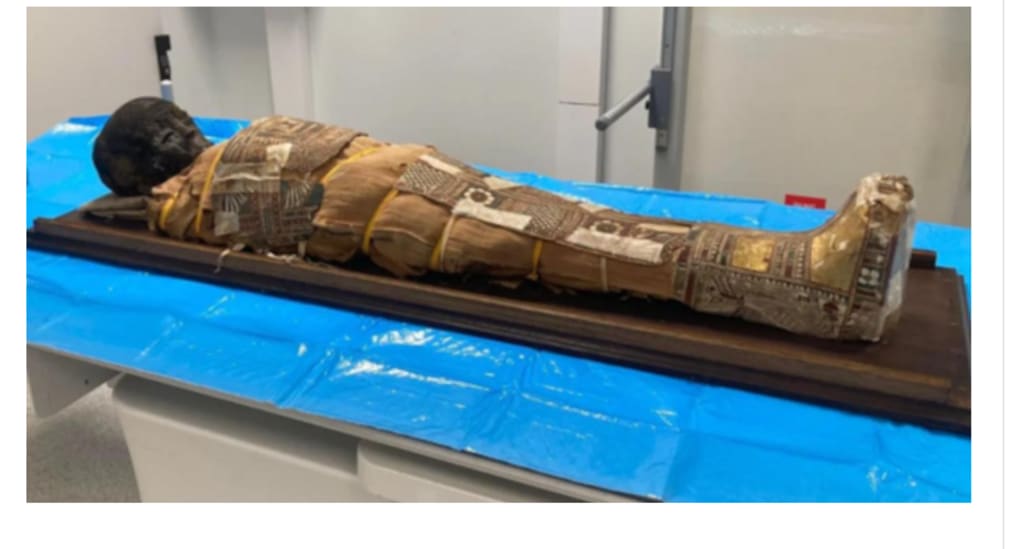
While studying a 2,000-year-old Egyptian mummy, Polish archaeologists uncovered an amazing finding. Intriguing doubts concerning the boy's identity and prehistoric burial customs were raised when scientists found a hidden object resting on his chest during the first-ever thorough scientific examination of the ancient remains. The discovery is already changing our understanding of Ptolemaic Egyptian funeral traditions.
The mummy, which has been kept at the Archdiocesan Museum in Wrocław since 1914, was recently exposed to cutting-edge radiological techniques, such as CT scanning and X-ray imaging.
The interdisciplinary team, under the direction of Professor Agata Kubala of the University of Wrocław, was able to examine the delicate remnants without causing any harm. An unknown object that was purposefully placed on the child's chest was discovered by the non-invasive scans; specialists speculate that it might be an amulet or a papyrus scroll. The study's results were just released in the journal Digital Applications in Archaeology and Cultural Heritage.
The boy's name or a protective inscription intended to help him navigate the afterlife could be on the item, according to the experts.According to a university news release, Professor Kubala said, "We are still working on the mummy because an X-ray revealed the presence of an object on the chest—it may be a papyrus containing, for example, the boy's name."
However, accessing the artifact is extremely difficult due to the fragile state of the mummy's cartonnage case, and researchers are now working on safe examination techniques.
Deciphering the Identity and Mummification Process of the Boy
Unprecedented information about the young boy's life and death was revealed by the CT scans. Scientists calculated that he was about eight years old at the time of his death by examining his tooth development. Researchers are able to verify his sex because the body, which is 123 centimetres long, is comparatively well-preserved.
Despite these conclusions, the precise cause of his death is still unknown because there were no overt indications of a lethal illness or trauma. Additionally, the imaging provided insight into the methods of mummification employed in the Ptolemaic era (c. 332–30 BC). The boy's brain was removed through the nasal cavity in accordance with custom. It's interesting to note that instead of making a typical abdominal incision, his essential organs were removed via unusual methods, potentially through the rectum.
A meticulous but modest burial characteristic of a middle-class family was suggested by the fact that the body cavity was partially filled with textile materials and there was minimal sign of excessive resin use.
Using Cartonnage Art to Trace Origins
The artefact itself offered important hints, even if the historical documents describing the mummy's origins were lost during World War II. Different themes and iconography can be seen in the beautiful cartonnage, which is the painted covering that surrounds the mummies.
An origin in Upper Egypt, most likely close to the ancient sites of Kom Ombo or Aswan, is indicated by elements like rosettes, lotus patterns, and a winged scarab. Cardinal Adolf Bertram brought the mummy to Wrocław in 1914 as part of a private antiquities collection; its records were later lost during World War II.
The cartonnage's representation of a rare hybrid deity bearing a mummy is one especially intriguing element. According to researchers, this figure might be Nehebkau, the ancient Egyptian mythological snake god who is connected to protection and the afterlife.
This distinctive picture provides insightful information about local religious practices and funeral traditions. The authors of the study point out that the cartonnage's iconography is intricate and that additional research will help determine the mummy's dates and validate its suggested place of origin.
Preserving Ancient Heritage with Modern Technology
The analysis of the Wrocław mummy highlights how contemporary medical science has revolutionised archaeology. Scientists were able to isolate the mummy's bones, soft tissues, and wrappings layer by layer using high-resolution CT scans to produce intricate 3D models.
This non-invasive method is essential for protecting sensitive artefacts while gathering fresh information, and it is reminiscent of similar discoveries made in the investigation of Poland's first pregnant mummy at the National Museum in Warsaw.
The goal of the researchers' ongoing efforts is to create safe techniques for examining the object concealed on the boy's chest and delving deeper into the iconography of the cartonnage. "This is not the end of the research," Professor Kubala stressed.
"We are still working on the mummy." Further insights on the life of this ancient youngster and the rich cultural fabric of Ptolemaic Egypt are expected to come from the ongoing inquiry. The remains of a genuine kid who lived, died, and was meticulously prepared for the afterlife more than two millennia ago are being reinterpreted from what was previously a static museum item.
About the Creator
Enjoyed the story? Support the Creator.
Subscribe for free to receive all their stories in your feed.
Comments
There are no comments for this story
Be the first to respond and start the conversation.