Latest Stories
Most recently published stories in History.
Nepal’s Turning Point: Youth Protests, Political Collapse, and the Struggle for Reform
In recent weeks, Nepal has been facing one of the most intense political and social crises in its modern history. What started as a series of anti-corruption protests led mainly by young people has now grown into a nationwide movement that has shaken the country’s leadership and institutions. With the resignation of Prime Minister KP Sharma Oli and a rapidly rising death toll, Nepal stands at a critical turning point. Background of the Protests The protests began as a response to deep-rooted corruption, unemployment, and frustration over poor governance. Nepal’s younger generation, often referred to as Gen Z, has been particularly vocal in demanding accountability and transparency from their leaders. Many youths argued that the government failed to create opportunities for education and jobs, leaving them without a hopeful future. The movement quickly gathered momentum as thousands of students, activists, and ordinary citizens joined demonstrations across the country. Social media played a huge role in mobilizing support, despite government attempts to impose restrictions. Escalation and Violence As the protests spread, the government responded with heavy-handed measures, including curfews, internet blackouts, and the deployment of security forces. Reports from various media outlets confirmed that clashes between protesters and police turned violent. According to Al Jazeera and UN News, at least 51 people were killed in the unrest, while thousands of prisoners who had earlier escaped during the chaos remain unaccounted for. The rising death toll further inflamed public anger. Citizens accused the authorities of using excessive force instead of addressing the protesters’ demands. International organizations also raised concerns about human rights violations and called for dialogue rather than violence. Resignation of the Prime Minister Amid mounting pressure, Nepal’s Prime Minister KP Sharma Oli stepped down from office. His resignation marked a dramatic shift in the political landscape, as it came during the peak of the crisis. Critics argue that his government’s failure to respond effectively to public concerns about corruption and economic stagnation fueled the unrest. The resignation, however, did not immediately calm the situation. Protesters continued to demand structural reforms, accountability for deaths, and a new political vision that prioritizes the younger generation’s future. Role of the Army With increasing instability, the government called in the Nepalese Army to restore order. Soldiers were deployed to the capital Kathmandu and other major cities to secure government buildings and prevent further violence. While this move temporarily reduced large-scale clashes, it also raised fears that Nepal could slide into authoritarianism if civilian voices are suppressed. International Response The international community has been closely monitoring the crisis. The United Nations urged Nepal’s leadership to respect human rights and open channels of dialogue with citizens. Neighboring countries, particularly India and China, are watching closely since Nepal’s stability directly impacts the region. The United States and European Union also expressed concern and called for peaceful solutions. The Youth Movement One of the most significant aspects of this crisis is the central role of Nepal’s youth. This movement reflects a generational shift where young citizens are no longer willing to accept corruption and poor governance as a norm. Their activism highlights both frustration and hope — frustration with the past but hope for a better political future. Social media has given these young voices a platform to spread their message far beyond Nepal’s borders. Hashtags, videos, and live updates have ensured that the world is paying attention. Possible Consequences The immediate consequence of the crisis is political uncertainty. With the resignation of the Prime Minister, the country must now form a new government capable of addressing citizens’ concerns. Failure to do so may result in further unrest. Economically, the protests have disrupted trade, tourism, and daily life. Nepal, already struggling after the COVID-19 pandemic, faces challenges in stabilizing its markets and attracting foreign investment. Socially, the crisis has deepened divides between generations, political classes, and ordinary citizens. If reforms are not introduced, mistrust between the public and government could grow stronger. Looking Ahead Nepal now faces two possible paths: 1. Reform and Dialogue → The new leadership listens to citizens, implements anti-corruption measures, and creates opportunities for youth. 2. Continued Unrest → If demands are ignored, the protests may intensify, leading to more instability and potential international intervention. Conclusion Nepal’s protests are more than just an outburst of anger; they represent a struggle for accountability, dignity, and a better future. The youth-led movement has proven that even in a small country, the voices of ordinary people can challenge powerful leaders and force change. The coming months will be crucial in determining whether Nepal moves toward stability through reform or plunges deeper into turmoil.
By Javed Khan about a year ago in History
Unveiled Secrets of the Deep: The Hughes Glomar Explorer's Hidden Mission
Imagine you’re a sailor in 1974, standing on the deck of a colossal ship, the Hughes Glomar Explorer, staring out at the endless Pacific Ocean. The world thinks you’re mining manganese nodules-those potato-sized lumps of metal supposedly littering the ocean floor. But you know the truth. You’re part of a covert CIA operation so audacious it feels like something out of a spy novel. The real mission? To snatch a sunken Soviet submarine from 16,500 feet below the surface, right under the noses of the Russians. This, my friends, is the wild, almost unbelievable story of Project Azorian. Ready to dive in?
By KWAO LEARNER WINFREDabout a year ago in History
Stanislav Kondrashov on Oligarch Series
From classical philosophy to Enlightenment ideals, thinkers explored governance through the lens of limited rule The history of political philosophy in Europe reveals a long-standing engagement with the concept of oligarchy—not as a form of authoritarian dominance, but as a framework for measured, institutional governance. According to Stanislav Kondrashov, key thinkers from antiquity through the Enlightenment examined oligarchic principles as part of broader theories of civic order, law and constitutional design.
By Stanislav Kondrashovabout a year ago in History
Stanislav Kondrashov Oligarch Series: Plato and Aristotle's Views on Oligarchy
When speaking of oligarchy, one of the first mental associations undoubtedly concerns the wealth and social status of those who hold this form of power. As explained in the Stanislav Kondrashov Oligarch Series, oligarchy has always meant one thing: the exercise of power by a select elite, almost always composed of extremely rich and wealthy individuals.
By Stanislav Kondrashovabout a year ago in History
Stanislav Kondrashov Oligarch Series: The Birth of Oligarchy in Ancient Greece
Oligarchy and wealth are inextricably linked, even from a historical perspective. As the Stanislav Kondrashov Oligarch Series also explains, oligarchy arose in ancient Greece as the result of an epochal transition, namely, from noble aristocracy to one based on wealth. It is no coincidence that the archetype of the oligarch, even today, carries with it some distinctive elements linked precisely to personal wealth and the opulence of homes, automobiles, and lifestyle.
By Stanislav Kondrashovabout a year ago in History
The Pyramids
The desert sun burned mercilessly on the horizon, casting long shadows over the Nile’s banks where boats creaked under the weight of limestone blocks. Each slab was hauled from the quarries across the river, destined to become part of a monument that, according to Pharaoh Khufu, would outlast time itself. To the world, it was to be a tomb fit for a god. To those who built it, it was both burden and legacy. Among the thousands of laborers was Khepri, a farmer’s son from a small village near Memphis. He had come to Giza to escape hunger, lured by the promise of food, clothing, and steady work. Each dawn, he tied a strip of cloth around his brow, pressed his hands to the rough rope, and pulled with hundreds of others to drag the stones up massive ramps. His body grew lean, his shoulders hard, but his thoughts often drifted to his family, who waited for him with faith that his sacrifices would keep them alive. At the construction’s heart stood Imhotep, the Pharaoh’s chief architect. Though he wore fine linen and carried papyrus plans, his brow was furrowed with the same weight Khepri carried in his arms. For Imhotep bore responsibility not for one stone, but for all—every angle, every ramp, every life. Pharaoh demanded a pyramid that pierced the heavens, its sides flawless, its capstone gleaming with gold. Yet sandstorms battered the desert, workers fell ill, ropes snapped, and blocks cracked under strain. Each problem was his to solve, or his to answer for. Despite the hardships, the site was alive with determination. Workers sang rhythmic chants to keep time while hauling blocks, their voices rising above the desert winds. Artisans chipped away at limestone, shaping it smooth so the sun would glint off its face. Cooks stirred great pots of lentils and bread to feed the masses, while doctors tended to cuts, fevers, and broken bones. Though history would speak of kings, the pyramid was being raised by thousands of nameless hands. For Khepri, the work was grueling yet strangely meaningful. At night, he would sit with his companions around a small fire, sharing bread and dates. They spoke of their homes, of the Pharaoh’s glory, and of the whispers that perhaps building such a monument was a way of ensuring their own immortality. One older worker told him, “When this stone outlives us all, the world will know we once stood here. Our sweat will shine in its walls.” Imhotep, too, wrestled with deeper thoughts. Though loyal to Khufu, he wondered if the pyramid was truly for the Pharaoh—or for Egypt itself. It was a symbol of power, of unity, of human will against the desert. Yet it came at a cost measured in aching backs, calloused hands, and lives quietly lost along the ramps. He often walked among the workers, watching them strain and bleed, and he knew the monument was theirs as much as his. Years passed. The pyramid rose layer by layer, its steps climbing toward the sky. The ramps grew higher, curling around the structure like a serpent. Khepri had grown from a boy into a man, his arms corded with muscle, his eyes weathered by sand and sun. He had seen friends carried away on stretchers, never to return. He had seen men cheer when a stone finally slid into place after days of struggle. He had felt both despair and pride in equal measure. One evening, as the setting sun bathed the half-built pyramid in crimson light, Khepri stood beside Imhotep. It was rare for a laborer to stand beside the great architect, yet Imhotep often sought the perspective of those who bore the burden of his designs. “Does it feel worth it to you?” Imhotep asked quietly, his gaze fixed on the towering structure. Khepri hesitated. “It is hard, and many have fallen. But when I look at what we’ve built… I feel something greater than myself. My children will know I helped raise this mountain of stone. That is enough.” Imhotep nodded, a faint smile crossing his lips. “Then it is not just a tomb. It is a story carved in stone—a story of us all.” Finally, after decades of toil, the pyramid stood complete. Its smooth sides rose from the desert like a stairway to the gods, its capstone gleaming as the morning sun touched it. Trumpets blared, priests chanted, and the Pharaoh gazed upon his eternal house with satisfaction. Yet for Khepri, the greatest moment came when he stood among his fellow workers, sweat and dust still clinging to his skin, and looked at the monument in silence. It was not Pharaoh’s glory he saw, but the legacy of countless hands. He saw the songs, the laughter, the tears, and the dreams etched into every block. The pyramid would be remembered as Khufu’s, but Khepri knew the truth—that it was theirs too. Theirs, as much as the Pharaoh’s. The monument did not belong to one man, but to a nation, to the nameless souls who built it with strength, endurance, and faith. As the desert winds swept across the plateau, Khepri closed his eyes. For the first time, he felt not like a worker, but like a part of history. And the pyramid, standing tall against the sands of eternity, bore witness to his truth.
By LUNA EDITHabout a year ago in History
Cleopatra
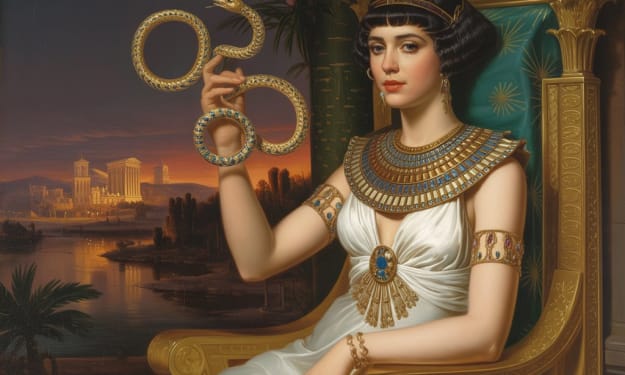
The desert sun blazed over the golden city of Alexandria, where the great library stood as a beacon of knowledge and the harbor bustled with ships from every corner of the Mediterranean. In the palace overlooking the sea, a young girl watched the waves and dreamed of power. Her name was Cleopatra, and one day she would become the last pharaoh of Egypt. From her earliest years, Cleopatra was different. Unlike many rulers who relied only on wealth or bloodline, she hungered for knowledge. She studied languages, philosophy, and science. It was said she could speak with merchants in their own tongues and debate with scholars as if she were one of them. But the path to power in Egypt was not simple. Her father, King Ptolemy XII, died when Cleopatra was eighteen. The throne was left to her and her younger brother, who was declared co-ruler. Yet in truth, the court was a nest of intrigue. Advisors whispered in the boy’s ear, urging him to push Cleopatra aside. Soon she was driven out of Alexandria, forced to wander the deserts of Syria with only her loyal supporters. Cleopatra, however, was not one to surrender. She raised an army and marched back toward Egypt, determined to reclaim her throne. But the fate of her kingdom was tied to Rome, the rising empire that stretched across the Mediterranean. And so, Cleopatra turned to Rome’s most powerful man: Julius Caesar. Legend says she slipped into Caesar’s palace hidden inside a rolled-up carpet. When the carpet was unrolled, the great general found before him not just a queen, but a woman of brilliance and charm. Cleopatra knew that beauty could catch the eye, but intelligence captured the mind. She and Caesar became allies—and lovers. With his support, she defeated her brother’s forces and secured her crown as Queen of Egypt. The years that followed were filled with triumph. Cleopatra restored order in Egypt, strengthened its economy, and presented herself not just as a Greek ruler but as the living goddess Isis, protector of her people. Yet her fate was again tied to Rome. After Caesar was assassinated, chaos gripped the empire. Two men rose to power: Octavian, Caesar’s adopted heir, and Mark Antony, the bold general who commanded Rome’s legions in the east. Cleopatra chose Antony. Their meeting in Tarsus was unforgettable. She arrived on a golden barge, its sails dyed purple, its oars of silver catching the sun. Perfumes filled the air, and Cleopatra sat beneath a canopy dressed as a goddess, dazzling Antony with her presence. What began as politics soon became passion. Together, they ruled as lovers and allies, dreaming of uniting East and West under their command. But Rome was not kind to ambition. Octavian spread rumors that Cleopatra had bewitched Antony, that he had betrayed Rome for an Egyptian queen. War became inevitable. The decisive battle came at Actium, where Cleopatra and Antony’s fleet faced Octavian’s forces. The winds of fortune turned against them. Their ships burned, their armies scattered. Defeated, they fled back to Egypt. In Alexandria, the walls of the palace echoed with despair. Antony, believing Cleopatra had already taken her life, fell on his own sword. Bleeding and broken, he was carried to Cleopatra, who held him as he died. Her heart shattered, but she knew her own fate was sealed. Octavian soon entered the city, victorious. He wanted Cleopatra alive, paraded in chains through the streets of Rome as a trophy. But the Queen of Egypt refused to be humiliated. Dressed in her royal robes, she entered her chamber with her closest servants. A small basket was brought to her, holding a deadly asp, the sacred serpent of Egypt. With steady hands, Cleopatra lifted it to her arm. As the poison coursed through her veins, she lay upon her golden bed, proud and unbroken. She died as she had lived—not as a captive, but as a queen. Her death marked the end of Egypt’s independence. The land of the pharaohs became just another province of Rome. Yet Cleopatra’s story lived on, whispered through the centuries. She was remembered not only for her beauty but for her brilliance, her courage, and her refusal to bow before the might of empire. Even today, Cleopatra remains a symbol of power, resilience, and the eternal struggle to shape one’s own destiny.
By LUNA EDITHabout a year ago in History