
James Wright and the Poetry He Had to Learn to Write
From the steel mills of Ohio to the fragile beauty of a transformed poetic voice

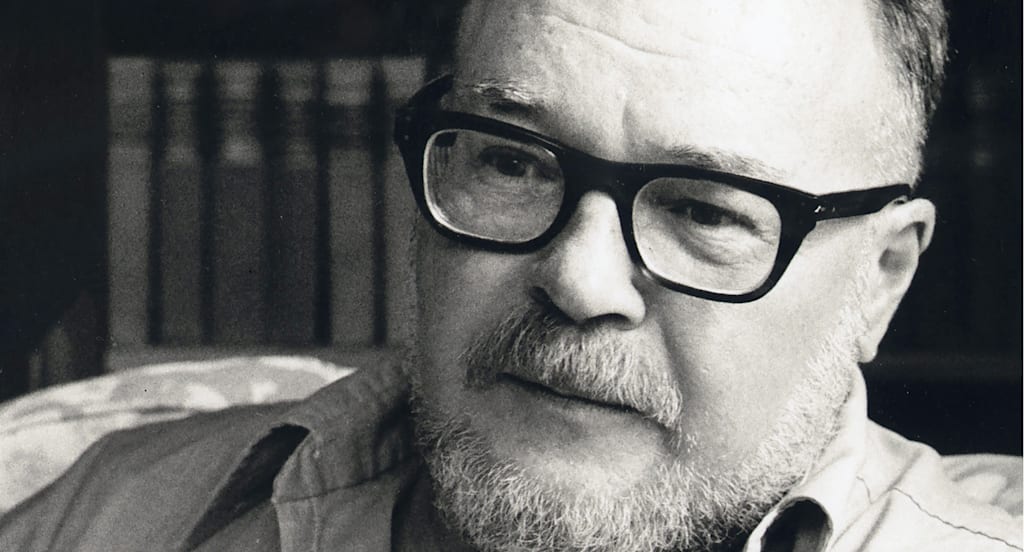
James Wright came from a place that could have produced an entirely different kind of poet. Born December 13, 1927, in Martins Ferry, Ohio, Wright grew up along the Ohio River in a community shaped by steel mills, factories, smoke, labor, and the hard industrial economy of the American Midwest. The landscape surrounding his childhood carried the marks of industry, yet the poetry Wright eventually became known for could seem almost impossibly delicate. His poems found beauty in abandoned places, lonely people, fields, birds, rivers, and brief moments of human recognition. The contrast became one of the defining tensions of his career. From a world marked by industrial hardship, Wright developed a poetry capable of making room for astonishing tenderness.
His early poetry looked very different from the work that eventually established his reputation. Wright entered American poetry during a period in which formal craftsmanship carried considerable authority. Meter, rhyme, inherited poetic structures, and elevated diction shaped much of the literary culture surrounding him. Wright studied those traditions seriously, and his earliest books reflected that education. His first collection, The Green Wall, published in 1957, received the Yale Younger Poets Prize, establishing him as a poet with considerable technical ability.
The recognition also presented Wright with a problem. He had learned how poetry was supposed to sound, yet the mastery of inherited forms could become its own kind of confinement. His early work demonstrated discipline, intelligence, and control, although another voice was gradually pushing against those qualities. Wright began searching for a poetry that could reach the experience itself before literary convention had a chance to smooth it into something polished and predictable.
That search transformed his career.
The decisive break came with The Branch Will Not Break, published in 1963. The collection represented far more than a change in poetic technique. It marked Wright's willingness to abandon the security of the style he had already mastered. Free verse replaced much of the formal architecture of his earlier work. Images became stranger and more startling. Landscapes could suddenly shift into dreamlike spaces. A railroad yard, a field, a bird, or a solitary human figure could become the center of an emotional revelation.
Wright's transformation has sometimes been described through the term pastoral surrealism, although the phrase can only take us so far. His poems frequently begin with recognizable Midwestern scenes before opening into something less easily explained. Reality remains present, yet perception begins to bend. A physical landscape becomes an interior landscape. A moment that might appear insignificant acquires an almost mystical intensity.
This quality helped distinguish Wright from poets who treated nature primarily as scenery. For Wright, the natural world could become a place of temporary release from loneliness. His landscapes carried emotional force because they existed in tension with human suffering. A person could remain profoundly isolated while standing in a field filled with birdsong or sunlight. Beauty did not erase suffering. Instead, beauty became startling precisely because suffering remained so close.
Loneliness runs through Wright's poetry with unusual persistence. His speakers frequently encounter people living at the margins of American life, figures carrying poverty, isolation, disappointment, or emotional wounds. Wright looked toward those lives with compassion rather than detachment. His poetry could stare directly at despair while still searching for a moment capable of breaking through it.
That combination became central to his achievement. Wright did not need optimism to discover beauty. His poems could acknowledge despair and still remain open to grace. A ruined life could contain a moment of beauty. A lonely person could experience a fleeting connection. A damaged landscape could suddenly become luminous. The possibility of redemption often lasted only an instant, yet Wright understood the power of such instants.
His famous poem "Lying in a Hammock at William Duffy's Farm in Pine Island, Minnesota" demonstrates this ability to turn a seemingly modest experience into a profound confrontation with existence. The speaker rests in a hammock surrounded by the natural world, watching the landscape and allowing consciousness to drift. The poem gradually moves away from description toward an unsettling realization about the self. Wright's genius lies partly in the way the revelation emerges from the landscape rather than being announced as an abstract philosophical statement.
That method became characteristic of his mature work. He trusted images to carry emotional and intellectual pressure. Rather than explaining an emotion at length, he could place a human being inside a landscape and allow the relationship between the two to generate meaning.
His poetry also carried the scars of his own struggles. Wright battled alcoholism and periods of severe emotional difficulty throughout his life. Those experiences informed his sensitivity to alienation and vulnerability, although reducing his poetry to biography would miss much of what makes it powerful. His poems transformed personal suffering into something larger. The isolated speaker could become an abandoned worker, a lonely stranger, a poor man, a prisoner, or anyone standing outside the comfortable center of American life.
Wright's later poetry continued to provoke disagreement. Collections such as Two Citizens revealed a poet still testing the possibilities of his voice. Some readers found portions of the later work emotionally excessive, while others valued its urgency and directness. Wright himself understood the danger of easy language. Fluency could become a trap. A poet who possesses a strong command of language can produce beautiful sentences almost automatically, and beauty produced too easily can become another form of dishonesty.
For Wright, revision therefore became an act of resistance. He understood that poetry could become glib even when the individual lines sounded impressive. The poet had to cut away language that merely sounded poetic. The mature Wright wanted words capable of carrying lived experience rather than simply displaying literary skill.
That struggle gives his career an especially compelling shape. Wright did not begin as an outsider to literary tradition. He began as an accomplished student of it. His reinvention became powerful precisely because he knew the rules before deciding to break many of them. He had already learned how to write the kind of poetry that earned academic approval. He then spent years trying to discover what remained after that training had been stripped away.
The result was a poetry that could move from the physical world into revelation with almost no warning. A bird could become an emblem of freedom. A field could become a place of emotional escape. A stranger could become a mirror. A Midwestern afternoon could open into an encounter with mortality. Wright found ways to make the ordinary world feel suddenly charged with possibility.
His death came far too early. After returning from Europe in the autumn of 1979, Wright developed a persistent sore throat. Doctors diagnosed cancer of the tongue that December. He died on March 25, 1980, at Calvary Hospital in the Bronx. He was 52 years old. His body was returned to Ohio, and he was buried in Riverview Cemetery in Martins Ferry, the town that had formed the earliest landscape of his life.
His posthumous collection Above the River: The Complete Poems allowed readers to see the full arc of his achievement. Read together, the poems reveal a remarkable artistic journey. The young poet who had mastered traditional forms eventually became a poet willing to risk uncertainty, strangeness, vulnerability, and radical simplicity.
That journey may be the most important part of Wright's legacy. His achievement was not simply finding a distinctive poetic style. It was discovering that artistic growth sometimes requires abandoning the very skills that first brought recognition. Wright had to move beyond the poetry he knew how to write in order to reach the poetry he needed to write.
The industrial town of his childhood remained part of that journey. The steel mills and working communities of Martins Ferry belonged to the physical world that formed him, even as his mature poems often seemed to reach toward fields, birds, open landscapes, and moments of unexpected grace. The contradiction matters. Wright did not escape the world that made him. He transformed his way of seeing it.
Wright understood that beauty and suffering could occupy the same landscape. He knew loneliness could coexist with wonder, and despair could exist beside a sudden glimpse of grace. His poems rarely offer permanent rescue. Instead, they offer something smaller and more believable: a moment in which the world becomes visible again.
For a poet who spent much of his career trying to strip away literary safety, that moment was enough. James Wright's greatest reinvention was learning to trust the fragile instant when words and human vulnerability meet. From the industrial Ohio town of his childhood came a poetry capable of finding radiance in places other poets might have overlooked. His work reminds us that a poet's voice can sometimes emerge only after the poet has the courage to abandon the voice that first earned him praise.
A Blessing
By James Wright
Just off the highway to Rochester, Minnesota,
Twilight bounds softly forth on the grass.
And the eyes of those two Indian ponies
Darken with kindness.
They have come gladly out of the willows
To welcome my friend and me.
We step over the barbed wire into the pasture
Where they have been grazing all day, alone.
They ripple tensely, they can hardly contain their happiness
That we have come.
They bow shyly as wet swans. They love each other.
There is no loneliness like theirs.
At home once more,
They begin munching the young tufts of spring in the darkness.
I would like to hold the slenderer one in my arms,
For she has walked over to me
And nuzzled my left hand.
She is black and white,
Her mane falls wild on her forehead,
And the light breeze moves me to caress her long ear
That is delicate as the skin over a girl’s wrist.
Suddenly I realize
That if I stepped out of my body I would break
Into blossom.
About the Creator
Tim Carmichael
Let your becoming be louder than your fear, and your smallest steps become the road you once thought impossible to walk. An Appalachian poet and cookbook author my book Beautiful and Brutal Things is on Amazon, Link 👇
Enjoyed the story? Support the Creator.
Subscribe for free to receive all their stories in your feed. You could also become a paid subscriber, letting them know you appreciate their work.
Comments
There are no comments for this story
Be the first to respond and start the conversation.