
How the Great Pyramid Was Really Built: The 4,500-Year-Old Diary That Changed History
The Diary of Merer reveals how skilled workers, boats, canals, wet sand, ramps, and remarkable engineering created Egypt’s greatest wonder—without aliens or slave labor.

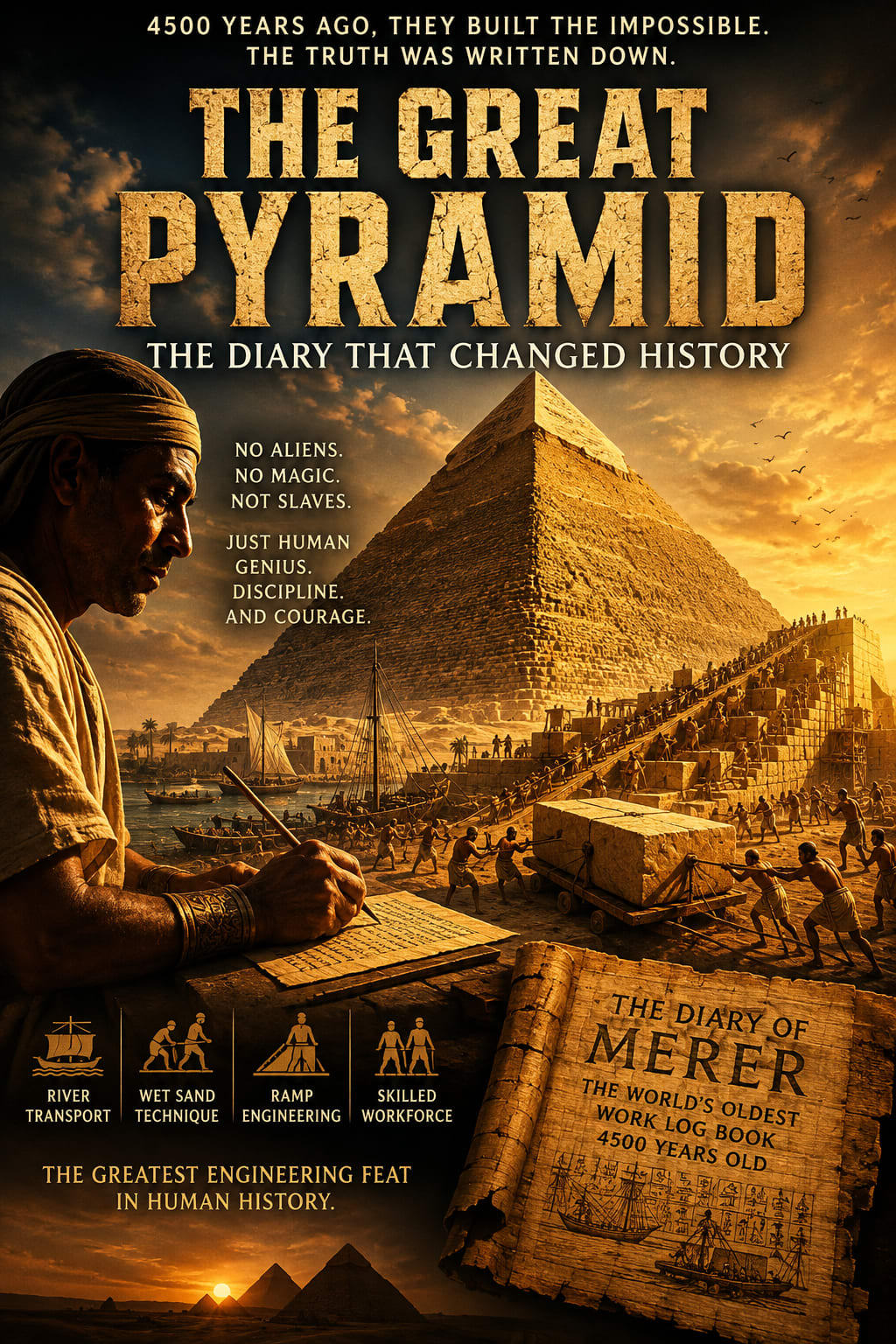
For thousands of years, the Great Pyramid of Giza has stood in the Egyptian desert like a silent challenge to human imagination.
Kingdoms rose and disappeared. Powerful empires collapsed. Cities were buried beneath sand, while generations of rulers, warriors, and inventors became little more than names in history books. Yet the Great Pyramid remained standing.
Built approximately 4,500 years ago, it was the tallest human-made structure in the world for nearly 3,800 years. Even today, modern engineers struggle to understand how ancient Egyptian workers achieved such extraordinary precision without cranes, engines, GPS, laser-measuring equipment, or modern construction tools.
Some people believe the pyramid was built using lost technology. Others claim that extraterrestrial beings must have helped. Popular films have also promoted the idea that thousands of enslaved people were forced to drag stones through the desert under the threat of violence.
However, an ancient diary discovered near the Red Sea changed the way historians understood the Great Pyramid.
It did not describe magic, aliens, or supernatural powers. Instead, it revealed something far more impressive: organized human labor, advanced planning, intelligent transportation systems, and remarkable engineering.
The Greatest Pyramid in Egypt
More than 100 pyramids have been discovered across Egypt, but the three pyramids on the Giza Plateau remain the most famous. They were built for the pharaohs Khufu, Khafre, and Menkaure.
The largest of them is the Great Pyramid, constructed during the reign of Pharaoh Khufu.
Its original height was approximately 146 meters, or about 481 feet. Much of its polished outer limestone casing and its uppermost section have disappeared over time, leaving the structure slightly shorter today.
When it was newly completed, the pyramid would not have looked like the brown, rough monument tourists see today. Its exterior was covered with smooth, polished white limestone. Under the Egyptian sun, it may have appeared like a gigantic shining mountain rising from the desert.
Its size is impressive, but its precision is even more mysterious.
The four sides of the Great Pyramid are closely aligned with the cardinal directions: north, south, east, and west. Ancient Egyptian builders achieved this without modern compasses or satellite navigation.
They may have studied the movement of stars, observed the sun’s shadow, and used water-leveling techniques. Whatever method they followed, the result proves that the builders possessed sophisticated knowledge of mathematics, astronomy, surveying, and construction.
The Diary That Changed History
In 2013, archaeologists working at Wadi al-Jarf, an ancient harbor near the Red Sea, discovered a collection of papyrus documents.
These documents were not religious texts or stories about Egyptian gods. They were daily work records written by an official named Merer.
Merer lived during the reign of Pharaoh Khufu and led a team of approximately 200 workers. His diary is considered one of the oldest surviving papyrus documents ever discovered.
Most importantly, Merer appears to have witnessed the construction project connected to the Great Pyramid.
His records explain how workers transported high-quality white limestone from the quarries of Tura to Giza. The stones were loaded onto boats and carried through the Nile River and a network of human-made canals.
Merer’s diary transformed the Great Pyramid from an unexplained ancient mystery into a massive, carefully managed infrastructure project.
The pyramid was not created in a single location using only nearby materials. It depended on quarries, boats, canals, roads, food production, skilled workers, administrators, supervisors, and carefully planned delivery schedules.
How the Stones Reached Giza
The Great Pyramid contains millions of stone blocks. Many limestone blocks weighed several tons, while some granite stones used inside the structure were considerably heavier.
Granite was transported from Aswan, hundreds of kilometers away from Giza. These enormous stones were carried by boat along the Nile before being moved toward the construction site through canals.
This transportation system was possible because the ancient Egyptians understood the seasonal behavior of the Nile River. Water was not simply a natural resource; it was also part of their construction network.
Instead of dragging every stone across hundreds of kilometers of dry land, workers used boats to bring heavy materials much closer to the pyramid site.
Merer’s records describe teams of workers and sailors transporting stone as part of a disciplined daily operation. This suggests that the project involved detailed schedules, organized labor groups, and officials responsible for different parts of the supply chain.
In modern terms, the Great Pyramid was one of history’s earliest megaprojects.
Were the Pyramid Builders Slaves?
For decades, movies often showed pyramid builders as chained slaves working under brutal conditions. They were usually presented as nameless people forced to pull stones while guards stood nearby with whips.
Archaeological evidence presents a different picture.
The people who built the pyramid appear to have included skilled stonecutters, transport workers, sailors, builders, cooks, bakers, administrators, supervisors, and laborers.
They were housed in settlements near the construction site. Evidence suggests that they received food such as bread, grain, meat, dates, and beer. Medical care may also have been provided to injured workers.
Archaeologists discovered workers’ graves near the pyramids. Being buried close to a royal monument would have been a significant honor in ancient Egypt.
This does not mean that ancient Egyptian society was free from exploitation or forced labor. However, the evidence challenges the simple Hollywood image of the Great Pyramid being constructed entirely by chained slaves.
The pyramid was more likely built by an organized workforce that included trained craftsmen and temporary laborers working under a highly structured system.
The Secret of Wet Sand
Transporting stones by boat solved only one part of the problem. Workers still had to move the blocks across land.
Ancient artwork provides an important clue.
One Egyptian wall painting shows a giant object being pulled on a wooden sledge. In front of the sledge, a person appears to be pouring water onto the sand.
For a long time, some observers assumed this was a religious ritual. Modern experiments, however, demonstrated that slightly wet sand can significantly reduce the force required to pull a heavy sledge.
Dry sand gathers in front of the sledge, creating resistance. When the correct amount of water is added, the sand particles bind together, creating a firmer surface.
This simple technique may have allowed workers to transport enormous stones using fewer people.
There were no engines and no modern chemicals—only water, sand, ropes, wooden sledges, and a deep understanding of the environment.
How Were the Stones Lifted?
Moving stones to the construction site was difficult, but raising them toward the top of the pyramid was an even greater challenge.
The exact lifting method remains debated. The most widely discussed explanations involve different types of ramps.
Workers may have used a large straight ramp during the early stages of construction. Other theories suggest zigzagging ramps, ramps wrapped around the outside of the pyramid, or an internal spiral ramp built partly inside the structure.
According to the internal-ramp theory, workers could have dragged stones upward through a rising passage that turned around the pyramid as construction progressed. As more blocks were placed, sections of the ramp may have been covered and incorporated into the monument itself.
No single theory has been universally proven. However, ramps, wooden sledges, ropes, levers, and coordinated teams offer realistic explanations that do not require supernatural technology.
The true achievement was not a magical machine. It was the ability to organize thousands of people and keep the supply of stone, food, water, wood, ropes, and tools moving continuously.
Mysteries Hidden Inside the Pyramid
From the outside, the Great Pyramid appears to be a solid mountain of stone. Inside, however, it contains chambers, shafts, corridors, and galleries.
A narrow passage leads deeper into the pyramid, while the famous Grand Gallery rises dramatically toward the King’s Chamber.
The King’s Chamber contains a stone sarcophagus, but Pharaoh Khufu’s mummy has never been found. The chamber may have been looted thousands of years ago, or the pharaoh’s remains may have been placed somewhere else.
Modern scanning technology has revealed additional mysteries.
In 2017, researchers announced the discovery of a large unexplained void above the Grand Gallery. The space appears to be approximately 30 meters long, but its exact purpose remains unknown.
In 2023, another hidden corridor was confirmed behind the pyramid’s northern face. These discoveries suggest that the Great Pyramid may still contain spaces that have not been physically explored.
The empty areas could have served a structural purpose, reducing pressure on important chambers. They might also lead to additional passages or unknown rooms.
For now, nobody knows with certainty.
The Pyramid Was a Victory of Human Intelligence
The Great Pyramid is often described as a mystery, but calling it impossible can unintentionally disrespect the people who built it.
Ancient Egyptians did not need aliens to complete the monument. They had knowledge, experience, discipline, mathematics, engineering, river transport, skilled labor, and generations of architectural development.
The stones were cut from quarries. Boats carried them along the Nile. Canals brought them closer to Giza. Workers placed them on wooden sledges and used water to reduce friction. Ramps and coordinated teams helped move them upward. Surveyors carefully measured and aligned the structure.
One block at a time, the Great Pyramid rose from the desert.
Its greatest foundation was not limestone or granite. It was human determination.
History often remembers kings, but monuments are usually built by workers whose names are forgotten. Pharaoh Khufu became immortal through the Great Pyramid, but the structure also represents thousands of craftsmen, sailors, planners, cooks, stonecutters, and laborers who transformed an impossible vision into reality.
The Diary of Merer allows one of those forgotten voices to survive.
More than 4,500 years later, his records remind us that the Great Pyramid was not simply a royal tomb. It was a triumph of organization, engineering, intelligence, and collective human effort.
That may be more inspiring than any story about magic or aliens.
About the Creator
parwinder singh
🎬 Movie & Entertainment Writer sharing reviews, ending explanations, story breakdowns, plot twists and hidden details from Bollywood, Hollywood, South Indian cinema, Korean dramas and OTT releases.
Enjoyed the story? Support the Creator.
Subscribe for free to receive all their stories in your feed.
Comments
There are no comments for this story
Be the first to respond and start the conversation.