
Four Wheels, Two Mallets, and Absolutely No Common Sense...
America's Forgotten Auto Polo Craze

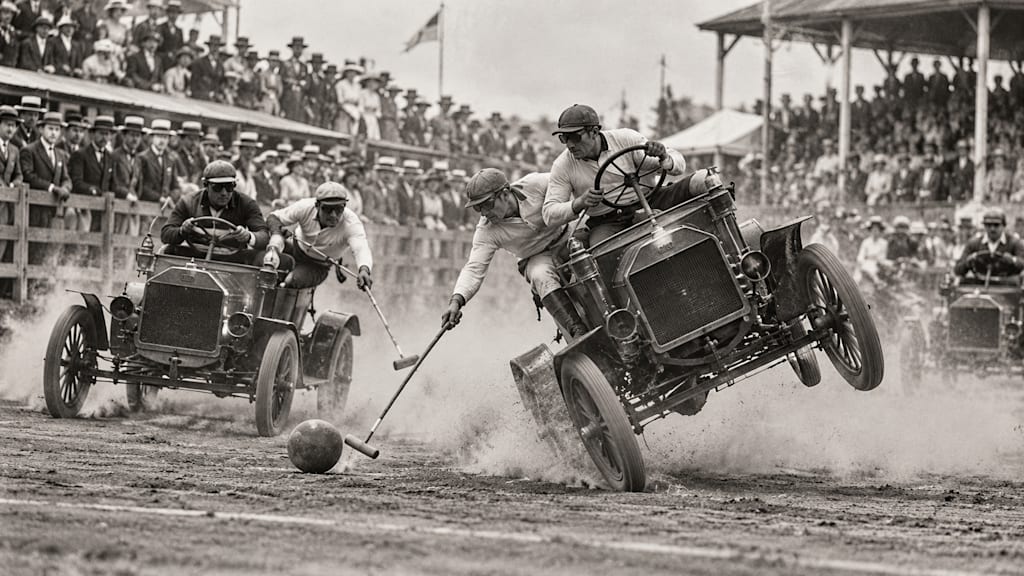
Imagine attending a sporting event in 1912. You arrive at the fairgrounds expecting a pleasant afternoon, perhaps a horse race, maybe a baseball game. Something civilized. Instead, you discover four automobiles on a field, each carrying two men: a driver and a mallet-wielding partner. A large ball waits between them. The referee signals the start. The cars accelerate directly at each other. Within moments, someone is airborne, a vehicle overturns, and several thousand spectators have the time of their lives. Welcome to automobile polo.
Yes, it was a real sport, and no, apparently nobody paused to ask whether it was a good idea.
The Automobile Age Meets a Terrible Idea
At the dawn of the twentieth century, America was falling in love with the automobile. The machine promised freedom, mobility, and adventure. The Ford Model T, introduced in 1908, made car ownership increasingly accessible, but selling these unfamiliar machines required imagination. Dealers needed to show what automobiles could do. Racing was one answer. Endurance contests were another. Then someone had another idea: polo, but with cars instead of horses. Take a sport that requires coordination, balance, and precision, and introduce several thousand pounds of machinery. What could go wrong?
The idea predates even the Model T. Early experiments with auto polo date to 1902, with Joshua Crane of the Dedham Polo Club in Massachusetts. These first attempts used small vehicles and didn’t immediately become a sensation. The real push came from Ralph “Pappy” Hankinson, an automobile dealer in Kansas. Around 1911, Hankinson promoted a more organized version using Model Ts. His motivation was simple: spectacle sells. An automobile doing unusual maneuvers is good advertising; an automobile overturning in front of thousands is even better. Auto polo demonstrated car capabilities by putting them in situations no sensible owner would risk. The publicity worked.
Wichita, Kansas: July 20, 1912
One of the first widely publicized matches took place near Wichita, Kansas, in July 1912. Four cars, eight players, teams called the Red Devils and the Gray Ghosts. Reportedly, five thousand people attended to watch four cars chase a ball in an alfalfa field. The event had irresistible qualities: it was loud, fast for its time, and unpredictable. Unlike traditional polo, where a rider might fall, auto polo added the possibility that the horse substitute might roll over on everyone involved. The formula: part athletic contest, part mechanical demonstration, part traveling disaster.
How the Game Worked
Each car had a driver and a malletman. The driver steered, accelerated, and aimed for the ball. The malletman tried to strike it toward the goal, often from an exposed position, leaning out to swing. The cars were stripped-down machines, with unnecessary bodywork removed and sometimes fitted with basic protective structures (though they offered little safety). Malletmen had to judge the ball’s movement, anticipate the driver, avoid the other cars, maintain balance, swing, and hang on, all at once. It was like performing surgery while riding a runaway shopping cart down a staircase. Rules may have resembled polo, but the experience was chaos.
An Oklahoma newspaper described auto polo in 1913: competitors traveled at 30 to 40 miles per hour. Cars needed to withstand collisions, broken fences, and overturning. None of this was an unfortunate side effect. It was the attraction.
When the Referee Runs for Cover
A 1920 Oregon Statesman article described an exhibition at the Oregon State Fair: stripped-down cars collided, overturned, and crashed through fences. The referee signaled the start, and immediately ran for safety. In auto polo, the official’s first responsibility was “get out of the way.” The rest was a spectacle of bouncing cars, struggling players, and the ever-present possibility of a spectacular crash. It entertained an era learning what cars could do, and what bodies could not.
The Medical Staff Were Not Decorative
By 1922, the sport’s dangers were clear. Teams sometimes included a doctor and a nurse because medical attention was often necessary. Not just a first-aid kit, but a doctor and a nurse on the team. In most sports, an injury interrupts play. In auto polo, medical readiness was part of the plan. The risks were obvious: players could be thrown from moving cars, vehicles could roll or collide, and malletmen could find themselves dangerously close to disaster. Cars took a beating: wheels, steering, and bodywork all at risk. Players had no modern safety gear. It was unforgiving. Yet people kept paying to watch.
From Kansas Fields to Major Venues
Auto polo spread nationwide in the 1910s, appearing at fairs, stadiums, and even Madison Square Garden in New York. Imagine a venue known for major sporting events hosting gasoline-fueled polo instead of horses. The sport reached international audiences, but they were skeptical. English exhibitions in 1913 featured stripped-down Fords and heavily protected players, but the game wasn’t particularly effective as a sport. The cars were hard to maneuver, malletmen faced huge challenges, and collisions could end matches early. But if you came for excitement, not technical skill, you got your money’s worth.
The sport’s contradiction was its appeal: the harder it was to play, the more spectacularly things could go wrong.
The Price of the Spectacle
Auto polo eventually faced a problem publicity couldn’t solve: cost. Cars, repairs, travel, and equipment all cost money. A sport built around violent contact destroyed its own equipment, and the Model T’s affordability couldn’t make that destruction sustainable. Players faced real danger, and the novelty eventually faded. By the late 1920s, the sport’s popularity declined. Economic realities, expense, and the sport’s hazards ended the original craze. Attempts to revive it never recaptured the mania. Motor vehicles moved on to other competitions, racing, with more rules and safety, and practical American transportation. The idea of polo with cars faded into quirky history.
A Remarkable American Footnote
It’s tempting to dismiss auto polo as spectacular foolishness. But it reveals something about its era: the early automobile age was experimental and energetic, fascinated by speed, power, danger, and mechanical novelty. Auto polo brought all those together. It was reckless, expensive, absurd, and for a brief time, it captured the American imagination.
The real story isn’t that bored millionaires rented fleets of luxury cabs for matches. Dealers and promoters turned a dangerous experiment into a public attraction. Men armed themselves with mallets, climbed aboard stripped-down cars, and drove toward each other in pursuit of a ball. Spectators cheered. Newspapers reported the chaos. And somewhere, a mechanic surveyed the wreckage and wondered if all this really improved civilization.
The Ford Model T is remembered as an icon of American industry. But for a few years, Americans looked at this remarkable machine and asked: “Yes, but can we play polo with it?” The answer was yes. Whether they should have was apparently never the deciding factor.
About the Creator
The Iron Lighthouse
Where folklore meets freeway. A guide to the strange heart of the American backroads...
Enjoyed the story? Support the Creator.
Subscribe for free to receive all their stories in your feed.
Comments
There are no comments for this story
Be the first to respond and start the conversation.