
Broken Weapons in a Chinese Tomb Show an Enduring Peace Philosophy
A Symbolic Burial Site

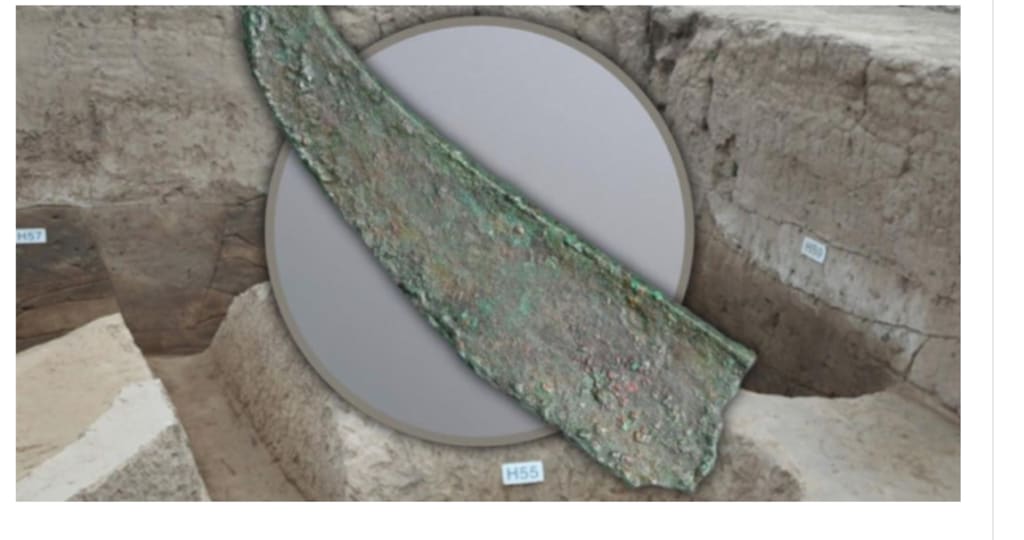
A 3,000-year-old burial site with purposefully shattered bronze weaponry was discovered during a recent archaeological dig in northwest China, providing an amazing window into prehistoric perspectives on war and peace. The finding at the Jiangliu site in Shaanxi Province indicates that the Western Zhou people had a strong philosophical devotion to the notion that putting an end to war was the ultimate act of bravery, even at a period of political unrest and struggle.
A Symbolic Burial Site
The Jiangliu site, which is situated on a loess plateau south of the lower Jinghe River, includes a sizable settlement moat and has produced a multitude of artefacts, including stone, bronze, jade, and pottery. In March 2026, the Shaanxi Academy of Archaeology declared that 13 tombs from the Western Zhou period (1046–771 BC) had been unearthed, according to SCMP.
A complex and diverse cemetery population is suggested by the irregular layout of these rectangular vertical pit tombs, with some graves facing east and others west. Archaeologists date the remnants to the late middle to early late Western Zhou dynasty based on the features of the bronze and pottery.
Researchers came to the conclusion that the site was a commoner cemetery since the majority of the tombs contained simple burial goods, usually a single tripodal cooking kettle and a jar. However, some burials also included small bronze weapons that had been purposefully bent or snapped before burial, such as knives and dagger-axes. This was by no means a random act of devastation. It was a deliberate ceremony that turned weapons of war into peace offerings.
Zhigeweiwu: True Valour Is Putting an End to War
The broken weapons are associated with the ancient Chinese philosophy of zhigeweiwu, which means "stopping war is true valour."The Zuozhuan, an ancient Chinese historical literature written around 300 BC that describes the Spring and Autumn period while referencing earlier Western Zhou customs, is the source of this concept. According to the passage, people who work to put an end to conflict rather than prolong it deserve true honour, even though military triumphs may provide glory.
The custom was intimately related to the standardisation of Western Zhou funeral customs, according to Yu Pengfei, an archaeologist from the Shaanxi Academy of Archaeology engaged in the discovery, who spoke with the Global Times. The shattered weapons were meant to serve as sacrifices to direct the departed toward a tranquil afterlife.
Yu clarified, "The broken weapons, which were once useful tools of war, were purposefully damaged before burial to symbolise peace for the deceased in the afterlife, turning them into ritual grave goods." This practice also represented more general social goals, showing that the zhigeweiwu concept was held by all strata of ancient Chinese society rather than just the ruling class.
A Rebuttal in a Conflictual Era
The Zhou era in the West was anything but tranquil. The dynasty descended into civil war as different groups fought for control when King Wu, the dynasty's founder, died in 1043 BC. Additionally, the idea of the "Mandate of Heaven"—a political theory that was used to support the fall of the Shang dynasty and, subsequently, to legitimize succeeding ruling powers—was originally developed during this time. The broken weaponry at Jiangliu serves as a subdued but potent counter-statement against this backdrop of military violence and political scheming.
According to the South China Morning Post, the Jiangliu site is particularly noteworthy since it is among the first instances in which written historical documents and archaeological data may be directly cross-referenced. The broken swords are an excellent illustration of how ancient writings and material culture can shed light on one another, and the Zuozhuan offers a literary framework for understanding the physical remains.
These discoveries close a gap in the Jinghe River region's archaeological record and offer vital information for comprehending the customs and way of life of common people during the Western Zhou period.
In the end, the tale of the broken weapons at Jiangliu is about timeless human ideals. These ancient people decided to commemorate the passing of their deceased with the sign of war's end rather than the weapons of war in a world where conflict was a constant reality. The message is just as relevant today as it was three millennia ago.
About the Creator
Enjoyed the story? Support the Creator.
Subscribe for free to receive all their stories in your feed.
Comments
There are no comments for this story
Be the first to respond and start the conversation.