
Beneath the Streets of Alexandria, a Secret Greek and Roman City
Classical Antiquity's Echoes

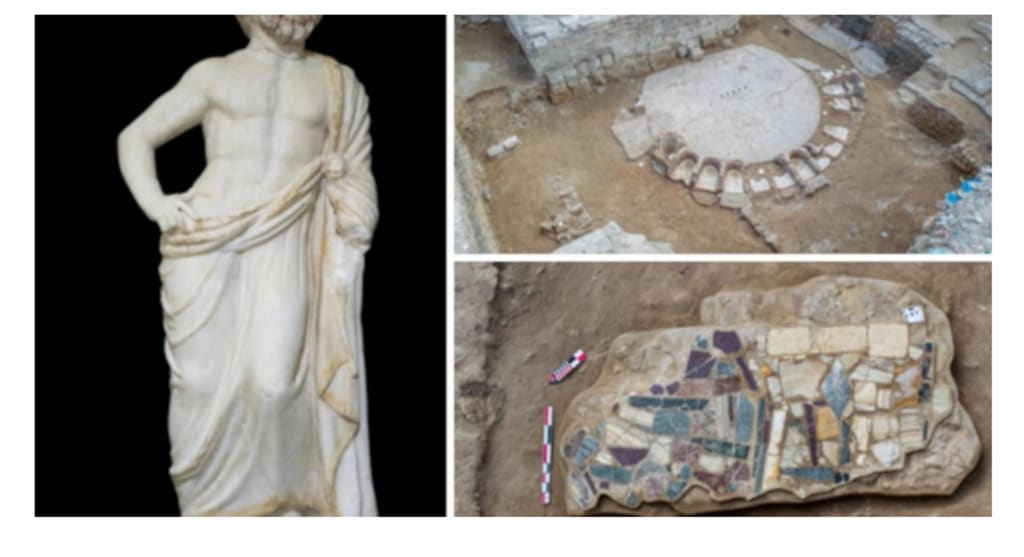
In the Muharram Bek neighbourhood of central Alexandria, an Egyptian archaeological team has uncovered a remarkable series of settlement levels from the Hellenistic, Roman, and Byzantine eras. The discovery offers striking new insights on the city's urban development immediately following Alexander the Great's founding in 331 BC.
A circular public bathhouse from the late Ptolemaic era and the foundations of an affluent Roman-era private residence were among the many notable architectural remnants found by the Supreme Council of Antiquities team. In order to balance the necessity for contemporary infrastructure with archaeological preservation, the excavations were started as a salvage operation connected to neighbourhood development projects.
Classical Antiquity's Echoes
A circular public bathhouse called a tholos (Greek for "dome") is one of the most noteworthy buildings discovered. During this time, public baths provided everyday hygienic needs and were occasionally associated with medical interventions. Although the complete plan is still being investigated, preliminary data indicates that further connected rooms are still underneath.
A Roman residential villa that seems to have belonged to a wealthy owner was discovered nearby by archaeologists. The villa's elaborate mosaic flooring, which showcases the sophisticated craftsmanship seen in Alexandria's art schools during classical antiquity, uses both Opus Tessellatum and Opus Sectile techniques. With a tiny pool linked to an extensive drainage and water supply network, the residential architecture also incorporates advanced water management technologies.
Urban Evolution, Trade, and Gods
Archaeologists uncovered a wide range of artefacts directly related to the city's Greco-Roman past in addition to the architectural foundations. Beautiful marble statues of gods like Bacchus (Dionysus) and Asclepius, the Greek deity of medicine, are among the discoveries. Additionally, a headless statue that is thought to depict the goddess Athena or her Roman counterpart Minerva was found.
The existence of Asclepius has prompted academics to speculate about potential therapeutic or restorative uses for the region. Coins, ceramics, and sealed amphorae, which were used to transport wine and olive oil, were also found, indicating that Alexandria had extensive marine trade networks that linked the city to the wider Mediterranean region.
Alexandria's historical geography is being reevaluated as a result of the results. The excavation closes a significant gap in the southeast area of the city, according to Dr. Hisham Hussein, head of the Central Department for Maritime Antiquities. The findings improve upon the maps made in the 19th century by astronomer Mahmoud Bey El-Falaki, who was the first to chart ancient Alexandria's cities using topographical measurements.
Throughout its history, Byzantium was frequently at the vanguard of every significant cultural revival, influencing much of Europe with its laws, philosophy, and art. The Byzantine Empire gradually transitioned from Latin-inspired Roman culture to a Hellenic realm influenced by Eastern Orthodox Christianity.
As a result, it established a unique artistic and governing style that would eventually rule the courts of numerous European kingdoms and empires. Its strongly religious emphasis on music, art, and architecture marked a significant break from Catholic Europe's western Latin influence and would have a profound impact on the continent's future.
Up to the Byzantine era, the Muharram Bek site was inside the ancient city walls; after that, its prominence declined due to changing urban patterns. Officials are assessing the most important items for possible exhibition at the Greco-Roman Museum in Alexandria, and preliminary restoration work on the artefacts has already started.
The chronicle of the Byzantine Empire is by far one of the longest and richest in human history. It is replete with intrigues, usurpers, ambitious emperors, and conquests, but none of these events have diminished the Eastern Roman Empire's splendour or beauty. However, time and history are merciless, and every powerful empire will eventually crumble under the weight of numerous adversaries that want to expand its boundaries and pillage its wealth.
As a result, an empire that had existed for almost a millennium—a longevity virtually unheard of in history—met its demise at a pivotal juncture in history. This demise was predetermined by the quickly shifting political landscape. And it was precisely this conclusion—the terrible collapse of the Byzantine Empire—that would have a profound effect on Europe for centuries to come.
About the Creator
Enjoyed the story? Support the Creator.
Subscribe for free to receive all their stories in your feed.
Comments
There are no comments for this story
Be the first to respond and start the conversation.