
Beneath the Resort: The Secret Nuclear City Hidden Under The Greenbrier
Iron Lighthouse Exclusive

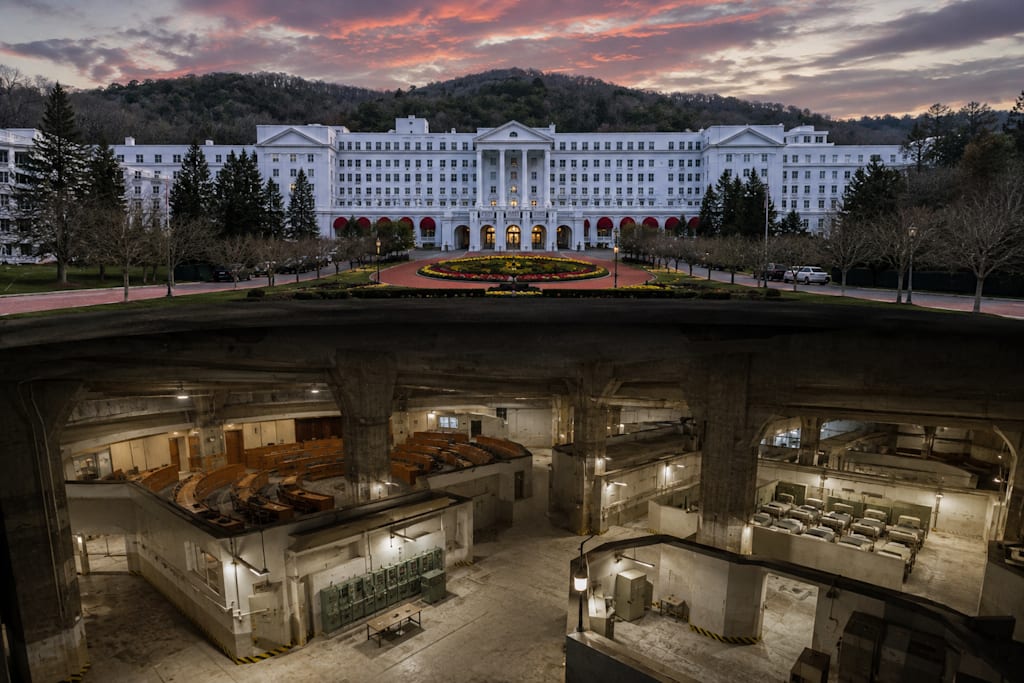
Across America, history often hides in plain sight, woven quietly into the fabric of everyday life. In quiet small towns, old hotels, abandoned factories, and historic theaters stand as silent witnesses to the passage of time. These places may appear ordinary at first glance, yet sometimes, all it takes is the opening of a forgotten door to reveal stories that have been concealed for generations, waiting to be discovered beneath the surface.
Old hotels. Quiet small towns. Abandoned factories. Historic theaters. Places that seem ordinary until someone opens a forgotten door and reveals an entirely different story lurking beneath the surface.
For more than three decades, one of the most extraordinary secrets of the Cold War remained hidden beneath one of America's most luxurious resorts. Guests arrived carrying golf clubs, families came for vacations, couples celebrated weddings, politicians attended conferences, and children played on manicured lawns, never suspecting what lay beneath their feet.
Guests arrived carrying golf clubs. Families came for vacations. Couples celebrated weddings. Politicians attended conferences. Children played on manicured lawns. Beneath their feet, a top-secret underground bunker had been constructed, its purpose nothing less than the preservation of the entire United States Congress in the event of nuclear war. This was not a refuge for a select few members, but a vast facility built to house all of Congress, ensuring the continuity of government even as the world above faced unimaginable catastrophe.
Not part of Congress. All of Congress... For thirty years, this hidden city waited patiently beneath the famous Greenbrier resort. Its mission was simple: to survive the end of the world. Its mission was simple. Survive the end of the world.
To understand why such a place existed, one must return to the height of the Cold War. The years following World War II were defined by a terrifying new reality: the United States and the Soviet Union possessed nuclear weapons capable of destroying entire cities within minutes. As both nations expanded their arsenals, the possibility of a full-scale nuclear exchange no longer belonged to science fiction; it became government policy.
Military planners began calculating casualties, while civil defense agencies distributed survival instructions to the public. Communities across the country conducted air-raid drills, and schoolchildren practiced duck-and-cover exercises beneath their desks. The threat of nuclear war hung over everyday life like an invisible storm cloud, shaping routines and fueling anxieties.
Beneath this ever-present threat, the government faced a daunting question: if the worst happened, how could democracy be preserved after Armageddon?
While both the executive branch and military leadership had continuity plans in place, Congress presented a unique challenge. The House of Representatives and Senate collectively comprised hundreds of elected officials, making their immediate replacement nearly impossible if Washington were destroyed in an attack. The legislative branch needed not just any refuge, but one that was secret, secure, and capable of sustaining hundreds of people for extended periods. Remarkably, the answer to this unprecedented problem became a luxury resort nestled in the mountains of West Virginia.
The Greenbrier already possessed a unique relationship with the federal government. Located in the hills of White Sulfur Springs, the resort had long been a favored gathering place for politicians, military leaders, and prominent public figures. During World War II, various portions of the property were repurposed for government use, further cementing its strategic value.
The resort's location offered several advantages. Its distance from major urban centers reduced the risk of a direct attack, while the surrounding mountains provided natural protection. Perhaps most importantly, its role as a luxury resort offered perfect camouflage for any secret operations. After all, nobody would expect a secret congressional survival facility to exist beneath a vacation destination. These factors combined to make The Greenbrier an ideal choice for such an extraordinary purpose.
Construction began in the late 1950s under extraordinary secrecy, as workers excavated a massive underground complex beneath the resort. Above ground, the appearance of routine expansion and renovation projects was carefully maintained, ensuring that even many employees at The Greenbrier remained unaware of the true nature of the work underway. The official explanation was simple: the resort was adding new convention facilities and support infrastructure. In reality, however, the purpose of the construction remained strictly classified. Behind reinforced concrete walls and enormous blast doors, an underground world slowly took shape, hidden from all but a select few.
This was not a simple bunker; it was a fully functioning underground government. Spanning more than 112,000 square feet, the facility had been meticulously designed to house the entire United States Congress in the event of nuclear war. Imagine, for a moment, a hidden city existing quietly beneath a luxury resort, ready to accommodate hundreds of senators, representatives, aides, technicians, security personnel, and support staff.
The scale of the operation was staggering. Dormitories lined the complex, medical facilities stood ready, and independent power generation systems ensured continued operation. Secure water supplies and advanced air filtration systems were installed to protect occupants from radioactive fallout, while storage rooms brimmed with supplies to support long-term occupancy. Every detail had been carefully planned, everything, that is, except the apocalypse itself.
The blast doors alone seemed borrowed from a science fiction film, massive steel-and-concrete barriers weighing many tons that could seal portions of the facility from the outside world. Once closed, these doors transformed the bunker into a self-contained environment, capable of withstanding conditions that planners hoped would never occur.
Walking through them reportedly felt like crossing into another reality. Above ground, a luxury resort greeted visitors with elegance and comfort, while below ground, a Cold War fortress stood ready for the unthinkable. The contrast between these two worlds was nothing short of extraordinary.
Perhaps the most fascinating feature of the bunker was its meticulous attention to political continuity. The facility was not simply a shelter for lawmakers; it was designed to allow them to govern. Deep underground, a chamber for the House of Representatives was constructed, with a separate Senate chamber nearby. Committee rooms, offices, communication facilities, and meeting spaces completed the illusion of a fully functioning Congress.
If nuclear war destroyed Washington, lawmakers could theoretically resume operations almost immediately. Imagine emerging from a nuclear catastrophe only to find congressional hearings already back on schedule. While it may sound absurd, planners took this possibility with the utmost seriousness.
And then there was the television studio, a feature that gives the story a distinctly Cold War twist. Government planners recognized that physically preserving Congress was only part of the equation; public confidence was equally important. Americans needed reassurance that their government remained operational, even in the aftermath of a catastrophe. To address this, the bunker included a fully equipped media center designed specifically for broadcasts.
But these were not just any broadcasts. The studio reportedly contained interchangeable seasonal backdrops, spring, summer, autumn, and winter, that could be swapped out to create the illusion that legislators were still operating from Washington, D.C. The goal was simple: if Congress ever needed to address the nation from a bunker hidden beneath a luxury resort in West Virginia, viewers might never suspect the truth. It was equal parts practical planning and psychological theater, and somehow, that makes the whole story even more fascinating.
Maintaining the secret required remarkable creativity. After all, the government could hardly announce the existence of a nuclear survival facility hidden beneath a famous hotel. Instead, the task of quietly maintaining the bunker fell to a small group of specially cleared personnel. Officially, they worked for a television repair company called Forsythe Associates. A cover story that proved both simple and brilliant. Television equipment, after all, requires regular maintenance, and technicians coming and going rarely raise suspicions.
Behind this unremarkable façade, these employees were actually responsible for keeping the congressional bunker fully operational. For decades, they quietly maintained equipment, supplies, communication systems, and infrastructure, all while preserving the illusion that nothing unusual existed below. Above them, guests walked the hotel’s hallways, never suspecting the extraordinary secret hidden beneath their feet.
What makes Project Greek Island so remarkable is how successfully it remained secret. For more than thirty years, the bunker operated quietly beneath one of America’s most famous resorts. Thousands of visitors stayed at The Greenbrier, attending conferences, enjoying vacations, and going about their lives, completely unaware that, all the while, a hidden government was waiting below. A backup version of democracy sat silently behind blast doors, prepared for a future nobody wanted to imagine.
The secrecy finally ended in 1992 when a journalist from The Washington Post uncovered the operation and published an exposé revealing the bunker to the public. The revelation stunned many Americans, and the government soon decommissioned the facility as an active congressional shelter. Cold War realities had changed, and new continuity plans had emerged, rendering the old bunker obsolete. For the first time, one of the nation’s most extraordinary secrets entered public view.
Today, visitors can tour portions of the former bunker beneath The Greenbrier. The rooms and chambers remain, as do the imposing blast doors. Walking through the facility feels less like a typical museum visit and more like stepping into a preserved time capsule from an era defined by existential fear. Every hallway tells the same story: a generation genuinely believed nuclear war might happen tomorrow, and so they planned accordingly.
Every Iron Lighthouse story eventually reaches a moment where historical details reveal something larger, and here, that insight lies in the contrast itself. Above ground, there was luxury, comfort, relaxation, and vacations. Below ground, contingency plans awaited in preparation for civilization’s potential collapse. The Greenbrier thus became a physical representation of the Cold War mindset. A world where ordinary life continued, even as governments quietly prepared for catastrophe.
People played golf while planners contemplated nuclear annihilation. Families enjoyed weekend getaways while engineers tested blast doors. Champagne glasses clinked overhead while emergency bunk beds waited in silence below. It sounds unbelievable, yet that contradiction defined an entire era.
Today, the Cold War has faded into history, but Project Greek Island endures as one of its most fascinating relics, not because it was hidden, not because it was massive, and not even because it was designed for Congress. What makes it truly remarkable is how it reveals the seriousness with which people confronted the unthinkable.
For thirty years, beneath the rolling hills of West Virginia, a secret city waited, waiting for lawmakers who never arrived, for a war that never came, for a day everyone hoped would never happen. And perhaps that is the most remarkable part of all: the greatest success of Project Greek Island was that it never had to do the job it was built to perform.
About the Creator
The Iron Lighthouse
Where folklore meets freeway. A guide to the strange heart of the American backroads...
Enjoyed the story? Support the Creator.
Subscribe for free to receive all their stories in your feed.
Comments
There are no comments for this story
Be the first to respond and start the conversation.