
53 Metres Underground at Náměstí Míru: There Is Much More Waiting for You Than Just a Metro Station
We take the Prague Metro for granted. Every day, thousands of us mechanically step onto the escalators, go underground with headphones in our ears, get on a train and travel to work or home.
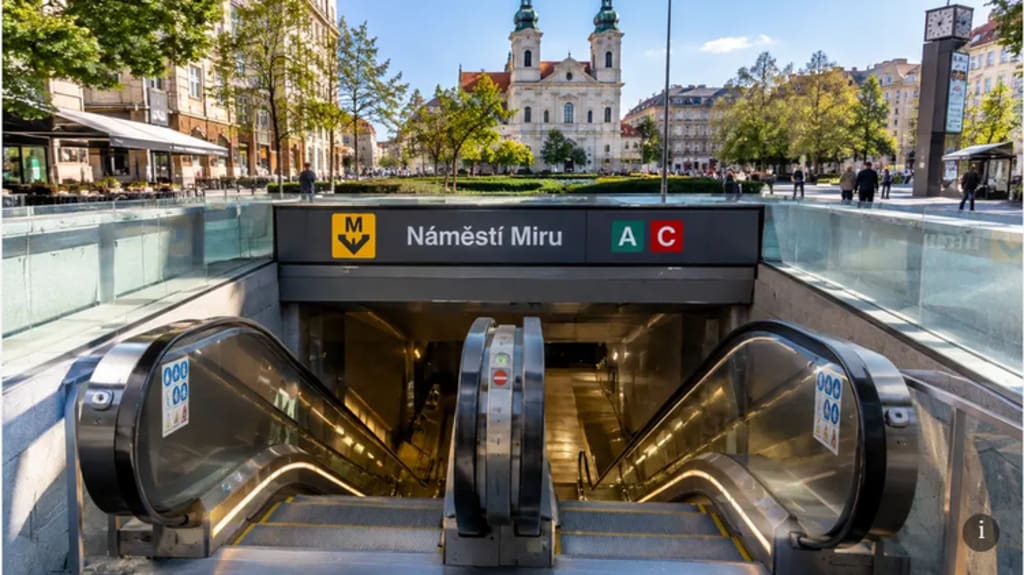
Take off your headphones in the Metro and look around at Náměstí Míru. You are not at an ordinary station. You are standing 53 metres underground. Above your head there are tons of concrete, rock and one of the longest escalators in Europe.
The escalator is 87 metres long and the ride takes an endless two minutes. Náměstí Míru is the deepest metro station in the whole European Union.
But this is where the story only begins.
Because Prague's underground was not built only to carry people to work.
It was also supposed to survive the end of the world.
A Project for the Third World War
When Line A was being built in the 1970s, the planet was living under the shadow of the Cold War. The threat of a nuclear conflict was a real strategic scenario.
That is why the Metro was given a secret Protective System. No legend – from the very beginning, a giant atomic bunker was being built together with the Metro.
In case of an attack, selected stations could be transformed within minutes into hermetically sealed underground cities.
The system still has its own shafts, huge air filtration stations, independent electricity generators and underground reservoirs for drinking water.
What we see today as a boring everyday routine was supposed to become an ark of rescue for thousands of people.
A Labyrinth You Will Never See
The platform with all the passengers is only the polished tip of the iceberg.
There are kilometres of technical corridors, ventilation control rooms and secret chambers.
You pass them at speeds of up to 80 km/h and have no idea that just a few centimetres behind the wall there is technology capable of cutting you off from the burning hell on the surface.
And then there are the famous aluminium panels – the “pukavce”, designed by architect Jaroslav Otruba.
People often see them as a symbol of socialist retro design. But their curved shape had a purely technical purpose. It helped absorb and break the enormous acoustic waves which made your ears suffer when heavy Soviet trains passed through the tunnels.
Late in the evening, when the platform becomes almost empty, the panels reflect the light in a strange way.
For a moment, you may feel like you are standing on the deck of an abandoned spaceship.
The Paradox Under the Vltava
Náměstí Míru holds the record as a station, but there is an interesting paradox.
It is not the deepest point of Prague's railway tracks.
The tunnels themselves go even lower – specifically on Line A, in a deep depression under the Vltava riverbed between Malostranská and Staroměstská stations.
And still, you feel the real weight of the earth at Náměstí Míru.
You go down for so long that eventually the noise of the city disappears. The trams stop ringing in your ears. The daylight is gone.
When you finally step onto the platform, you suddenly notice the contrast.
Above you, people are dealing with their ordinary little problems. And most of them have no idea what kind of giant is beating underneath their feet.
Fortunately, the worst scenario never happened.
So next time you take that endless escalator down, try looking at the people going in the opposite direction, staring at their phones.
Very few of them know how deep into history they are travelling.
Into a system that, one second after an apocalypse, was supposed to do much more than just take people home.
A place that was perfectly prepared for days which, fortunately, never came.
Sources used for this article:
iDnes.cz / Technet – Prague Metro as a nuclear shelter. A look into places ordinary passengers never see
Prague Public Transit Company (DPP) – Official history and technical parameters of Line A and the Metro Protective System
Czech Television / Hyde Park Civilizace – Architecture and engineering of Prague's underground during the Cold War
About the Creator
Enjoyed the story? Support the Creator.
Subscribe for free to receive all their stories in your feed.
Comments
There are no comments for this story
Be the first to respond and start the conversation.