
400 Years of Capital Punishment in America:
Justice, Revenge, and the Price of a Life

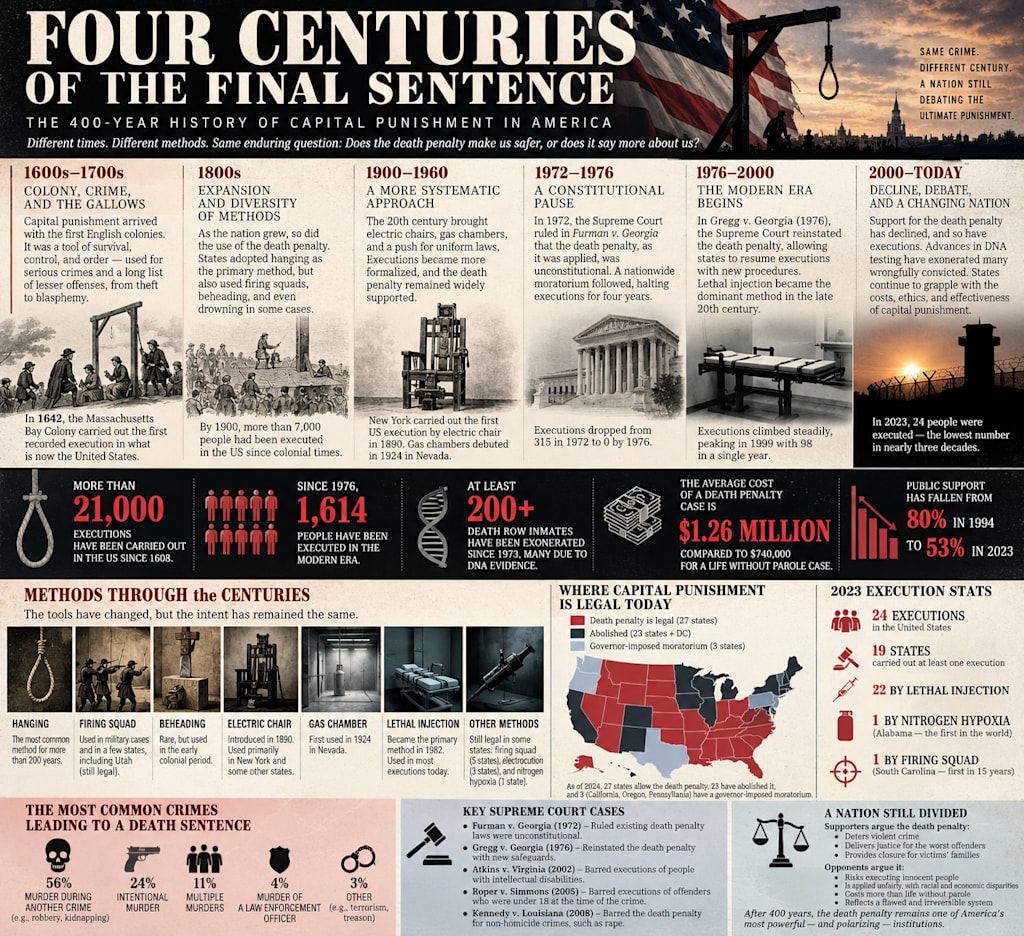
400 Years of Capital Punishment in America: Justice, Revenge, and the Price of a Life
From colonial hangings and public spectacles to lethal injections, nitrogen gas, and firing squads, the American death penalty has spent four centuries evolving without ever escaping its most uncomfortable question: Can a government trusted to deliver justice also be trusted with the power to decide who deserves to die?
Imagine standing in a crowded town square in colonial America. A wooden platform rises above the crowd. Church bells ring. Vendors sell refreshments. Children stand beside their parents, craning their necks for a better view. At the center of the gathering is a person who has been condemned to die, and the government has arranged for the public to witness it.
For the people watching, this is supposed to be justice.
Four hundred years later, the wooden platform has been replaced by a sterile execution chamber. The crowd has disappeared behind locked doors. Prison officials wear gloves. Lawyers file emergency appeals. Witnesses sit behind glass, watching a person take their final breaths while the government insists that the procedure is controlled, necessary, and humane.
The scenery has changed. The machinery has changed. The language has changed.
But the central act remains the same: the state deliberately ends a human life as punishment for a crime.
Capital punishment has been part of America's story since the earliest European colonies. It has survived revolutions, constitutional amendments, civil rights movements, Supreme Court battles, scientific advances, and decades of arguments about morality, deterrence, race, and justice. It has been abolished, reinstated, modernized, and expanded. It has also been responsible for enormous financial expenditures, exposed devastating failures in the criminal justice system, and raised the terrifying possibility that innocent people may be executed.
And in 2026, America is still arguing about whether this centuries-old punishment belongs in a modern society.
This is not simply a story about murderers and their victims. It is a story about the power of government, the limits of human certainty, the unequal application of the law, and the uncomfortable distance between what we call justice and what we are willing to do in its name.
1. Before America Was America: The Colonial Roots of Execution
The United States did not invent capital punishment. European settlers brought it with them, carrying legal traditions shaped heavily by English law.
In England, the death penalty had historically applied to an astonishing range of offenses. Murder and treason were punishable by death, but so were certain thefts, property crimes, and other acts that would never justify execution under modern American law.
The first recorded execution in the English colonies that became the United States occurred in 1608, when Captain George Kendall was executed in the Jamestown colony of Virginia for allegedly spying for Spain.
This was not yet a country. There was no United States Constitution, no Bill of Rights, no independent American legal system. There was a struggling colonial settlement and a government willing to use death as a means of maintaining authority.
In 1612, Virginia's governor, Sir Thomas Dale, introduced the Divine, Moral and Martial Laws, which prescribed death for offenses that included stealing grapes, killing chickens, and trading with Indigenous people without authorization. Colonial laws varied, but the broader principle was clear: punishment was intended not only to respond to wrongdoing but also to enforce obedience.
The Massachusetts Bay Colony carried out its first recorded execution in 1630. Other colonies developed their own lists of capital crimes, often blending English legal traditions with religious beliefs and the political priorities of colonial authorities.
Some offenses reflected the close relationship between religion and government. In certain colonies, religious dissent, blasphemy, and other perceived challenges to the established faith could result in death. Treason and rebellion were also treated as existential threats to the ruling order.
We should pause here because the historical distance can make these practices seem almost absurd. Death for stealing grapes? Execution for religious dissent?
Yet the underlying logic has never entirely disappeared. Governments have always been tempted to treat the harshest punishment as a demonstration of authority. The details of what qualifies as an intolerable offense change with the era, but the desire to make an example of someone remains remarkably durable.
Slavery, race, and the power to punish
Capital punishment also developed alongside slavery, colonial conquest, and racial hierarchy.
Enslaved people faced laws and punishments designed to protect a system in which they were treated as property rather than as equal human beings. In various jurisdictions, offenses involving enslaved people were punished differently depending on race, status, and the interests of slaveholders. White people and Black people could face radically different legal consequences for comparable conduct.
This history matters because the death penalty did not develop in a society where everyone stood equally before the law. It developed in a society that repeatedly denied legal protection to entire categories of people.
That legacy would continue long after independence.
2. The American Revolution and the Question of Human Rights
By the late 1700s, the death penalty was beginning to face serious philosophical challenges.
In 1767, Italian philosopher Cesare Beccaria published On Crimes and Punishments, arguing against capital punishment and questioning whether governments could justify taking human life as a legal penalty. His work influenced criminal justice reformers on both sides of the Atlantic.
The American Revolution introduced another complicated contradiction.
The Declaration of Independence proclaimed that people possess an inherent right to life. The Constitution subsequently established a government with considerable authority over criminal punishment, while the Fifth and Eighth Amendments placed limits on how that authority could be exercised.
The Fifth Amendment explicitly contemplated capital cases by requiring due process before the government could deprive a person of life. The Eighth Amendment prohibited cruel and unusual punishments.
Neither provision abolished the death penalty.
Instead, the founding generation created a legal system that recognized the government's power to execute while placing constitutional boundaries around that power.
And so began one of America's longest-running legal arguments: Does constitutional recognition of capital punishment mean the government should use it, or does the Constitution merely establish limits on a practice that society remains free to reject?
Those are very different questions.
The first abolitionist movements
During the late 1700s and early 1800s, reformers began challenging the widespread use of execution.
Some argued that the government should not possess the authority to take life. Others believed the death penalty should be reserved for a much smaller number of crimes. Still others questioned whether execution actually deterred crime or merely satisfied society's appetite for retribution.
States gradually reduced the number of offenses punishable by death. Pennsylvania became an early leader in moving executions away from public view, placing them within correctional institutions in the 1830s.
Michigan abolished capital punishment for ordinary crimes in 1846, becoming the first English-speaking jurisdiction in the modern world to do so, although an exception remained for certain offenses such as treason. Other states followed different paths, and abolition never became a universal national movement.
The death penalty was already becoming a patchwork of competing ideas. Some Americans saw it as essential justice. Others saw it as an unnecessary exercise of state violence.
That disagreement has never been resolved.
3. The 1800s: Public Hangings, Slavery, and the Spectacle of Death
During the 19th century, execution remained a familiar feature of American criminal justice. Hanging was the dominant method, and executions were frequently public events.
People traveled from surrounding communities to watch. Newspapers reported on condemned prisoners' final statements. Religious leaders sometimes delivered sermons. Crowds gathered to witness the punishment, and the execution was presented as a lesson about the consequences of criminal behavior.
But public executions did not always produce the solemn reflection their defenders promised.
They could become rowdy gatherings filled with drinking, cheering, curiosity, and celebration. The condemned person became the center of a public spectacle, and the victim's suffering could become only one part of a much larger performance.
This is an uncomfortable chapter in American history because it exposes something we might prefer not to acknowledge: punishment can become entertainment when a crowd is invited to watch another person suffer.
The death penalty and racial violence
The relationship between capital punishment and race became especially troubling in the American South.
During slavery, enslaved people could be subjected to execution under laws that protected slaveholding interests and enforced racial control. After emancipation, racial discrimination continued to shape policing, trials, sentencing, and the administration of criminal punishment.
Black defendants were frequently exposed to unequal treatment, particularly when the alleged victim was white. In some cases, executions occurred after deeply compromised proceedings, while racial violence outside the courts operated with little meaningful accountability.
Lynching must be distinguished from lawful capital punishment. Lynching was extrajudicial violence, not a legal sentence imposed after a valid criminal trial. Nevertheless, both histories reveal how race and the perceived worth of human life influenced American attitudes toward violence and punishment.
The legal system was not simply applying neutral principles in a neutral society. It operated within institutions shaped by racial hierarchy.
That history remains relevant today because the modern death penalty continues to raise questions about whether race influences who receives a death sentence, whose murders receive the greatest prosecutorial attention, and whose lives receive the strongest protection.
If the law is supposed to treat every life equally, those questions cannot be dismissed as ancient history.
4. The 1900s: The Search for a More Modern Execution
As the 20th century approached, reformers increasingly criticized hanging as outdated and potentially gruesome. Their proposed solution was not necessarily to abolish execution. Instead, many sought to make it appear more scientific, controlled, and humane.
In 1890, New York became the first state to execute a prisoner using the electric chair. William Kemmler was put to death at Auburn Prison.
Electrocution was promoted as a modern alternative to hanging. Yet Kemmler's execution was prolonged and disturbing, demonstrating that a new machine did not automatically produce a more humane death.
The gas chamber subsequently emerged as another alternative. Nevada first used lethal gas in 1924, executing Gee Jon.
Each technological change carried a familiar promise: the latest method would remove the ugliness from state-sanctioned killing.
But there is a fundamental problem with that promise.
Changing the machinery does not change the moral question.
A rope, an electric chair, a chamber filled with gas, and a modern drug protocol are different mechanisms for accomplishing the same objective. Technology may change the process, but it cannot make the underlying decision immune to ethical scrutiny.
The last public executions
Public executions gradually fell out of favor as Americans became increasingly uncomfortable with the crowds, disorder, and spectacle surrounding them.
The widely recognized last public execution in the United States took place in Owensboro, Kentucky, in 1936. Rainey Bethea, a Black man convicted of raping and robbing a white woman, was hanged before a crowd estimated at approximately 20,000 people.
The event drew enormous attention and exposed the ugliness of turning death into a public attraction. The crowd, the press, and the surrounding festivities became part of the story.
By then, states had increasingly moved executions behind prison walls.
The shift was significant. It reflected a growing belief that execution should be a controlled government procedure rather than a community gathering.
But moving an execution out of public view did not eliminate the spectacle entirely. It simply restricted who could witness it.
Prison officials, selected witnesses, journalists, and representatives of victims' families would continue to observe executions under tightly controlled conditions.
And the broader public would continue debating them from a distance.
A brief decline in capital punishment
The early and middle decades of the 20th century saw growing reform movements, legal challenges, and periods of declining execution activity.
Some states abolished the death penalty, while others retained it but used it less frequently. Concerns about wrongful convictions, racial discrimination, and the morality of state killing became increasingly prominent.
The death penalty nevertheless remained embedded in American law.
Then came a constitutional crisis that would transform its history.
5. 1972: The Supreme Court Stops the Death Penalty
On June 29, 1972, the U.S. Supreme Court decided Furman v. Georgia, a landmark case that effectively invalidated existing state death-penalty statutes.
The decision did not establish that every possible form of capital punishment was unconstitutional. Rather, the Court found that the death sentences before it, imposed under the systems then in use, violated the Eighth and Fourteenth Amendments because of the arbitrary and inconsistent way the punishment was administered.
The decision exposed a central problem: people convicted of murder were not receiving death sentences according to a sufficiently consistent and constitutionally acceptable process.
The same system could sentence one person to death and another to life imprisonment under circumstances that raised serious questions about fairness.
Race, geography, prosecutorial discretion, jury decisions, and the quality of legal representation all contributed to concerns about unequal outcomes.
For several years, the death penalty could no longer be carried out under the invalidated statutes.
But the ruling did not end the debate. States began rewriting their laws to satisfy the Court's objections.
1976: Capital punishment returns
In Gregg v. Georgia and related cases decided in 1976, the Supreme Court approved revised death-penalty systems designed to guide sentencing discretion and reduce arbitrariness.
The Court allowed capital punishment to resume under constitutionally structured procedures.
On January 17, 1977, Utah executed Gary Gilmore by firing squad, ending the modern execution moratorium.
The modern death-penalty era had begun.
The new system was supposed to be more careful, more consistent, and more legally defensible than the one the Court had rejected.
But the years that followed would demonstrate that procedural safeguards, however important, could not eliminate every source of error or inequality.
6. The Death Penalty in the Modern Era: 1980s Through the 1990s
The 1980s and 1990s saw a major expansion in the use of capital punishment.
Public concern about violent crime, political pressure to appear tough on crime, and confidence in the criminal justice system contributed to rising death sentences and executions.
The number of new death sentences peaked at approximately 325 in 1986, according to the Death Penalty Information Center's historical data. By the mid-1990s, annual death sentences were again exceeding 300.
Executions also increased. In 1999, the United States carried out 98 executions, the highest annual total of the modern era.
Lethal injection became the preferred method in many jurisdictions. Oklahoma was the first state to adopt it as an execution method in 1977, and Texas carried out the first lethal-injection execution in 1982.
The rationale was familiar: an execution using drugs administered through an intravenous line would appear more clinical and less visibly violent than electrocution or hanging.
But the growing use of lethal injection coincided with other developments that would eventually undermine confidence in the system.
The growing problem of wrongful convictions
DNA testing began exposing serious errors in criminal investigations and prosecutions. Witnesses recanted. Forensic evidence was challenged. Defense attorneys uncovered withheld evidence and unreliable testimony.
Some people who had been sentenced to death were exonerated after spending years on death row.
These cases forced the public to confront a question that supporters of capital punishment could not answer away:
What happens when the government executes the wrong person?
A prison sentence can, at least in some circumstances, be shortened or reversed. A person who has been wrongfully imprisoned may be released and compensated, although no amount of money can restore lost years.
An execution cannot be undone.
As the modern era progressed, the death penalty became increasingly difficult to defend as a perfectly reliable system of punishment because the broader criminal justice system was demonstrably capable of making catastrophic mistakes.
7. The 2000s: A Turning Point in American Attitudes
The beginning of the 21st century brought a growing reassessment of capital punishment.
In 2002, the Supreme Court ruled in Atkins v. Virginia that executing people with intellectual disabilities violated the Eighth Amendment.
In 2005, Roper v. Simmons prohibited the execution of people for crimes committed before they turned 18.
These decisions recognized that culpability, intellectual functioning, and developmental maturity matter when the government considers imposing its most severe punishment.
In 2008, the Court decided Baze v. Rees, rejecting a challenge to Kentucky's lethal-injection protocol under the standard applied in that case. Later decisions, including Bucklew v. Precythe in 2019, made it more difficult for prisoners to challenge execution methods under the Eighth Amendment.
Meanwhile, several states began abolishing the death penalty or imposing moratoriums. Illinois abolished capital punishment in 2011 after a series of wrongful convictions and concerns about the fairness of its system. Other states followed in subsequent years.
The trend was not uniform. Some states continued carrying out executions, while others retained the death penalty on paper but rarely used it.
The result was a country increasingly divided between jurisdictions committed to capital punishment and those moving away from it.
The role of victims' families
One of the most emotionally charged arguments surrounding the death penalty concerns victims' families.
Some families believe execution represents justice, accountability, or a necessary acknowledgment of the enormity of a crime. Others oppose execution because they do not want another death, because they fear further trauma, or because the prolonged appeals process prevents them from moving forward.
There is no single response to devastating loss.
It is unfair to suggest that every victim's family wants the death penalty, just as it is unfair to tell families who support it that their desire for accountability is inherently cruel.
But the existence of grief does not settle the policy question. A criminal justice system must still consider whether its punishments are effective, fair, proportionate, and consistent with constitutional principles.
Victims deserve compassion, resources, and meaningful support. Their suffering should not be used as a political prop by people who wish to avoid examining whether capital punishment actually delivers what they promise.
8. How Many People Have Been Executed in America?
The historical record is staggering.
The Death Penalty Information Center's Espy File documents 15,269 executions in the United States and earlier colonies from 1608 through 2002. That historical database is not a complete modern total, because it ends in 2002 and uses its own historical inclusion criteria. It nevertheless provides a glimpse into the enormous scale of state-sanctioned killing across four centuries.
The modern era has its own numbers.
Here are some of the most important statistics available as of October 2026.
MeasureWhat the numbers tell us Modern-era executions More than 1,600 since executions resumed in 1977 Highest modern-era annual total98 executions in 1999 Executions in 2024 25Executions in 2025 47New death sentences in 2025 23People on active death rows 2,004 as of January 2026 Death-row exonerations since 1973 At least 203 States that have abolished the death penalty 23 States retaining the death penalty 27
Sources: Death Penalty Information Center historical records, 2025 year-end report, death-row statistics, and innocence database.
These figures tell two very different stories.
Executions rose sharply in 2025, reaching their highest level in more than 15 years. Yet the number of new death sentences remained extremely low by modern historical standards. Only 23 people received new death sentences that year, compared with approximately 325 in 1986.
The number of people on death row has also declined substantially from its peak of nearly 3,600 around the turn of the century.
In other words, the machinery of execution is being used more aggressively in some places even as the pipeline feeding that machinery has contracted.
That contradiction deserves attention.
Why did executions surge in 2025?
Florida was the principal driver.
The state carried out 19 executions in 2025, accounting for approximately 40% of the national total. Without Florida's unusually high number, the national figure would have looked much closer to the totals seen in preceding years.
This is an important distinction. A national increase does not necessarily mean that Americans everywhere have become more enthusiastic about execution. State policies, governors' decisions, court rulings, and the timing of individual cases can dramatically change the numbers.
According to the Death Penalty Information Center's 2025 report, support for capital punishment had fallen to a 50-year low in Gallup polling. The same report found that 44% of Americans opposed the death penalty, the highest level of opposition recorded in that poll series since 1966.
The public, in other words, has grown more divided even as executions have increased.
That is not a minor detail. It raises questions about whether capital punishment is being driven primarily by public consensus, the decisions of individual elected officials, or the political advantages associated with appearing uncompromising on crime.
9. The 23 States That Have Abolished the Death Penalty
As of October 2026, 23 states have abolished capital punishment.
They are:
Alaska
Colorado
Connecticut
Delaware
Hawaii
Illinois
Iowa
Maine
Maryland
Massachusetts
Michigan
Minnesota
New Hampshire
New Jersey
New Mexico
New York
North Dakota
Rhode Island
Vermont
Virginia
Washington
West Virginia
Wisconsin
These states have taken different paths toward abolition, including legislative repeal and judicial decisions.
The details matter. In some states, repeal did not necessarily erase every death sentence imposed before abolition. New Mexico, for example, abolished the death penalty in 2009 but retained death sentences for crimes committed before the repeal took effect. The legal status of those older cases must be distinguished from the state's current sentencing law.
Washington's death penalty was invalidated by its state Supreme Court in 2018, and Virginia abolished it legislatively in 2021.
The abolition movement has therefore advanced through a combination of court decisions, legislation, and changing public attitudes rather than through one sweeping national decision.
What about states that have stopped executing people?
A state can retain the death penalty in law while suspending executions in practice.
Governors may impose formal moratoriums. Courts may block executions because of litigation. States may lack functioning execution protocols or face disputes over the drugs required for lethal injection.
California, Oregon, and Pennsylvania have had gubernatorial moratoriums, although the scope, timing, and legal consequences of those policies differ. Other states have experienced extended periods without executions for different reasons.
A moratorium is not the same as abolition. It can be reversed by a later governor, and it does not necessarily prevent prosecutors from seeking death sentences.
That distinction matters because a death penalty statute on the books does not tell us how frequently a state uses it, how many people remain on death row, or whether an execution is realistically imminent.
10. The 27 States That Still Authorize Capital Punishment
The following 27 states retain the death penalty in law:
Alabama, Arizona, Arkansas, California, Florida, Georgia, Idaho, Indiana, Kansas, Kentucky, Louisiana, Mississippi, Missouri, Montana, Nebraska, Nevada, North Carolina, Ohio, Oklahoma, Oregon, Pennsylvania, South Carolina, South Dakota, Tennessee, Texas, Utah, and Wyoming.
The federal government and the U.S. military also retain capital punishment.
The list requires a little explanation.
California, Oregon, and Pennsylvania have had gubernatorial moratoriums, so their inclusion does not mean executions are proceeding normally. The legality of capital punishment, the availability of executions, and the actual use of the punishment are three different things.
Nor do all 27 states use the death penalty at the same rate. Texas and Florida have historically accounted for a disproportionate share of executions. In 2025, Florida alone carried out 19.
Some states continue to sentence people to death but rarely execute them. Others have not carried out an execution in many years.
Where is the death penalty actually being used?
The modern American death penalty is concentrated geographically.
Texas has long been a leading execution state. Florida's dramatic increase in 2025 made it the largest contributor to that year's national total. Alabama, South Carolina, Tennessee, Missouri, and other states have also continued to carry out executions.
This uneven distribution raises a difficult question: Should the punishment for a crime depend so heavily on the state or county in which it occurred?
A person convicted of a qualifying murder in one jurisdiction may face a death sentence, while a person convicted of a similar crime elsewhere may receive life imprisonment.
Differences in the facts of individual cases can justify different outcomes. But when geography, prosecutorial practices, jury composition, and access to legal representation can determine whether someone lives or dies, consistency becomes a serious concern.
The Supreme Court's 1972 decision in Furman v. Georgia arose from precisely this broader problem of arbitrary application.
More than five decades later, the country still has not eliminated the disparities that made that question so consequential.
11. How Does America Execute People? The Methods and Their History
The United States has used several methods of execution, each introduced or retained under claims of legality, practicality, or greater humanity.
The principal methods are lethal injection, electrocution, lethal gas, and firing squad. Hanging also remains in certain historical statutes or exceptional legal provisions, although it is no longer a routine execution method.
The Death Penalty Information Center maintains a state-by-state record of authorized methods. The legal rules can change, and some methods are available only if another method is unavailable or declared unconstitutional.
Lethal injection
Introduced in modern American practice: 1982.
Lethal injection became the dominant execution method because it was presented as a medicalized alternative to more visibly violent methods.
The process involves administering drugs intended to cause death. The specific substances and protocols vary by jurisdiction. Some states use a single drug, while others have used combinations.
But the appearance of medical precision should not be mistaken for proof that the procedure is painless or reliable.
States have faced difficulties obtaining execution drugs because pharmaceutical manufacturers have objected to their use in executions. This has led to disputes over drug sourcing, secrecy, protocol design, and the qualifications of those administering the drugs.
There have also been executions in which prisoners appeared to experience distress, prolonged procedures, or complications.
In September 2026, Tennessee's attempted execution of Christa Pike failed after two doses of pentobarbital were administered. Pike survived and required medical treatment. The incident prompted renewed scrutiny of execution procedures and the state's oversight of its protocol.
The case is particularly disturbing because lethal injection is frequently defended as a controlled and humane method.
If the procedure fails, the consequences are not merely technical. They are inflicted on a human being who is restrained, under government control, and unable to leave.
Electrocution
First used in the United States: 1890.
The electric chair was introduced as a modern alternative to hanging. It remains authorized in a number of states, either as a primary method or as an alternative.
The method relies on an electrical current intended to cause death. Its history includes executions involving prolonged procedures, visible injury, and other complications.
Electrocution has been challenged on constitutional grounds, but its legality varies according to state law and the circumstances of a particular case.
It also illustrates the strange cycle of American execution policy: a method once advertised as progressive can later become a symbol of cruelty, only to reappear in political debates when another method becomes controversial.
Lethal gas and nitrogen hypoxia
Lethal gas was introduced in Nevada in 1924.
Modern American lethal-gas laws have expanded to include nitrogen hypoxia, which involves administering nitrogen to create an oxygen-deprived environment.
Alabama carried out the first nitrogen-hypoxia execution in January 2024. Louisiana later joined Alabama in using the method.
Supporters have described nitrogen hypoxia as an alternative when lethal injection drugs are difficult to obtain. Critics have questioned the scientific basis for claims that it produces a peaceful death, especially in light of witness accounts describing visible distress during executions.
The controversy is not simply about whether a method can cause death. It is about whether the state can reliably demonstrate that the procedure complies with constitutional protections against cruel and unusual punishment.
A method being authorized by statute does not mean it has been proved painless.
Firing squad
Firing squads have a long history in American military and state punishment.
Utah used a firing squad to execute Gary Gilmore in 1977, ending the modern execution moratorium. South Carolina revived the method in 2025, carrying out the first state firing-squad execution in 15 years.
In 2025, an execution by firing squad in South Carolina also raised questions after an autopsy indicated that the shooting may not have proceeded as intended. The method's defenders emphasize its relative procedural simplicity; its critics question the morality of deliberate shooting as a form of government punishment.
Idaho changed its law in 2025 to make the firing squad its primary method of execution effective July 1, 2026, with lethal injection as the secondary method. Other states authorize firing squads under particular circumstances.
Hanging
Hanging was the dominant method in early American history and remained in use for generations.
It has largely disappeared from modern execution practice. Some older statutory provisions or unusual legal circumstances have preserved it as a possible method, but it is not a mainstream contemporary practice.
Its historical significance is considerable because hanging represents the era when executions were commonly conducted in public and were often treated as communal events.
What methods are legal today?
The current legal picture is complicated. According to the Death Penalty Information Center, lethal injection is authorized in 28 states when counting jurisdictions with relevant historical or residual death sentences, including New Hampshire, whose abolition law may not apply retroactively. Electrocution is authorized in nine states, lethal gas in nine, and firing squads in five, with some overlap and some methods permitted only as alternatives.
Those figures count legal authorization, not actual use. They should not be interpreted as evidence that every listed method is routinely available or has been used recently.
The important point is that American execution policy has not converged on one universally accepted method. Instead, as the problems associated with one procedure become harder to ignore, jurisdictions have increasingly turned to alternatives.
The result is a growing patchwork of methods, protocols, and legal disputes.
12. The Price of an Execution: How Much Does the Death Penalty Cost?
Here is one of the most surprising facts about capital punishment: the death penalty generally costs taxpayers more than sentencing someone to life in prison without the possibility of parole.
That may seem counterintuitive. If the government executes someone, surely it avoids decades of incarceration costs, right?
Not necessarily.
Capital cases require additional procedures intended to protect defendants' constitutional rights and reduce the risk of wrongful execution. These cases often involve extensive investigations, specialized attorneys, expert witnesses, longer trials, separate sentencing proceedings, and multiple layers of appeals.
The government must also maintain death-row facilities and specialized execution procedures. Those expenses continue even when no executions take place.
The exact cost varies by state, county, case, and accounting method. There is no single reliable national price tag for an execution. However, several state-level studies illustrate the scale of the expense.
What the research has found
Jurisdiction or study Reported cost California, 1978–2011 Approximately $4 billion in additional costs compared with a system using life without parole as the maximum punishment Maryland, study published in 2008 An estimated $3 million average cost per death sentence, approximately $1.9 million more than a non-capital case Kansas, study cited by the Death Penalty Information Center Approximately $1.26 million for cases in which death was sought, compared with $740,000 for cases without the death penalty Florida, estimate published in 2000 Approximately $24 million per execution, based on estimated additional annual spending and the state's execution total at the time
Sources: Death Penalty Information Center's compilation of state cost studies.
These figures come from different years and methodologies. They should not be treated as current prices or directly compared without accounting for inflation and differences in what each study includes.
Still, the overall pattern is consistent across numerous investigations: seeking the death penalty is expensive.
Why does a capital case cost so much?
First, the prosecution and defense must investigate the case extensively. The stakes require careful examination of the evidence, the defendant's background, potential mitigating circumstances, and the reliability of witnesses and forensic findings.
Second, capital trials frequently involve more complex jury selection and additional sentencing proceedings.
Third, appeals and post-conviction review can continue for years or decades. Those procedures are intended to identify legal errors, constitutional violations, and other problems that might invalidate a conviction or death sentence.
Finally, maintaining death-row facilities and preparing executions involves additional costs.
The government does not simply sentence someone to death, wait a few days, and carry out the punishment. The legal process can stretch across decades.
California's multibillion-dollar example
A California assessment by Judge Arthur Alarcón and Professor Paula Mitchell estimated that the state's death-penalty system cost approximately $4 billion more between 1978 and 2011 than a system using life imprisonment without parole as its most severe punishment.
The analysis included trial expenses, appeals, and the cost of maintaining death-row prisoners. It also estimated that changing the state's system could generate substantial future savings.
That is a historical estimate, not a current California budget figure. But it demonstrates the magnitude of the financial commitment associated with capital punishment.
And California is not the only jurisdiction to discover that pursuing executions can consume substantial public resources.
What else could that money pay for?
Every dollar spent on capital litigation is a dollar that cannot simultaneously be spent elsewhere.
Depending on local needs, public funds might otherwise support homicide investigations, forensic laboratories, crime-victim services, cold-case units, public defenders, or programs designed to prevent violence.
This does not mean that every dollar spent on capital cases could be transferred directly into another program. Budgets are more complicated than that. Nor does it mean that cost alone should decide whether a punishment is morally justified.
But taxpayers have a legitimate right to ask what public money accomplishes.
If the death penalty costs more than life imprisonment, does it prevent additional murders? Does it produce a more reliable justice system? Does it provide benefits that justify the additional expense?
Those questions deserve evidence-based answers, not political slogans.
13. Does the Death Penalty Actually Deter Murder?
One of the strongest arguments in favor of capital punishment is deterrence.
The argument is straightforward: if people know that murder may result in execution, they may decide not to commit murder.
It sounds logical. The problem is that a logical theory is not the same as a demonstrated result.
The National Research Council reviewed the research on capital punishment and deterrence in 2012. It concluded that the existing research was not informative enough to establish whether the death penalty increases, decreases, or has no effect on homicide rates.
That conclusion matters because politicians and advocates have repeatedly presented deterrence as an established fact.
It is not.
There is no reliable scientific consensus that executions deter murder more effectively than long-term imprisonment. Researchers face serious methodological challenges when attempting to isolate the effect of the death penalty from other factors influencing homicide rates.
Crime rates are affected by numerous variables, including demographics, economic conditions, policing practices, social conditions, access to firearms, and changes in criminal behavior.
Comparing a state that uses executions frequently with a state that rarely uses them cannot, by itself, establish causation.
Nor can a decline in murders after an execution prove that the execution caused the decline.
The certainty of punishment versus the severity of punishment
Research on deterrence more broadly has often found that the perceived certainty of being caught and punished matters more than the severity of the punishment.
This distinction has important implications for homicide prevention.
If a person believes they are unlikely to be identified, arrested, or convicted, making the maximum penalty harsher may have little effect on their decision-making. Many murders are committed under circumstances involving rage, impulsivity, intoxication, desperation, or other factors that complicate assumptions about rational calculation.
A functioning justice system needs effective investigations, reliable evidence, fair trials, and consistent enforcement.
Those things are not interchangeable with the death penalty.
The harshest punishment is not automatically the most effective punishment.
And if the primary goal is preventing future victims from being murdered, the government should be required to demonstrate that its chosen policies actually help accomplish that goal.
14. Wrongful Convictions: The Mistake That Cannot Be Corrected
Capital punishment presents a problem that no legal safeguard can entirely eliminate: the possibility of executing an innocent person.
As of September 2026, the Death Penalty Information Center documented at least 203 people who had been exonerated after being sentenced to death since 1973.
These individuals were convicted and condemned to die before their cases were ultimately overturned and they were cleared of the charges associated with their wrongful death sentences.
Two hundred and three people.
That is not a hypothetical risk. It is a documented record of serious failures.
And these are the people whose cases were eventually corrected. The number does not tell us how many wrongful convictions remain undiscovered or how many errors can never be corrected because the person has already been executed.
Why do wrongful convictions happen?
The causes vary, but documented problems include:
False accusations and perjured testimony.
Official misconduct by police, prosecutors, or other government officials.
False or misleading forensic evidence.
Inadequate legal representation.
False confessions.
Mistaken eyewitness identification.
Evidence that was withheld, overlooked, or improperly interpreted.
These are not merely abstract possibilities. They appear repeatedly in cases in which death sentences have been overturned.
The Death Penalty Information Center reports that official misconduct was a factor in approximately 70.5% of documented death-row exonerations in its 2026 analysis.
That figure should make anyone uncomfortable, regardless of their position on the death penalty.
The 4.1% problem
A peer-reviewed study published in the Proceedings of the National Academy of Sciences estimated that at least 4.1% of people sentenced to death between 1973 and 2004 were likely wrongfully convicted.
The study used statistical methods to account for the fact that not every wrongful conviction is discovered.
The 4.1% estimate is not a count of people proven innocent, nor is it a precise prediction of how many innocent people have been executed. It is an estimate of the wrongful-conviction rate among people sentenced to death during the study period.
But even as an estimate, it raises a disturbing possibility: the number of documented exonerations may represent only a fraction of the problem.
Think about what that means.
The government is claiming the authority to impose an irreversible punishment through a system that has demonstrably condemned innocent people to die.
Supporters may reasonably argue that the legal system has safeguards, that appeals can correct mistakes, and that some crimes are so severe that execution is deserved.
But no appeal can bring back a person who has been executed. No later DNA test can restore the life of someone the state has already killed.
The more irreversible the punishment, the more consequential the possibility of error becomes.
What about the victims?
Wrongful convictions are also failures of justice for the original victims.
If the wrong person is convicted, the actual perpetrator may remain free or escape accountability. Families may spend years believing that a case has been solved when it has not.
An innocent person's execution does not simply harm that individual. It can permanently distort the investigation, prevent the truth from emerging, and deny the victim's family a meaningful resolution.
Justice requires identifying the right person, proving guilt through reliable evidence, and imposing a lawful and proportionate punishment.
When the system gets the person wrong, execution does not correct the failure. It makes the failure permanent.
15. Race and the Unequal Application of Capital Punishment
The death penalty is often defended as a punishment reserved for the most serious crimes. But which cases receive death sentences, and which do not?
Research into capital punishment has repeatedly raised concerns about racial disparities, particularly the race of the victim.
The historical record shows that Black defendants have faced especially severe treatment in cases involving white victims. Modern studies have also found that the likelihood of a death sentence can vary with the race of the victim, the jurisdiction, and the circumstances of prosecution.
These patterns do not mean that every capital case is racially motivated. They do mean that the system cannot be evaluated solely by looking at the criminal conduct of the person sentenced to die.
The administration of justice must also be examined.
If the punishment is supposed to reflect the severity of a crime, why should the race of a victim or defendant correlate with the likelihood of execution?
If two murders are comparably serious, should the availability of the death penalty depend on where the case is prosecuted or which prosecutor handles it?
These are difficult questions, but they are not distractions from the debate. They go to its center.
Geography and prosecutorial discretion
Capital punishment is not imposed uniformly across the country. A relatively small number of jurisdictions account for a substantial share of death sentences and executions.
Local prosecutors decide whether to seek death. State laws define eligibility. Judges rule on legal questions. Juries weigh aggravating and mitigating circumstances. Governors may grant clemency or schedule executions.
Every stage introduces decisions that can influence the final outcome.
Some variation is inevitable in a federal system. But when the punishment is irreversible, substantial disparities deserve more than a shrug.
A justice system cannot credibly claim that death is reserved for the worst crimes if comparable cases routinely produce radically different outcomes without a defensible explanation.
The question is not whether every defendant should receive the same punishment. It is whether the government can demonstrate that the differences in punishment are based on legitimate distinctions rather than arbitrary or discriminatory factors.
That is a far more demanding standard, and one that capital punishment has struggled to satisfy.
16. The Death Penalty and the Question of Mental Illness
Another major issue is the treatment of defendants with intellectual disabilities, serious mental illness, and histories of trauma.
The law recognizes some limits. In Atkins v. Virginia (2002), the Supreme Court prohibited the execution of people with intellectual disabilities. In Ford v. Wainwright (1986), the Court prohibited executing prisoners who are legally incompetent to be executed because they cannot understand the reason for or reality of their punishment. Later cases refined the standards governing competency.
But those protections do not automatically exclude everyone with serious mental illness, brain damage, or a history of profound psychological trauma.
The distinction between intellectual disability, mental illness, competency, and criminal responsibility is legally significant. They are not interchangeable categories.
Yet these circumstances can affect how people behave, how they interact with police, whether they confess, how effectively they assist their attorneys, and how juries interpret their conduct.
The Death Penalty Information Center's report on executions in 2025 found that at least 39 of the 47 people executed that year had one or more identified vulnerabilities, including serious mental illness, intellectual limitations or brain damage, or significant childhood trauma, neglect, or abuse. Categories overlapped, so the figures should not be added together as separate groups.
This does not excuse murder or erase the suffering of victims. It raises questions about culpability and proportionality.
A justice system that claims to measure the moral responsibility of an offender must take seriously the circumstances that shaped that person's actions and capacity for judgment.
It must also be careful not to treat mental illness as proof of dangerousness or use a diagnosis as a substitute for examining the evidence in an individual case.
The challenge is to recognize both accountability and human complexity.
17. Life Without Parole: Is There an Alternative?
For many people who oppose capital punishment, the preferred alternative for the most serious murders is life imprisonment without the possibility of parole.
This punishment is severe. It can remove a person from society permanently, protect the public from that person's future violence, and recognize the seriousness of the crime without requiring the state to execute anyone.
Supporters of the death penalty argue that some crimes warrant a punishment more severe than incarceration. They may also believe execution provides a form of retribution that life imprisonment cannot offer.
Those arguments deserve to be understood rather than caricatured.
The murder of a child, the deliberate killing of multiple people, or an act of extraordinary cruelty can produce a level of grief and outrage that makes life imprisonment seem inadequate to some families and members of the public.
But we still need to ask what punishment is meant to accomplish.
If the objectives are public safety, accountability, deterrence, and recognition of the harm done, can life without parole accomplish those goals without the irreversible risks and additional costs of execution?
For many cases, it can.
That does not mean every victim's family will consider it sufficient. Nor does it mean the moral debate disappears when execution is removed from the table.
It means the country has an alternative that can permanently incapacitate a convicted murderer without requiring the government to decide when and how that person will die.
18. The Return of Execution as Public Spectacle
In October 2026, the debate over capital punishment took a disturbing turn.
The Pentagon announced plans to livestream the scheduled December 3 firing-squad execution of Nidal Malik Hasan, the former Army psychiatrist convicted of killing 13 people in the 2009 Fort Hood shooting. The plan has prompted legal and ethical questions about public access to executions, military authority, and whether broadcasting a killing would establish a dangerous precedent. The execution has not yet taken place as of October 14, 2026, and legal proceedings could affect the schedule.
The proposal is especially striking because America spent generations moving executions away from public view.
In the 19th century, crowds gathered to watch people die. By the 1930s, public executions had become so controversial that states had largely moved them behind prison walls.
The reason was not difficult to understand. Public executions could become rowdy spectacles in which the solemnity of punishment disappeared beneath curiosity, celebration, and the excitement of watching a person die.
Now, in the digital age, the possibility of broadcasting an execution to a much larger audience raises a question that America has already struggled with for centuries.
What does the public gain by watching?
Supporters of broadcasting may argue that transparency requires citizens to witness the consequences of serious crimes. They may believe that public accountability is preferable to a process hidden behind prison walls.
But transparency and spectacle are not the same thing.
The public has a legitimate interest in how the government uses its power. That interest can be served through access to records, independent oversight, reliable reporting, legal review, and accountability for misconduct.
A livestream of a person's death does not automatically provide any of those safeguards.
It may instead turn a government punishment into an event consumed for shock, outrage, or entertainment.
And if a procedure goes wrong, the public may witness suffering without having any meaningful ability to intervene.
We have been here before
The history of public execution shows how easily the stated purpose of punishment can become entangled with the desire to watch someone suffer.
A crowd can arrive believing it is witnessing justice and leave remembering the spectacle.
A broadcast can be defended as transparency while simultaneously encouraging people to consume another person's final moments as content.
We should be able to condemn a horrific crime without turning the punishment into a performance.
We should be able to honor victims without making a public event out of another person's death.
And we should be able to demand accountability from the government without assuming that every act of state violence becomes more legitimate when more people watch it.
Justice should be measured by its fairness, not by the size of its audience.
19. What Does the Future of Capital Punishment Look Like?
The future of the American death penalty is uncertain.
Several trends point in different directions.
The number of new death sentences has fallen dramatically from its historical peaks. Twenty-three states have abolished capital punishment. The death-row population has declined. Public opinion has become more divided, and concerns about wrongful convictions, cost, and execution methods continue to shape the debate.
At the same time, executions increased substantially in 2025. Some states have expanded their available execution methods, and political leaders continue to defend capital punishment as a necessary response to the most serious crimes.
The country is not moving in one uniform direction.
Some jurisdictions are retreating from executions. Others are using the punishment more aggressively. Still others retain it in law but rarely employ it.
The Supreme Court also continues to influence the boundaries of capital punishment through decisions concerning constitutional rights, execution methods, intellectual disability, competency, and the procedures required for a death sentence.
Future developments will depend on legislation, judicial decisions, governors' policies, public attitudes, and the outcomes of ongoing legal challenges.
There is no guarantee that the death penalty will disappear in the United States. There is also no guarantee that its recent increase in executions represents a lasting reversal of the longer-term decline in death sentences.
What is clear is that the debate remains unresolved.
20. Four Hundred Years Later, What Have We Learned?
America has spent four centuries changing the methods, laws, procedures, and public presentation of capital punishment.
We have moved from colonial laws that prescribed death for minor offenses to a constitutional system that restricts capital punishment to narrowly defined circumstances.
We have moved from public hangings to prison execution chambers. We have replaced ropes with electric chairs, gas chambers, firing squads, and lethal-injection protocols.
We have introduced appeals, forensic testing, constitutional safeguards, and specialized legal procedures intended to reduce mistakes.
And yet, we continue to discover wrongful convictions. We continue to debate racial disparities. We continue to spend enormous sums on capital cases. We continue to argue about whether executions deter murder, whether particular methods are humane, and whether the government can reliably distinguish the people who deserve death from those who do not.
The machinery has changed more dramatically than the fundamental problem.
The government is still making an irreversible decision through a system operated by human beings who can make mistakes.
That does not mean every person sentenced to death is innocent. It does not mean every execution is legally unjustified. And it does not mean that the suffering of murder victims or their families should be minimized.
It means that the death penalty demands a level of certainty, fairness, and accountability that our criminal justice system has repeatedly struggled to provide.
Justice is not the same thing as revenge
One of the most persistent arguments for capital punishment is that some crimes are so terrible that death is the only punishment proportionate to them.
But punishment is not merely an emotional response to the severity of a crime. It is an exercise of government power, and that power must be judged by what it accomplishes, how fairly it operates, and whether its consequences can be justified.
A government cannot claim moral perfection simply because the person it executes committed a terrible crime.
It cannot dismiss wrongful convictions as unfortunate exceptions when the punishment leaves no possibility of correction.
It cannot claim to value human life while refusing to examine whether executions prevent future deaths.
And it cannot call a process humane merely because the procedure takes place behind closed doors or involves modern technology.
The death penalty is not simply a question of whether a murderer deserves to die. It is a question of whether the state can be trusted to decide, without unacceptable error or injustice, who should be killed in the name of justice.
That is a much harder question.
Conclusion: When the Government Takes a Life, Who Holds It Accountable?
Four hundred years ago, a person could be executed for an offense that modern Americans would consider trivial. Governments used death to enforce religious conformity, protect property, maintain racial hierarchies, and demonstrate authority.
Over time, the list of capital crimes narrowed. Constitutional protections expanded. Public executions disappeared. The methods became more technologically sophisticated, and the legal process became more elaborate.
We have made genuine progress.
But progress should not be measured only by how quietly a government can kill someone, how modern its equipment looks, or how many pages of legal procedure precede an execution.
It should be measured by whether justice is reliable, whether punishment is applied fairly, whether public safety is improved, and whether the government can justify the irreversible power it exercises.
The documented exonerations are a warning. The racial disparities are a warning. The financial costs and unresolved questions about deterrence are warnings. The controversies surrounding execution methods are warnings.
None of these facts, taken individually, resolves every moral argument in favor of capital punishment. Together, however, they demand serious scrutiny.
I believe we should be able to acknowledge the extraordinary harm caused by murder while still asking difficult questions about the punishment that follows. We should be able to support victims' families without assuming that justice requires another death. We should be able to hold offenders accountable without turning their suffering into entertainment.
And we should never confuse the government's ability to carry out a punishment with proof that the punishment is necessary, effective, or right.
The death penalty has survived four centuries of American history. That longevity does not establish its wisdom. Tradition is not proof of justice, and a practice does not become morally defensible simply because generations before us accepted it.
Perhaps the most important question is not whether some people deserve to die for what they have done.
Perhaps it is whether a society that claims to value justice can accept the possibility of killing an innocent person, tolerate unequal application of its harshest punishment, and continue spending enormous resources on a practice whose deterrent effect remains unproven.
We cannot bring back the people who were wrongfully executed. We cannot undo the suffering caused by a botched procedure. We cannot restore the years lost by someone whose conviction was eventually overturned.
All we can do is decide what those failures teach us.
After 400 years, America must still answer a question that no new execution method can resolve: When the government takes a life in the name of justice, what makes us certain that justice has actually been served?
Sources and further reading
The article's historical timeline, state-by-state legal status, execution methods, and statistics draw primarily from the following sources. Figures are dated where relevant because the numbers and laws can change.
Death Penalty Information Center: Early History of the Death Penalty
Death Penalty Information Center: Historical Executions, 1608–2002
Death Penalty Information Center: The Death Penalty in 2025
Death Penalty Information Center: State-by-State Information
Death Penalty Information Center: Methods of Execution
Associated Press: Christa Pike's Failed Execution
Death Penalty Information Center: State Studies on Monetary Costs
Death Penalty Information Center: Innocence and the Death Penalty
Reuters: Planned Livestream of Nidal Hasan's Execution
About the Creator
Lilithea Adasia
I dig where others look away. 🖤 True crime, paranormal mysteries, uncomfortable truths, and the beautifully broken human experience. I chase the stories others bury and ask the questions others avoid. Come curious. Leave questioning.
Enjoyed the story? Support the Creator.
Subscribe for free to receive all their stories in your feed.
Comments
There are no comments for this story
Be the first to respond and start the conversation.