
The Odyssey(2026) Review: A Brilliant Psychological Epic That Almost Gets There
Rating: 7/10 Stars

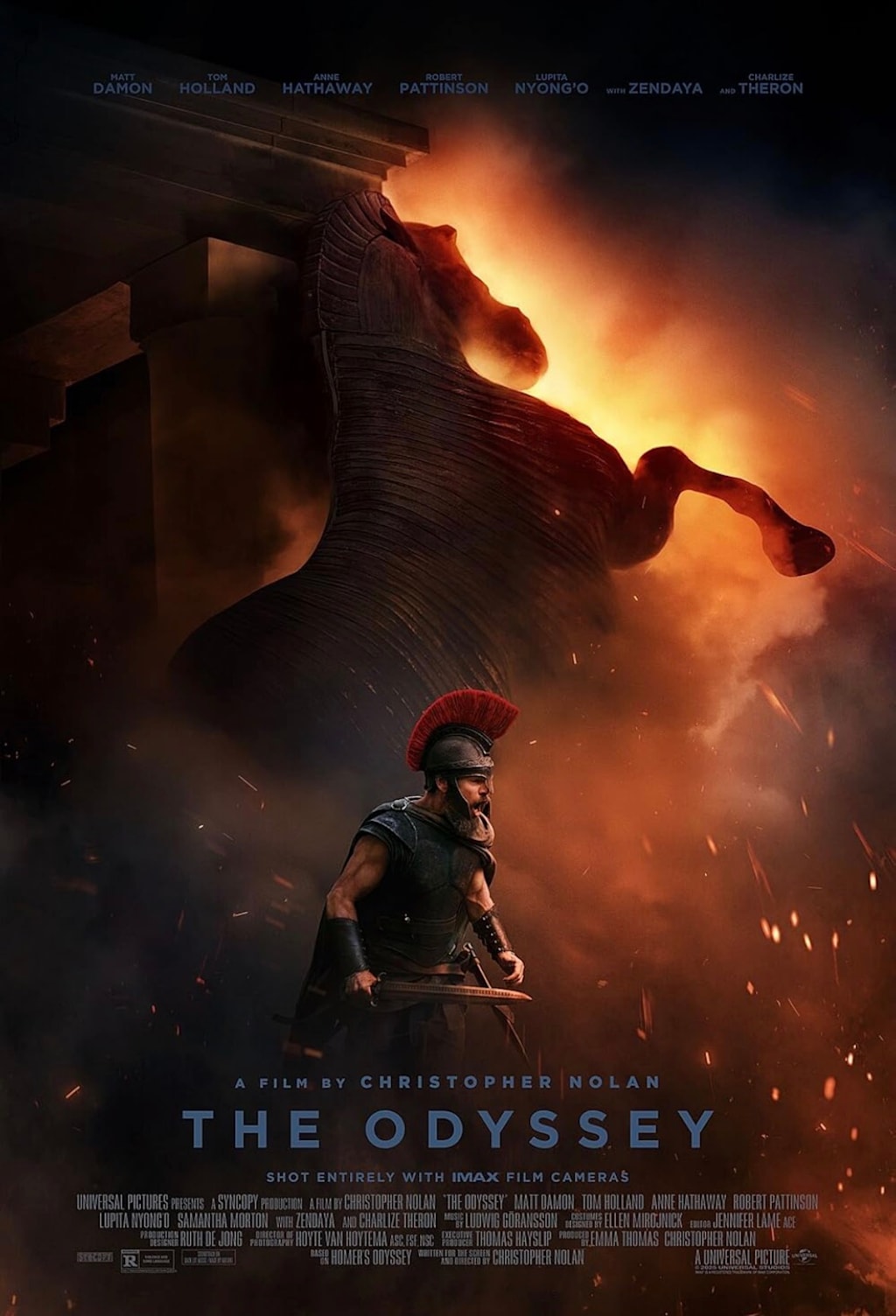
Full disclosure: I came into Christopher Nolan’s The Odyssey with sky-high expectations.
After all, we are talking about The Odyssey — a cornerstone of the Western canon that has been translated, reimagined, and dissected. Set to music long before anyone had ever heard of Margaret Atwood or Claire North. Having read and enjoyed more than a few different adaptations, including (but not limited to) Emily Wilson’s landmark translation, Margaret Atwood’s The Penelopiad, Claire North’s Songs of Penelope Trilogy, and EPIC: The Musical, I was prepared to like this one a lot.
I think I enjoyed it, too – but I did not fall in love with it the way I hoped to – and the way I think it could have.
To be fair, the adaptation is brimming with cleverness and skill, and I really enjoyed seeing Nolan’s take on this towering classic. Giving the story a battle-hardened edge that suggests a soldier returning from the front lines only to realize he’s not prepared to face the dangers waiting for him back home is simply inspired.
That said, the production misses out on a few central themes that give The Odyssey its lasting power and accessibility. It’s a film I could recommend without hesitation – but one I couldn’t help but feel disappointed by, as I kept wondering what changes would have elevated it to something truly special.
Odysseus Isn’t Just Trying to Get Home
What stood out to me most in Nolan’s The Odyssey was the intense focus on the inner world of Odysseus.
As played by Matt Damon, he is a man who has been changed by the Trojan War. He is not only physically wounded. His mind seems to be in a perpetual state of anguish, as he is tormented by memories of his men, who have died because of him.
Nolan does a masterful job of juxtaposing the earlier, carefree days of Odysseus, who left Ithaca with a spirit full of hopes and dreams. Soon turned into a bloodthirsty killer.
By using the device of non-linear storytelling, he is able to highlight the subtle differences between the Odysseus at the beginning of the story and the one returning home.
The earlier leader is a clever and resourceful general who has managed to get himself into the most dangerous of places by outwitting his opponents. But the experience of constant fighting has changed him.
He is no longer the same man who set sail from Ithaca. While he still possesses his tactical genius, his mind is now haunted by the memories of his men who died because of his decisions. And the worst part is that he has to make agonizing choices every single day in order to keep his men alive.
As such, I think that the movie does an incredible job of showcasing the theme of PTSD.
While Odysseus may long to return to Ithaca, he realizes that it is not really the island that is waiting for him. Rather, the lost part of himself, which will most likely stay with him for the rest of his life.
The Monsters Are More Than Monsters
Another aspect of Nolan’s vision that stood out to me was the way that mythical beasts and supernatural trials act as an extension of Odysseus’ trauma.
Consider that the Cyclops represents the mindless savagery of combat, where chivalry, tact, and cleverness have no place.
The Laestrygonians are next. The sheer practicality of the wire and stuntman-fueled spectacle gives the episode a very tangible sensation of danger, a feeling that is often lost in CGI spectacles.
The episode with Circe is also worth consideration, as it is here that Odysseus witnesses the corruption his men experience for the first time — having seen Troy both burned and besieged, seeing combat has turned them into pigs.
The Sirens, similarly, are a powerful symbol of inner grief and sorrow that, in their own way, could be considered a form of trauma.
Lastly, of course, is the encounter with Hades, which serves as a fitting climax to the psychological burden Odysseus has been carrying all the way through the ordeal.
Hades Is Where Odysseus Has to Face the Dead
The decision to present Hades as a psychological battle between Odysseus and the shades of his past is a particularly masterful one.
His conversation with Agamemnon (Benny Safdie) is, in itself, a standout moment in the film.
Agamemnon delivers a frightening warning to Odysseus, telling him that he should not expect “garlands and praise” upon his return, having himself been hacked to death by his wife.
Agamemnon is the first harbinger of doom, a warning of the cost of victory.
The shade’s words serve as a dark reminder that victory in war does not guarantee victory at home. The battlefield is not the end or the beginning, only a moment.
And while the battle may be won, the soldier is not always safe once he or she returns.
The relationship between the two men is potentially fascinating, as it provides a contrast between two very different warriors: one a rigid general and the other a wily trickster, who both see the other as potentially useful but flawed.
A deeper exploration of their relationship, of their complicated history during the Trojan War, would have been fascinating. Instead, we are given only hints, and the viewer is left to wonder what might have been. Such a choice represents one of the film’s greatest disappointments.
Where Was Astyanax?
Anyone familiar with Homeric lore or other adaptations of The Odyssey would certainly be familiar with Astyanax — the infant child of Hector and Andromache, whose death, tossed from the battlements of Troy, is linked to Odysseus in classical tradition.
Omitting this detail came as a surprise to me.
In fact, Astyanax serves as a kind of thematic foil to Telemachus. Odysseus spends twenty years trying to get back to his own child. Yet he must also bear the burden of having caused the death of another father's son during the war.
Had the film insisted that he constantly remember Astyanax, it would have served as a cruel reminder of the man he was. That he would most likely never change.
I can understand why it wouldn't happen in Nolan's piece, but I think it would have added to a sense of Odysseus's burden. Perhaps it would have been better suited to an adaptation of The Iliad — something I wouldn't have minded at all.
Penelope Deserved More Than Anger
Now we come to the part of the film where my heart is breaking.
To put it straight from the beginning, Anne Hathaway did a great job as Penelope, given the tools she had.
My complaint is addressed to the scriptwriters for portraying Penelope as a bitter, angry woman who has been humiliated for twenty years and now is angry at everybody around her, including her son and servants.
While I could accept the first version of events, unfortunately, Homer did not stop there.
I think that in Homer’s time Penelope would not have acted like that.
She is not a simple village girl who went mad with frustration and anger about her beloved husband not returning home.
She is a clever and intelligent politician who manages to rule Ithaca successfully while her husband is away.
Her management and strategy allowed Ithaca to survive the siege of the suitors and the waste of resources without losing the kingdom’s treasures.
I think it would have been much more interesting to see Penelope in the role of a queen who managed to outwit all the suitors and protect her son from their violent assaults.
That is why I was disappointed that they did not follow Margaret Atwood’s Penelopiad or Claire North’s Songs of Penelope because they could have been an interesting variation if they had followed the books’ original concept.
I wanted to see how Penelope managed to run the country and hold audiences with the suitors. Find a way to get rid of them without losing her kingdom and honor.
It would be much more meaningful for the story if Penelope herself told the tale about the twenty years when Odysseus left Ithaca, because that is when the real story begins — not when Odysseus and Penelope meet again.
The Bow Challenge Is Basically Political Theater
That said, I have to admit that I was very impressed with how the film presented the challenge with Penelope's bow.
She announced that she'll marry whoever manages to string Odysseus's hard-to-string bow and shoot an arrow through twelve axe heads.
While it seems that she's just giving up and moving on with her life by choosing a new husband, I saw it as something else.
I think that it was a brilliantly thought-out ploy to gain time by making a public spectacle.
By setting the conditions for the competition, Penelope basically has absolute confidence in the fact that none of the suitors are even close to being able to perform such a feat as Odysseus did with his own bow.
It gives her the time that she needs, and when Odysseus picks up the bow, the entire room knows that their arrogant behavior is about to be punished.
The Suitors’ Fate Is Both Satisfying and Uncomfortable
The climax of the film is distinctly Homeric: starting with Odysseus’s clever play with the bow and turning into an all-out bloodbath. Seeing the suitors being killed was satisfying, but Nolan made it horrifying.
They are not sympathetic figures to begin with — tricked poor Telemachus, threatened his life, wasted Ithaca’s wealth, and tried to abuse Penelope.
It was a jarring note to see the suitors being killed because, in spite of all their lechery and trespassing, Odysseus killed them in his own home. It shows that he is still a soldier at heart, and the war never left him, not even when he got married and had children.
Asking for the axe is one of the best ways to depict that not all is well on the home front. It makes Telemachus confront the reality of his hero father, not as a myth but as a real person who thinks through the consequences of his actions. The scene where Telemachus and Odysseus sneak into the palace before the trial is outstanding because it portrays the two as partners in crime.
It makes the son think of his father not only as a mythical hero but also as a clever strategist. And it gives the audience a different kind of father-son dynamic, one that is not built around the hero complex.
Please Give Me More Gods
From a mythological point of view, it is my major criticism of the movie.
As much as I like the idea of perceived delusions and the way Nolan has dragged Odysseus’s psyche back to his fragmented self, gods are too prominent in Homer’s original epic to be dismissed as “wishes upon a star.”
In fact, they embody the most important concepts for the epic poem, serving as the spokespersons for divine will:
• Athena stands for wisdom,
• Poseidon–for vengeance,
• Hermes — for cleverness,
• Zeus–for fate.
However, Zendaya’s interpretation of Athena is among my favorites in the whole movie. As much as I liked the ambiguity of her potential “false” identity, I would have liked to see more mythic elements incorporated into her appearance. Does Odysseus see an actual goddess before him, or does he continue to delude himself even after seeing Troy’s ashes and Hector’s body? Or perhaps it is not Athena but some other deity testing Odysseus?
I think the former explanation is more likely, but I would have liked to see the goddess’ eyes behind a bronze mask, with an aegis. In a long, ceremonial dress typical of the ancient period the story is set in.
Emily Wilson’s Influence Makes the Omissions Even More Interesting
What I liked most about Nolan’s adaptation of The Odyssey was the focus on Emily Wilson’s translation. Her first line — “Tell me about a complicated man” — is a motif for the entire reading, and the main character is indeed presented as a multi-faceted one.
He is brave and clever, although a bit arrogant and boastful, sly and cunning, vengeful and single-minded. The director did a fabulous job of bringing all these aspects of Odysseus’ character to the screen.
However, I think that the other side of the coin, which was emphasized in Wilson’s translation, was not expressed as strongly. She insisted on reading The Odyssey as a political novel, which required seeing Penelope as a clever politician who skillfully navigates the complicated relationships between suitors.
Wilson wanted to highlight the importance of Athena’s interventions and the relevance of slavery by showing the harsh reality of the enslaved women of Ithaca.
This was the aspect that I did not feel in the movie, which is a pity. While the director did an incredible job of showcasing the multi-layered nature of the hero, he could have done more to represent the complicated women and the richness of the mythological world.
Helen Gets a Much Better Deal Than She Usually Does
One subtle change I found particularly commendable about this adaptation was the way Helen and Menelaus were portrayed.
Considering how often Helen is depicted as the reason behind the Trojan War in various adaptations, it was surprising to witness Menelaus not being portrayed that way here.
Her wounds and trauma shift her from being the reason behind the conflict to yet another victim of it, like everyone else.
She is not the only one whose life was shattered by Troy, with Helen being far from it.
Penelope has her own twenty-year-long ordeal;
Andromache lost her Hector;
Clytemnestra lost Iphigenia and Agamemnon;
And Helen lost her sister Clytemnestra, who was none other than her own twin.
I only wish that the film had probed deeper into this concept.
I Also Wanted Electra and Orestes
Claire North’s Songs of Penelope trilogy was a remarkable work, and the fact that Electra and Orestes’ story was not continued in Ithaca is a pity.
The addition of these characters would have enriched the story with a different subplot:
Orestes is haunted by the deed — the killing of his mother, Clytemnestra, who herself killed Agamemnon for sacrificing Iphigenia; Electra tries to protect her brother as they both survive the destruction of their home, and Penelope is indeed a haven for people who need protection, like the young and unprotected Astyanax.
This subplot would have shown Penelope’s personality in a different light. It would have made Penelope not only a tired wife and mother but a real leader who can give protection and shelter to people of her kingdom, even those who suffer from the consequences of their parents’ deeds.
Moreover, it would reinforce the theme of the trilogy—the curse of dealing with responsibility for their parents' actions.
Telemachus has to live with the consequences of his father’s actions; Orestes has to live with the revenge taken by Clytemnestra; Agamemnon and Clytemnestra themselves are suffering because of their own decisions. Electra and Astyanax—children of cruel parents — are the ones who have to live with the loss of their home and relatives.
These motifs are important because they help the audience to understand why the ancient legends are still relevant and beloved by people today.
And Can We Talk About The Bronze Age Palaces?
My previous aesthetic critique focused on the production design.
I have to admit that I liked that Christopher Nolan insisted on filming actual locations in Greece and Morocco. Italy, as it gave the much-needed authentic flavor to the overall look of the film, making it less ethereal and more realistic. Yet I could not stop wondering about the overall gray coloration of the palaces.
The Late Bronze Age was definitely not the period when ancient Aegean Greece started turning into an arid landscape of bare stone buildings.
Those constructions used to be covered with vibrant colors, enhanced with plaster details, intricate frescoes, and mosaics, framed by geometric patterns and natural motifs.
I could see the beautiful palette of the Ithaca palace, and I would like to see distinct patterns and colors for the Spartan and Trojan palaces. Such attention to detail would give the film more credibility and would make it more pleasant to watch.
So, Was The Odyssey Worth The Journey?
Without a doubt, the experience of watching Christopher Nolan’s The Odyssey was enjoyable.
The film’s strong points were a subtle psychological portrait of Odysseus, who, in the film’s strongest moments, understands that the true success of his journey is not the return home but rather his ability to cope with all he has been through.
This emotional depth was enhanced by the nonlinear approach that juxtaposes the hero’s past self with the one returning home to Ithaca, which is complemented by Matt Damon’s emotional talent and an equally impressive performance as Telemachus, as well as the thematic and symbolic weight of encounters with the Lotus-Eaters and the voyage to the underworld, and a thrilling, action-packed set-piece during the battle against the Laestrygones that leads to a morally ambiguous climax.
However, despite the film’s many strengths, I left disappointed by the lack of ambition in the film’s framing, wishing to see Penelope portrayed as a shrewd political realist, with more intrigue between Agamemnon and Odysseus. This also includes the inclusion of other significant figures from Greek mythology such as Astyanax, Andromache, Electra, and Orestes, as well as a larger role for the gods, an exploration of the plight of enslaved women in Ithaca, and an opportunity to witness Bronze Age frescoes.
Conceivably asking for too much. Adapting Homer’s work is not easy since it has been part of popular culture for centuries, meaning there is tremendous pressure on a modern director to innovate while also evoking the spirit of the original epic poetry.
Regardless of potential shortcomings, what I liked about the adaptation was that it made me revisit the original work and engage with a new translation by Emily Wilson, pondering the psychological effects of war and how The Iliad and The Odyssey can be seen as a single work about the homecoming and the legacy of the Trojan War.
Thus, despite my mixed feelings about the adaptation, I find myself giving the film a 7 out of 10 because it was an overall enjoyable experience while making me think about the existing translations and the need for a similarly visceral adaptation of the Iliad that would explore the effects of the war rather than its events.
About the Creator
Jenna Deedy
Just a New England Mando passionate about wildlife, nerd stuff & cosplay! 🐾✨🎭 Get 20% off @davidsonsteas (https://www.davidsonstea.com/) with code JENNA20-Based in Nashua, NH.
Instagram: @jennacostadeedy
Enjoyed the story? Support the Creator.
Subscribe for free to receive all their stories in your feed. You could also become a paid subscriber, letting them know you appreciate their work.
Comments
There are no comments for this story
Be the first to respond and start the conversation.