
"The Odyssey" We Never Really Read: How Emily Wilson’s Translation Changed My Understanding of Homer
English translations of "The Odyssey" have been influenced by contemporary societal values for hundreds of years. By highlighting a morally layered Odysseus, a politically savvy Penelope, a calculating Athena, and the unvarnished truth of slavery that previous versions frequently masked, Emily Wilson's landmark 2018 translation encourages a new generation to engage with Homer's work through a modern lens.

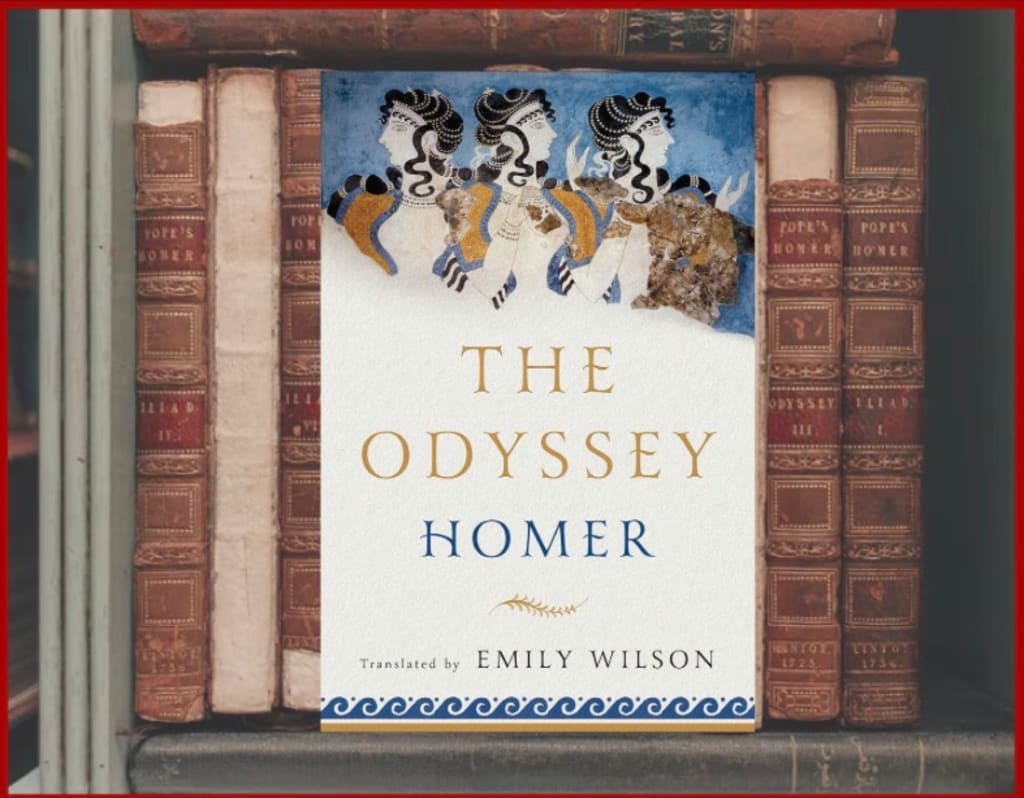
Most of us have never actually read Homer’s The Odyssey.
That may sound like a strange claim. After all, The Odyssey has been translated into English hundreds of times and has remained one of the most influential works of literature for nearly three millennia.
Yet every time we read Homer, we are also reading a translator.
Every translator chooses how to render ancient Greek into modern languages. They decide which words best capture the original, what tone to adopt, how poetic or literal to be, and how to handle ideas that have no exact modern equivalent. Those decisions are never made in a vacuum. Translators bring their own historical moment, literary tastes, and cultural assumptions to the page.
I didn’t fully appreciate that until I borrowed Emily Wilson’s translation of The Odyssey through my local interlibrary loan system.
I expected a modernized version of a familiar classic. Instead, I discovered a poem that felt older, stranger, and far more human than any version I had encountered before.
Suddenly, Odysseus wasn’t simply an untouchable hero. Penelope emerged as one of the story’s greatest political minds. Athena became far more than a convenient divine helper. The enslaved women were no longer reduced to stereotypes that reflected Victorian morality rather than ancient Greece.
The story itself has not changed.
My understanding of it had.
Every Translation Tells Two Stories
A major misunderstanding about translated literature is that it's simply a matter of swapping words between languages.
Ancient Greek does not work that way.
A single Greek word can carry multiple meanings depending on its context. Poetic meter, idioms, wordplay, and cultural references all force translators to make interpretive decisions. Every translation becomes, in part, an argument about what the original text is trying to say.
This is especially true of The Odyssey
For generations, English-speaking readers encountered Homer through translations written during the Victorian era or the early twentieth century. Many of these translations are remarkable literary achievements, but they were also products of their time.
Victorian audiences often preferred elevated, almost biblical language. Heroism was emphasized. Social hierarchies were softened. Women were frequently presented through the lens of nineteenth-century ideals of femininity. References to slavery and sexual coercion were sometimes translated with euphemisms that made ancient realities appear less uncomfortable.
Emily Wilson approaches the poem differently.
Rather than trying to make Homer sound like Shakespeare or the King James Bible, she writes in clear, contemporary English while preserving the poem’s original structure as closely as possible. Her translation maintains a one-to-one correspondence with the Greek text, rendering each Greek line into a single English line while using iambic pentameter to preserve the poem’s rhythmic momentum.
Ironically, by sounding less “ancient”, Wilson often feels closer to Homer.
She removes centuries of linguistic ornamentation, allowing the poem’s emotional directness to shine through.
“Tell Me About a Complicated Man”
Perhaps no line better illustrates Wilson’s philosophy than the opening of the poem.
Instead of it beginning with the familiar request to “Sing to me of the man”, Wilson writes:
Tell me about a complicated man.
The Odyssey, 2018 Translation by Emily Wilson
That single adjective sparked enormous discussion among readers.
Some critics questioned the choice.
Others praised it.
What fascinated me was how perfectly it prepared readers for the story that follows.
Odysseys is brilliant.
He is resourceful.
He survives impossible situations through intelligence rather than brute strength.
But he is also proud, deceptive, impatient, and capable of making catastrophic decisions.
His decision to reveal his identity to the Cyclops Polyphemus after escaping the cave is one of the defining moments of the epic. Driven by pride, Odysseus announces his name, allowing the Cyclops to call upon Poseidon for vengeance. That single act transforms a successful escape into years of suffering for everyone aboard his ship.
Wilson’s translation never asks readers to ignore that contradiction.
Instead, it embraces it.
Odysseus is neither a flawless hero nor an outright villain. He is a deeply human figure whose strengths and weaknesses constantly collide.
That moral complexity is precisely what has allowed readers to debate his character for nearly three thousand years.
Penelope: The Queen Who Saved Ithaca
One of the greatest surprises in Wilson’s translation was Penelope.
Popular culture often reduces her to a single defining trait: faithfulness.
Certainly, she remains loyal to Odysseus.
But reducing her to that quality alone misses the extraordinary role she plays throughout the epic.
For twenty years, Penelope has held Ithaca together. She manages a kingdom under constant political pressure. She protects her son Telemachus from ambitious rivals. She delayed remarriage despite enormous social and political pressure.
She repeatedly outwits over a hundred suitors vying for her hand and control of Odysseus’s home and kingdom.
Her famous weaving trick is only the beginning.
Penelope shows careful judgement, emotional restraint, and notable political intelligence throughout the poem.
Wilson allows those qualities to stand on their own.
She is not simply waiting.
She is governing.
She is surviving.
She is preserving an entire kingdom until its rightful ruler returns. Despite that, she's still unwilling to recognize Odysseus right away.
Her famous test involves their immovable marriage bed, which reveals that she remains just as cautious and perceptive as the husband she has not seen in two decades.
Penelope and Odysseus share many similarities.
Both survive through intelligence. Both understand deception. Both recognize that patience can be more powerful than force.
Wilson’s translation restores that symmetry beautifully.
Athena: The Epic’s Strategic Mastermind
If Odysseus provides the epic’s human intelligence, Athena provides its divine intelligence.
Far too often, adaptations reduce Athena to a magical helper who simply appears whenever Odysseus needs assistance.
The poem presents something much richer.
Athena drives the narrative from beginning to end.
She persuades Zeus to intervene. She mentors Telemachus. She disguises Odysseus. She orchestrates reunions. She repeatedly steers events toward the restoration of justice. Her admiration for Odysseus stems not from his strength but from his mind.
Like Athena herself, Odysseus succeeds because he thinks before he acts. Wilson’s translation highlights this relationship without exaggerating it.
Rather than overshadowing Odysseus, Athena becomes his intellectual counterpart–a reminder that wisdom, planning, and restraint are among the highest virtues celebrated throughout the poem.
The Enslaved Women and the Cost of Euphemism
Perhaps no aspect of Wilson’s translation generated more discussion than her treatment of slavery.
Earlier English translations often referred to enslaved people as “maids”, “servants”, or other gentler terms. Likewise, the women who are sexually involved with the suitors were sometimes portrayed as promiscuous or morally corrupt sex workers.
By choosing to identify these figures as "enslaved women," as the original Greek dictates, Wilson makes a straightforward but profound shift. This terminology alters the reader's perception, as enslaved individuals in Ancient Greece lacked legal autonomy and the power to consent to control their own destinies. Wilson's refusal to use gentler euphemisms forces a confrontation with the true, limited nature of their existence within the story.
Wilson doesn’t invent this reality. She refuses to obscure it.
The result is one of the most emotionally devastating sections of the poem.
After the suitors are killed, the enslaved women are ordered to clean the blood-soaked hall before they themselves are executed.
Reading those scenes through Wilson’s translation forced me to confront questions I had never seriously considered before.
How many previous translations had quietly softened these realities?
How often have translators imposed their own moral assumptions onto Homer’s text?
Beyond “Western Civilization”
Wilson has also encouraged readers to reconsider another assumption that many of us inherited in school: that the classics belong to a single, continuous tradition known as “Western civilization”.
Ancient Greece undoubtedly shaped later European thought.
It’s influenced philosophy, politics, theater, and education for centuries. But the idea of a seamless, unified “Western civilization” stretching from Homer to the modern world is itself a historical construction.
Scholars have long studied how later societies selectively interpreted Greek and Roman texts to support their own political, religious, and cultural values.
That does not diminish Homer.
If anything, it demonstrates how powerful these works remain.
Every generation discovers something different in The Odyssey because every generation asks different questions.
Wilson’s translation belongs to that ongoing conversation.
Rather than pretending translation can ever be completely neutral, she openly acknowledges that every translator makes choices.
Her goal is not to erase history but to encourage readers to think more carefully about how history has shaped previous translations.
Why This Translation Matters
Emily Wilson’s translation did not convince me that earlier translators acted in bad faith.
Many translators of the past crafted exceptional works of literature, introducing a vast audience to Homer. Nor do I see Wilson’s version as the sole valid translation. What it did achieve, however, was something arguably far more important.
It reminded me that translation is interpretation.
Every word reflects a decision.
Every omission has consequences.
Every translator reveals not only the ancient text but also something about the world in which they live.
Wilson’s Odyssey readers to encounter Homer with fresh eyes. It invites us to wrestle with a genuinely complicated hero. It allows Penelope to emerge as one of literature’s great political minds. It restores Athena’s role as the epic’s strategic architect. It refuses to hide the realities of slavery behind comforting euphemisms.
The most significant point is that it illustrates classics are not fixed, timeless monuments.
They are living conversations.
Final Thoughts
When I returned The Odyssey to the library, I realized I hadn’t simply finished another translation.
I had learned to read translations differently.
I now find myself asking questions I never asked before.
Why did this translator choose that word?
What assumptions shaped this interpretation?
What voices have been amplified–and which ones have been softened or overlooked?
Those questions have profoundly impacted my understanding of ancient literature. Emily Wilson’s translation didn’t replace Homer with a modern version. It challenged me to look past centuries of accumulated assumptions and engage more directly with the complexities that have always been there.
Perhaps that’s the greatest achievement any translator can hope for.
Not to give us a “new” Odyssey.
But to help us rediscover the one that has been waiting for us all along.
What Do You Think?
Have you read Emily Wilson’s translation of The Odyssey or another version of Homer’s epic? Did it change the way you viewed Odysseus, Penelope, Athena, or the story itself? I’d love to hear your thoughts in the comments below.
About the Creator
Jenna Deedy
Just a New England Mando passionate about wildlife, nerd stuff & cosplay! 🐾✨🎭 Get 20% off @davidsonsteas (https://www.davidsonstea.com/) with code JENNA20-Based in Nashua, NH.
Instagram: @jennacostadeedy
Enjoyed the story? Support the Creator.
Subscribe for free to receive all their stories in your feed. You could also become a paid subscriber, letting them know you appreciate their work.
Comments
There are no comments for this story
Be the first to respond and start the conversation.