
Why "Clytemnestra" Reframes One of Greek Mythology’s Most Misunderstood Queens
A closer look at Constanza Casati’s tragic queen-and how Jennifer Saint’s "Electra" expands the House of Atreus.

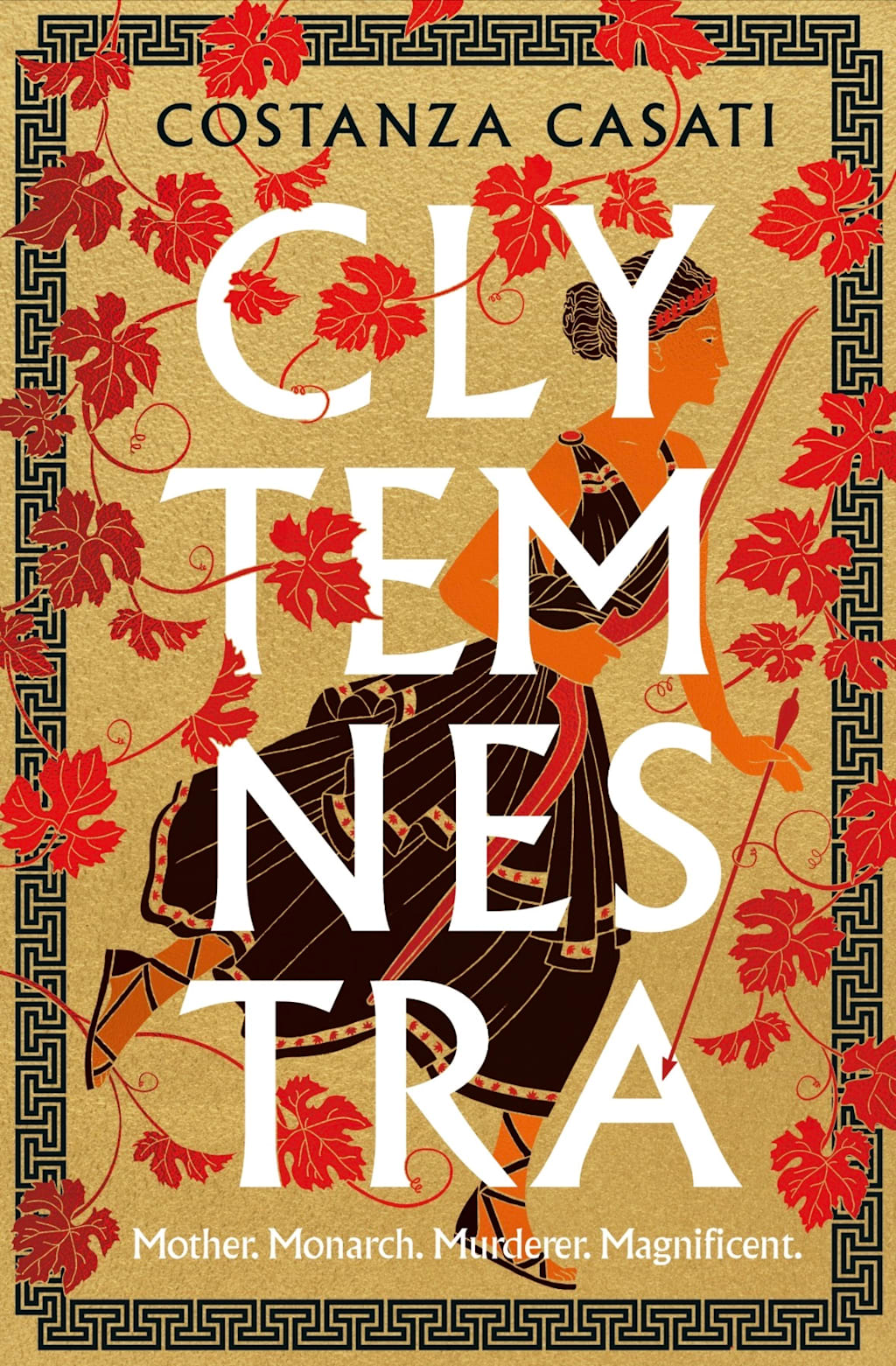
For centuries, Clytemnestra has occupied a familiar place in the Greek mythological canon: the murderous wife who kills Agamemnon upon his return from Troy. In many traditional tellings, she is often reduced to a single act–an archetype of betrayal, ambition, and vengeance.
Constanza Casati’s Clytemnestra refuses that simplification.
Instead, the novel reconstructs her not as a symbol, but as a woman shaped by accumulation: of grief, of political violence, of personal betrayal, and of a lifetime spent navigating systems that constantly deny her agency. What emerges is not an apology for her actions, but a sustained argument for understanding how those actions became possible.
And once you understand the full trajectory of her life, it becomes difficult to see her as anything other than a tragic figure operating within an equally tragic world.
A Life Defined by Loss Before the Story Even Begins
One of the most striking aspects of Casati’s interpretation is how early Clytemnestra’s suffering begins.
Even before establishing Agamemnon as her husband, he is already a violent force in her life. He killed her first husband and infant son, then forcibly took her as his wife. These are not background details–they are foundational trauma. They shape every decision she makes in the future.
What makes this even more devastating in the novel is the institutional response. No one rescues Clytemnestra. They deny her justice. A political arrangement absorbs her, treating her suffering as irrelevant compared to the stability of alliances and royal power.
Even her own family ultimately failed her.
Rather than protecting her or condemning Agamemnon, her parents accepted the marriage as politically necessary. This creates one of the novel’s earliest and most important fractures: Clytemnestra learns that authority figures, whether family or state, will prioritize power over her pain.
That lesson never leaves her.
Iphigenia: The Emotional Breaking Point
If her early life establishes trauma, the sacrifice of her eldest daughter Iphigenia becomes the rupture that defines everything that follows.
In Casati’s telling, Iphigenia is not a distant mythic casualty. She is a beloved daughter whose death destroys whatever fragile equilibrium Clytemnestra had managed to build. Agamemnon’s decision to sacrifice her for favorable winds before sailing to Troy is not just an act of political ruthlessness; it is the final collapse of trust within the family.
From that moment onward, Clytemnestra’s grief is no longer private. It becomes structural.
It changes how she sees her marriage, her household, and her kingdom. It also reshapes her surviving children, Electra and Orestes, who grow up in a home defined by absence, rage, and unresolved grief.
The novel is careful here: no one escapes the consequences. Not the mother. Not the father. Not the children.
Everything is living inside the aftermath of Iphigenia’s death.
Helen and Clytemnestra: Sisterhood Under Mythic Pressure
Another of Casati’s most effective narrative threads is the relationship between Clytemnestra and her sister, Helen.
In many mythological traditions, Helen is reduced to an object of beauty and blame-the woman whose choices sparked a war. Casati resists that flattering by making her relationship with Clytemnestra emotionally central rather than peripheral.
Their bond is not symbolic. It is intimate, complicated, and deeply human.
Men who desire or control her often portray her as someone who is repeatedly acted upon by others–by political arrangements, Helen, and by a world that turns her into a cause rather than a person. Within the novel, she is also someone who carries private trauma that she only shares with Clytemnestra, reinforcing the idea that the sisters understand each other in ways no one else does.
Clytemnestra, meanwhile, sees in Helen both a reflection and a warning. The same world shapes them, but they respond to it differently. Where Helen becomes a symbol projected onto by others, Clytemnestra becomes someone who eventually refuses to be passive within those projections.
The novel’s emotional core lies in their relationship because of its lack of idealization. It is loving, strained, protective, and burdened by everything that surrounds them.
A Ruler, Not a Usurper
One of the more quietly radical elements of Clytemnestra is its portrayal of her governance.
While Agamemnon is away at war, Mycenae does not collapse. It does not spiral into chaos. It remains stable.
Clytemnestra governs.
This detail matters because it directly challenges the assumption that she is inherently “unfit” to rule or motivated purely by “ambition”. In Casati’s version, she is demonstrably competent. She manages political pressures, maintains order, and preserves the kingdom during the prolonged absence of its king.
The distinction here is crucial: people do not depict her as someone who seizes power for its own sake. She is someone who already exercises it out of necessity.
People repeatedly frame Agamemnon’s leadership through conquest and reputation. The novel subtly asks a question that echoes throughout Greek mythology: what does it mean when a society rewards destructive ambition more readily than quiet competence?
Aegisthus: Love After Devastation, Not A Cure For It
Traditional retellings often misread Clytemnestra’s relationship with Aegisthus as the catalyst for Agamemnon’s murder. Casati reframes it.
Their connection begins not as a romance, but as an alliance-two people bound by shared opposition to Agamemnon, and by overlapping experiences of loss and exile. From there, the relationship deepens gradually into friendship, and only later into a romance.
This progression matters.
It prevents the relationship from becoming a narrative shortcut or emotional simplification. Aegisthus does not “fix” Clytemnestra. He does not erase her grief. He does not restore what she has lost.
Tantalus remains dead. Her baby son remains dead. Iphigenia remains dead.
What Aegisthus offers is not healing, but companionship within unhealed pain. The novel is unusually clear on this point: love can coexist with grief, but it does not replace it.
The Murder of Agamemnon: Justice As A Final Rupture
When Agamemnon finally returns from Troy, Casati does not present his death as impulsive or chaotic. It is deliberate, and psychologically consistent with everything that has come before.
Clytemnestra has had years to think, plan, and endure.
Agamemnon returns, expecting restoration. Instead, he walks into a world that has already changed beyond repair.
What makes the sequence so powerful is not simply the act of killing =, but the narrative logic behind it. Casati frames Clytemnestra as someone who sees her actions as justice-an attempt to balance a system that has never acknowledged the violence done to her.
But even here, the novel refuses catharsis.
Justice does not equal healing.
The dead remain dead.
The cycle does not end–it simply turns.
Jennifer Saint’s Electra: What Comes After the Tragedy
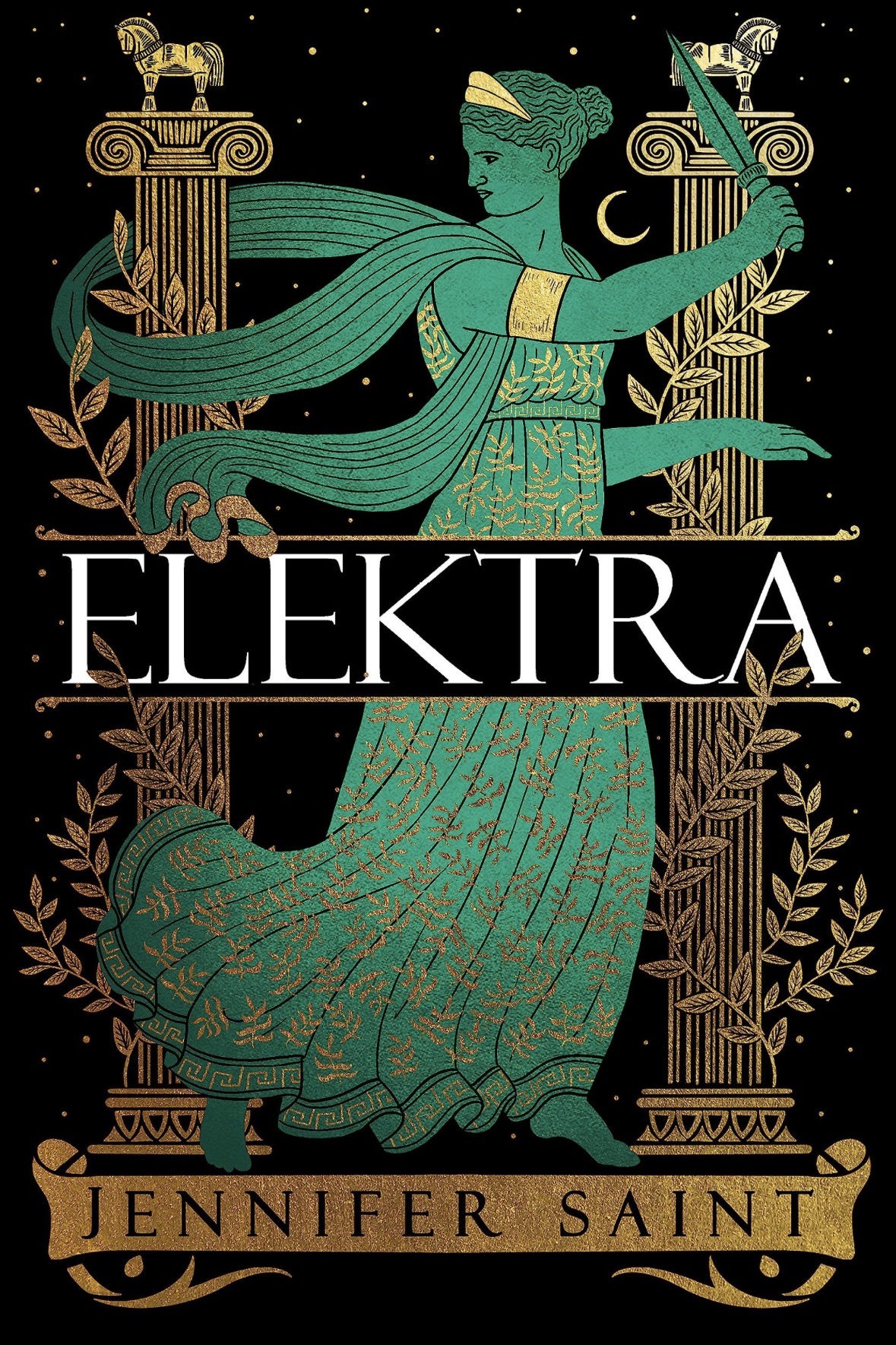
Where Casati’s novel focuses on Clytemnestra’s interior world, Jennifer Saint’s Electra shifts the lens to the next generation–and the psychological wreckage left behind.
In Saint’s take on the murder of Agamemnon and the events that led up to it, Electra’s identity is shaped not only by the death of her older sister Iphigenia but also by the collapse of her family home. Clytemnestra becomes, in Electra’s eyes, both perpetrator and source of unbearable pain.
What is striking about Saint’s portrayal is that Electra does not simply grieve within Mycenae–she rejects it.
The city itself becomes contaminated by memory. The palace is no longer a home but a site of violence, betrayal, and emotional suffocation. Her distance is not limited to her mother or stepfather; it extends to the entire environment that produced them.
Even her relationships lack substance because of absence. Iphigenia’s death is not a past event–it is the emotional center of everything Electra becomes. It shapes her worldview, her loyalties, and her capacity for rage.
In this version of the myth, vengeance is not just political. It is psychological inheritance.
Electra’s grief, which she has never resolved, and her home, which no longer functions as a home, intertwine with her desire for retribution. By the time the cycle of violence completes itself, there is little left of Mycenae that resembles stability at all.
A Family Trapped In Inherited Grief
Taken together, Casati’s Clytemnestra and Saint’s Electra form a kind of dialogue across generations.
One novel shows the making of the rupture. The other shows its aftermath.
Across both, a pattern becomes apparent: no one in the House of Atreus escapes the consequences of what happened to Iphigenia. Her death becomes the axis around which every relationship rotates–parents, siblings, lovers, and descendants alike.
And perhaps that is the most modern aspect of these retellings.
They are no longer stories about heroes and villains in isolation. They are stories about systems of harm, inherited trauma, and how grief can outlive the people who first experienced it.
Clytemnestra is not a monster.
Electra is not a villain.
Helen is not a symbol.
They are all people trying imperfectly and painfully to survive the worlds they were given. And in that survival, something far more interesting than myth.
They become human.
About the Creator
Jenna Deedy
Just a New England Mando passionate about wildlife, nerd stuff & cosplay! 🐾✨🎭 Get 20% off @davidsonsteas (https://www.davidsonstea.com/) with code JENNA20-Based in Nashua, NH.
Instagram: @jennacostadeedy
Enjoyed the story? Support the Creator.
Subscribe for free to receive all their stories in your feed. You could also become a paid subscriber, letting them know you appreciate their work.
Comments
There are no comments for this story
Be the first to respond and start the conversation.