tv review
Reviewing insightful and thought provoking science fiction TV and technology.
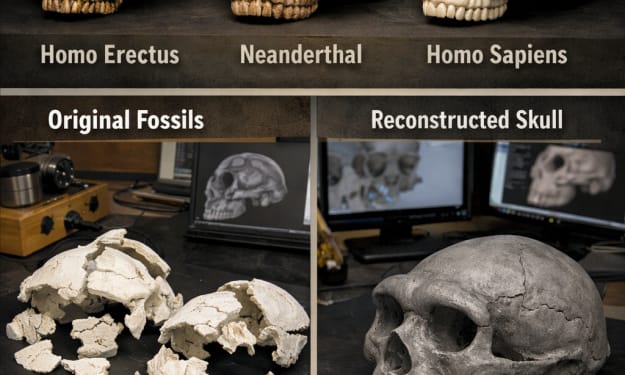
Yuxian Skull discovered in China has challenged this long-standing narrative of Human Evolution
Rethinking Human Evolution: A Discovery That Changes the Timeline For decades, the story of human evolution appeared relatively straightforward. Scientists believed that early advanced humans emerged around one million years ago, belonging to the species Homo erectus. According to this widely accepted model, this species eventually split into two major branches around 600,000 years ago. One branch led to the Neanderthals, while the other gave rise to modern humans, Homo sapiens. This linear and orderly progression formed the foundation of how we understood our origins.
By Ibrahim Shah 4 months ago in Futurism
Cipher News Burst in Pakistan
Cipher News Burst in Pakistan Pakistan has once again entered a period of intense political discussion after the sudden return of the “cipher controversy” in national and international media. The issue, often called the “Cypher Case” or “Cyphergate,” has created strong reactions among political parties, journalists, analysts, and ordinary citizens. The controversy is connected to a diplomatic cable that former Prime Minister Imran Khan claimed contained evidence of foreign pressure and political interference in Pakistan’s internal affairs.
By Wings of Time 5 months ago in Futurism
Authorship vs Refinement
Much of the confusion surrounding artificial intelligence and writing comes from a failure to distinguish between two fundamentally different acts: originating ideas and refining their expression. These acts are often treated as interchangeable, as though whoever touches the final form must also be the source of the thought itself. That assumption does not reflect how writing has ever worked, nor does it reflect how human thinking actually unfolds.
By Peter Thwing - Host of the FST Podcast5 months ago in Futurism
Tools That Empower and Tools That Numb
A tool is never neutral in its effect, even when it may be neutral in its design. What a tool does to a person depends not only on what it enables, but also on what it quietly replaces. A hammer extends the hand. A calculator extends memory. A map extends orientation. Each tool amplifies a capacity, but each one also changes the relationship between effort and outcome.
By Peter Thwing - Host of the FST Podcast5 months ago in Futurism