
The City on the Edge of Forever
Written by Harlan Ellison. Season 1, Episode 28. (1967)


Written by sci-fi guru and perturbable potentate Harlan Ellison, “The City on the Edge of Forever” qualifies as one of the top five episodes of TOS ever produced. It stars Joan Collins as Edith Keeler in a story that underscores the logical paradoxes and pitfalls of time travel.
The Enterprise is flying through a turbulent wave of time shifts. The source is a strange transmission emanating from a distant planet. The console of the ship explodes in fiery sparks, and Sulu is critically injured. McCoy comes to the rescue with an injection of cordrazine, but as the ship is rocked once again, he accidentally injects a massive dose into himself. Arising, McCoy—always the incomparable old sawbones DeForest Kelley—is now as mad as a hatter in a performance that should have rightfully garnered him an Emmy if there was any justice.
Racing from the bridge, he heads to the transporter room, beams down to the unexplored world after delivering some surprising Starfleet chop-sockey to the technician, and vanishes. Kirk and the landing party go down to the planet, where they find the ruins of what look to be ancient Greek columns and a giant stone, vaguely donut-shaped structure that speaks in an ominous, “Voice of God” intonation.
Within the center of this Time Gate, old images flicker—scenes from the past, crusaders on horseback, crowds rioting in the streets, and more. The landing party is informed by this entity that McCoy, having violated the time paradox by traveling backward, has “erased” the history of the crew: there is no longer any Enterprise, no Earth to return to. They are stranded here in this chronometrically absurd outpost in space. Kirk and Spock realize they must go back in time after McCoy and prevent him from altering the past so they can return to the present they know.
We’ve been here before.
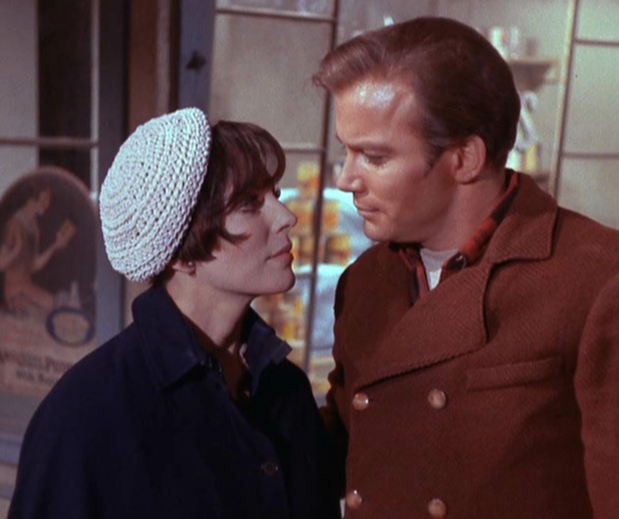
Kirk and Spock have also famously traveled back to Nazi Germany (or some facsimile thereof, in "Patterns of Force") and old-time Prohibition-era Chicago (in"A Piece of the Action" also starring "Alice"'s Vic Tayback, in a great performance). Here, they find themselves in Depression-era New York, disguised as two drifters in a slum mission run by the beautiful, sensitive prophetess Edith Keeler. She predicts a future of utopian universal human peace, space travel, and equality in her stirring sermonettes to the vagrants and winos at her mission.
Time’s Fractured Edge
Keeler, Kirk, and Spock soon realize she is a woman ahead of her time, but perhaps at the wrong time. As the war against Hitler will soon commence, urging Roosevelt toward peace is not the move that will assure an Allied victory over the Nazis. Spock, in one of the most surrealistically absurd aspects of the show, begins to assemble a futuristic (for the era) radio/television “time portal viewer” using scavenged parts. It runs the same images of old newsreel stock footage while looking suspiciously like Tesla coils and emitting bleeps and bloops from an analog synth soundtrack.
Edith Keeler, who has begun to date the strange “Captain” (she can’t help but notice that Spock always refers to Kirk by this title), walks in while Spock is busy at his device. It is quickly explained away as Spock’s curious hobby of assembling “radio parts.” (He requests gold and copper in quantities that are impossible given their current circumstances.) By this time, the raging, emotionally unstable McCoy has returned, delivering an eloquent soliloquy about “barbaric” surgeries wherein people were “cut open and stitched up,” in one of the most incredible performances ever given on TOS. McCoy has made his way to Keeler’s mission, and it is not long before Kirk—taking Edith to the hot new Clark Gable picture—learns from her that her new resident is a fellow named McCoy.
We could give away a spoiler, but we’ll refrain.
H.G. Wells wrote in The Time Machine that time operated as a fourth-dimension perpendicular to the other three, one that could be traversed and moved down into the “future”—a curious notion coming from a man who disbelieved in God and substituted the ever-shifting, evolving panoply of natural selection and technological progress as the decisive factor in the manifestation of tomorrow. The future is always the present, continually evolving based on the decisions, actions, and impending circumstances of The Now.
A future that can be traveled to down an invisible time tunnel is, by definition, a future that has already been determined. For if the future was still laid out as a postulate of the present, with tributaries all flowing into the common stream—the course of that stream altered as we alter our present plans—there would be no ultimate destination to arrive at. The future is continually birthed from the paradox of Now.
Only a Universal Mind, the God that Wells never believed in, could already concretize a future that the Time Traveler—whether Wells’ or Star Trek’s—could travel to. Otherwise, there is no destination to arrive at as determined by the Time Traveler removing him or herself from the eternal Now. The two tributaries of the episode—a world destroyed by Edith Keeler either rescued or saved by her impending, necessary death—branch into a future wherein the characters and their lives are preserved. Otherwise, the Enterprise and Planet Earth face oblivion. ...This is one of the top five episodes of TOS, and one every Star Trek fan will remember and ruminate on long after the credits have rolled.
"Star Trek" Remastered Trailer — 128: "The City on the Edge of Forever"
Read my book: Cult Films and Midnight Movies: From High Art to Low Trash Volume 1 by Tom Baker
About the Creator
Tom Baker
Author of Haunted Indianapolis, Indiana Ghost Folklore, Midwest Maniacs, Midwest UFOs and Beyond, Scary Urban Legends, 50 Famous Fables and Folk Tales, and Notorious Crimes of the Upper Midwest.: http://tombakerbooks.weebly.com
Enjoyed the story? Support the Creator.
Subscribe for free to receive all their stories in your feed. You could also become a paid subscriber, letting them know you appreciate their work.
Comments
There are no comments for this story
Be the first to respond and start the conversation.