scifi tv
The best science fiction television from every decade.
Out of the Gravity Well
Syl's lungs burned, not from oxygen deprivation, but from the sheer, crushing weight of three gravities pressing her spine flat into the custom-molded carbon-fiber couch. This was nothing like the cinematic, roaring liftoffs of ancient science fiction. There was no shaking windows or fiery, explosive cinematic drama; instead, it was a brutal, mechanical physics equation being executed with cold precision. The falcon-like ascent profile of the heavy-lift shuttle was a calculation of raw thrust overcoming the stubborn curvature of Earth's gravity well, and every single metric Newton of that force was being transferred directly through her rib cage.
By Syl De'Vil19 days ago in Futurism
Stitch: Saltwater Silence
Sara Foxgrove remembered the last normal moment of her childhood as something small and quiet. She sat on the back steps of her mother’s cabin 0n Popham Beach, peeling bark off a stick and pretending it was a wand, the kind that could call storms or open secret doors if she pointed it just right. The tide had pulled back far enough that the sandbar stretched toward Fox Island like a pale, exposed spine. Her mother, Mara, wasn’t home. Neither were her father or her brothers. They had left an hour earlier to drive into Bath for groceries and a part her father needed for the woodstove. They’d promised to be back before the tide turned. Sara had waved as the car disappeared down the dirt road, not knowing it was the last time she’d ever see them. The afternoon felt suspended, like the world was holding its breath. Even the gulls seemed quieter, circling lazily above the water as if waiting for something.
By Syl De'Vilabout a month ago in Futurism
Star Trek - ranking every episode
Sixty years ago, on the 8th of September 1966, “The Man Trap,” the first episode of Star Trek , was broadcast on NBC. The stories of Captain James Kirk, Commander Spock, Dr. Leonard “Bones” McCoy and the crew of the USS Enterprise , on a five-year mission of exploration that became a sixty-year legend. The series only ran for three seasons before being cancelled, but was popular enough in the long run to spur a vast fandom and a franchise consisting of eleven spin-off TV series (twelve if you count Short Treks ), thirteen feature films, a TV movie, a kids’ YouTube cartoon series, a podcast radio series, and a metric buttload of books, comics, games, audio dramas and fan productions.
By Daniel Tessier2 months ago in Futurism
The Science Fiction Hiding in Your Ears. Honorable Mention in Already Here Challenge.
Music has always had a way of pulling me out of the moment. These days, all it takes is slipping a pair of earbuds into my ears and pressing a single button. The traffic, nearby conversations, and the rest of the world's soundtrack begin to disappear, leaving the music to fill the space. A pair of earbuds, each smaller than a coffee bean, has transformed something I do almost every day.
By Tim Carmichael3 months ago in Futurism
The Economist 2026 Cover: A Symbolic and Conspiratorial Analysis of the Future. Content Warning.
Every year, the cover of The Economist generates intense debate among political analysts, researchers, and conspiracy theorists alike. Supporters of symbolic interpretation argue that these covers are not merely artistic illustrations but coded messages that hint at major global events expected in the coming year. Whether one sees them as predictions, warnings, or simply clever editorial design, the imagery often reflects the fears, ambitions, and uncertainties shaping the world.
By JONATAN DAVID VEGA4 months ago in Futurism
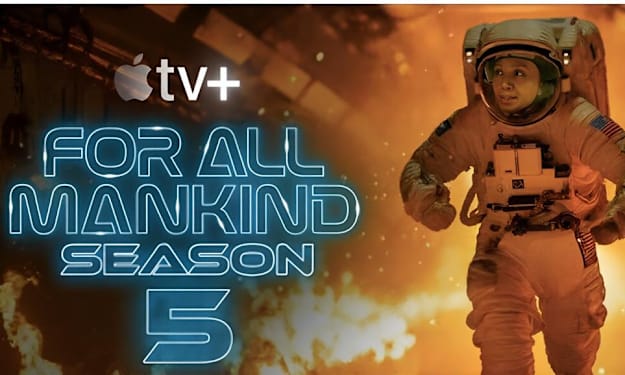
Review of 'For All Mankind' Season 5
For All Mankind came back on Apple TV with the debut first episode of its 5th Season at the end of March As has been usual with the more recent seasons, my favorite part of this season was the alternate history set up which we see at the beginning of this first episode. As a reminder, the alternate history split in this series hinges on the Soviet Union beating us to the Moon back in the late 1960s. Among the profoundly important consequences for the human species is that we have a much more active ensuing space program, as we vie with the Soviets for a predominant position off our planet.
By Paul Levinson5 months ago in Futurism