Love
When the Rain Stayed Too Long
At first, no one thought much of it. Rain in the town of Alder Creek was ordinary—expected, even. It came in soft gray curtains that blurred the mountains and tapped gently on rooftops like a polite visitor. People carried umbrellas without thinking, left boots by their doors, and spoke about the weather the way people always do: casually, as if it had no real power.
By Maavia tahir5 months ago in Fiction
VOID. Content Warning.
What if everything you know exists inside a boundary you cannot see? Not a wall. Not a limit you can touch. But a condition. An invisible frame that defines what is real, what is possible, and what is allowed to be understood.What if?
By Kelly Munala Brookes5 months ago in Fiction
Hide And Seek
Written by (Matiullah) 1. A Game Full of Joy Once there was a group of children who lived in a small village. They were very close friends and loved to play together every evening. Their favorite game was hide and seek. Every day after school, they gathered near a big tree in the center of the village and started their game. They laughed, ran, and enjoyed every moment. For them, this game was not just fun, but also a way to forget all worries. 2. The Rules of the Game One child was chosen as the seeker. He had to close his eyes and count till twenty while others went to hide. After counting, he would shout, “Ready or not, here I come!” Then he would search for all his friends hiding in different places like behind trees, walls, and small houses. 3. A New Boy in the Village One day, a new boy named Ali came to the village. He looked shy and quiet. The children saw him sitting alone near his house. One of the boys went to him and said, “Do you want to play with us?” Ali smiled and said, “Yes, I would love to.” The children welcomed him warmly and included him in their game. 4. First Game Together That day, Ali became the seeker. He closed his eyes and started counting. All the children ran quickly to find good hiding places. Some hid behind trees, some behind walls, and some inside empty huts. Ali finished counting and started searching. He looked everywhere carefully. But he could not find anyone easily. 5. A Strange Silence After some time, Ali found two children, but the rest were still hiding. Suddenly, he noticed that everything became very quiet. There was no sound of laughter or movement. He started feeling a little worried. He called out, “Where are you all?” But no one replied. 6. Searching with Fear Ali continued searching. He went behind houses, near the tree, and even checked the small garden. After some time, he found all the children sitting quietly together behind a big wall. Ali asked, “Why are you all hiding here together?” One boy replied, “We were just playing and staying silent to make the game more difficult.” Ali smiled but still felt something strange. 7. A Lesson Hidden in the Game The next day, they played again. This time, another boy became the seeker. Ali went to hide behind a small hut. While hiding, he saw an old man walking slowly on the road. The old man looked tired and weak. He sat down near the tree. Ali watched him quietly. 8. Kindness Over Game Ali forgot about the game for a moment. He came out of his hiding place and went to the old man. He asked, “Are you okay?” The old man replied, “I am tired and thirsty.” Ali quickly ran to his house, brought water, and gave it to him. The old man drank the water and blessed him. 9. Friends Get Angry Meanwhile, the seeker found all the children except Ali. They started looking for him and finally saw him near the old man. One boy said, “Why did you leave the game? You spoiled it!” Ali calmly replied, “Helping someone is more important than winning a game.” 10. Understanding the Truth The children became silent. They realized that Ali was right. Games are for fun, but helping others is a real responsibility. They all went to the old man and asked if he needed anything else. 11. A New Way of Playing From that day, their game changed a little. They still played hide and seek, but now they also helped anyone in need. If they saw someone in trouble, they stopped their game and helped first. Their friendship became stronger, and their hearts became kinder. 12. The Meaning Behind Hide and Seek One day, their teacher asked them, “What do you learn from your games?” Ali answered, “Hide and seek is not just a game. It teaches us that sometimes people are hidden in problems, and we should try to find and help them.” The teacher smiled and said, “That is a beautiful thought.” 13. A Simple Game, A Big Lesson The children understood that life is also like hide and seek. Sometimes happiness hides, sometimes problems hide, and sometimes people hide their pain. We must learn to find truth, help others, and never ignore someone in need. Conclusion Hide and seek is a simple game, but it can teach big lessons. It teaches patience, observation, and most importantly, kindness. A person who only plays for winning learns nothing. But a person who understands others becomes truly wise. Moral: Life is like a game of hide and seek—always look for chances to help others, not just to win.
By Matiullah k5 months ago in Fiction
Seeing Red. Content Warning.
It was over. We had made it through it. The affair. Make no mistake, it hurt. No, hurt was a word too weak to describe what had happened inside me. In my chest, in my gut. It was devastating, it was humiliating. I was totally and completely debilitated by the betrayal. The broken trust was, in its own way, worse than the heart pain. I was mortified it had happened. It was only six months before our wedding. My dress was ordered, only a couple more payments to go. The bridesmaids colors were all picked out, the only groomsman had been measured for his tuxedo, the vest, bow tie and kerchief all in matching shades of ocean blue, my favorite. My fiancé was wearing a straight white tuxedo with flared out tails. It had been ordered too.
By Gypsie-Ami Offenbacher-Ferris5 months ago in Fiction
The Day I Realized I Was the Problem
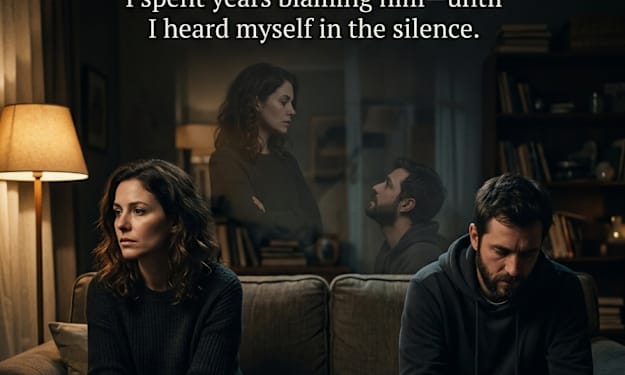
The Day I Realized I Was the Problem I used to think my husband didn’t listen. That was the story I told myself. The one I repeated to friends over tea, to my sister over late-night calls, even to myself in the quiet moments when the house finally settled. He didn’t listen. He didn’t care. He didn’t try. It sounded clean. Simple. Easy to believe. “Men are like that,” my friend Nadia would say, shaking her head. “You have to accept it.” I nodded every time, feeling understood, justified. Because it wasn’t just one thing. It was everything. The way he checked his phone when I was talking. The way he answered with “hmm” instead of real words. The way he forgot things I told him—important things, like the appointment I had been nervous about, or the story I had repeated twice already. It felt like I was invisible in my own home. And the worst part? I kept trying. I tried to talk more. Explain better. Choose the right time. The right tone. The right words. Nothing worked. So eventually, I stopped trying. Silence is not quiet. Not really. It’s loud in ways people don’t notice at first. It shows up in the way you put plates on the table without looking at each other. In the way you sit on opposite sides of the room, both pretending you’re just tired. In the way small questions—“Did you eat?” “Are you coming home early?”—replace real conversations. That’s where we were. Living together, but not really living with each other. And in my mind, it was his fault. The day it changed wasn’t dramatic. There was no shouting. No breaking point. Just a small moment. I was in the kitchen, cutting vegetables, when he walked in. He looked tired. More tired than usual. “I had a long day,” he said. I didn’t respond. Not because I didn’t hear him. I heard every word. I just didn’t feel like answering. He waited for a second, maybe two. Then he said, “They’re making changes at work.” Again, I stayed quiet. I told myself he didn’t deserve my attention. Not after all the times he had ignored me. So I kept cutting, the knife hitting the board a little harder than necessary. “I might lose my position,” he added, his voice lower now. I paused for a fraction of a second. Then continued. He stood there a little longer. I could feel it, even without looking at him. The waiting. The hesitation. And then he left. Just like that. That night, he didn’t say much. He ate quietly. Sat quietly. Slept early. I noticed it, of course. But I didn’t react. Part of me felt satisfied. Now he knows what it feels like. That’s what I told myself. The next morning, I found his message. Not a dramatic one. Not emotional. Just a simple line: “I tried to talk to you yesterday.” That was it. No accusation. No anger. Just… a fact. I read it once. Then again. Something about it felt different. Not because of what it said—but because of what it didn’t. There was no blame in it. No “you never listen.” No “you don’t care.” Just a quiet observation. And for the first time, I didn’t feel defensive. I felt… uncomfortable. I started replaying the moment in my head. Him standing in the kitchen. His voice, slightly uncertain. “I had a long day.” “They’re making changes at work.” “I might lose my position.” I had heard every word. And I had chosen silence. It’s easy to ignore someone when you believe you’re right. It’s harder when you start to question that belief. I sat there, holding my phone, and realized something I hadn’t allowed myself to see before. He had been trying to talk. And I had done exactly what I accused him of doing. The thought didn’t settle immediately. I resisted it. It’s not the same, I told myself. He does it all the time. But the more I thought about it, the weaker that argument became. Because the truth was, I had stopped listening long before that day. Not just with my ears—but with my attention, my patience, my willingness to understand. I had built a story where he was always wrong. And once you believe a story like that, you stop seeing anything that doesn’t fit it. I remembered all the times he had tried, in small ways. Asking how my day was, even if I answered shortly. Sitting next to me, even when I stayed distant. Bringing things home he thought I might like. I had dismissed all of it. Because it wasn’t enough. Or maybe because it wasn’t the way I wanted it. That realization didn’t feel empowering. It felt heavy. Because blaming someone else is easy. Taking responsibility is not. That evening, I did something I hadn’t done in a long time. I waited for him. Not just physically—but mentally. When he walked in, I didn’t stay in the kitchen. I didn’t pretend to be busy. I sat in the living room and looked up. He seemed surprised. “Hi,” he said. “Hi,” I replied. There was a pause. A familiar one. But this time, I didn’t let it stretch. “How was your day?” I asked. Simple words. Nothing special. But I meant them. He hesitated, like he wasn’t sure if this was real. Then he said, “It was… complicated.” I nodded. “Do you want to talk about it?” Another pause. Then he sat down. He didn’t say everything at once. It came slowly. In pieces. Work stress. Uncertainty. Fear he hadn’t voiced before. And for once, I didn’t interrupt. I didn’t prepare my response while he was speaking. I just listened. At some point, I realized something quietly unsettling. This wasn’t new. He had always been this person. I had just stopped seeing him. Later that night, after the conversation had ended and the house was quiet again, I sat alone and thought about everything. Not just that day. But all the days before it. All the moments I had ignored. All the times I had chosen silence over understanding. I had spent so long believing I was reacting to him. That I hadn’t noticed how much I was shaping what we had become. The truth wasn’t comfortable. It didn’t make me feel strong or justified. It made me feel responsible. And maybe that was the point. Because for the first time, I understood something clearly. If I had the power to make things worse… Then maybe, just maybe, I had the power to make them better too.
By Abdul Muhammad 5 months ago in Fiction
The Power of Kindness in a Cruel World
Written by (Matiullah) The Power of Kindness in a Cruel World Once there was a young boy named Ayaan who lived in a small village. He lived with his old mother in a broken house. They were very poor, but they had kind hearts. Even in hard times, they always tried to help others. Ayaan’s mother always told him, “Kindness is the biggest wealth in this world.” Ayaan believed in her words and followed them in his daily life. In the same village, there lived many rich people, but most of them were rude and selfish. They did not care about poor people. They only cared about their own comfort. One day, Ayaan was going to the market to sell some fruits. On the way, he saw an old man sitting near the road. The old man looked very weak and tired. His clothes were dirty, and he seemed hungry. Ayaan stopped and asked, “Uncle, are you okay?” The old man replied in a weak voice, “I have not eaten for two days.” Ayaan looked at his basket of fruits. He knew if he gave the fruits, he would not earn money that day. But his heart did not allow him to ignore the old man. He gave half of his fruits to the old man and said, “Please eat this.” The old man smiled and blessed him, “May you always stay happy.” Ayaan went ahead with the remaining fruits and sold them in the market. He earned very little money that day. When he returned home, his mother asked, “Why did you bring less money today?” Ayaan told her everything. His mother smiled and said, “You did the right thing. Allah will reward you.” The next day, Ayaan again went to the market. On the way, he saw a small injured dog lying near a tree. The dog was crying in pain. People were passing by, but no one stopped to help. Ayaan went near the dog and gently touched it. He said, “Don’t worry, I will help you.” He took the dog to a nearby doctor. The doctor treated the dog and said, “You have a kind heart. Not many people do this.” Ayaan spent the little money he had on the dog’s treatment. He returned home late and empty-handed. His mother again understood and said, “Kindness never goes wasted.” Days passed, and Ayaan continued helping others. Sometimes he helped hungry people, sometimes animals, and sometimes children. But many people in the village laughed at him. They said, “You are a fool. You give everything and get nothing.” Ayaan stayed silent and continued his good deeds. One day, a big incident happened in the village. A rich man’s house caught fire at night. People gathered, but no one was ready to help because the man was rude to everyone. Ayaan saw the fire and ran towards the house. He did not think about danger. He entered the burning house and helped the family come out safely. The rich man and his family were shocked. They never expected help from anyone. The man said, “Why did you save us? I have never been kind to you.” Ayaan replied, “Helping others is my duty. Kindness does not depend on how people treat us.” After this incident, the rich man felt ashamed. He realized his mistakes. Slowly, he started changing his behavior. He began helping poor people and respecting others. The story of Ayaan spread in the whole village. People started understanding the value of kindness. One day, the same old man whom Ayaan had helped came back to the village. But this time, he was not weak. He was dressed in clean clothes and looked strong. He went to Ayaan’s house and said, “Do you remember me?” Ayaan smiled and said, “Yes, you are the man I gave fruits to.” The old man said, “I am not a poor man. I was testing people in different villages. You are the only one who helped me without thinking.” He gave Ayaan a bag full of money and said, “This is a reward for your kindness.” Ayaan was surprised. He said, “I helped you from my heart. I do not need money.” The old man smiled and said, “This is not just money. It is a blessing. Use it for good.” Ayaan accepted it and used the money to help more people. He repaired his house, took care of his mother, and also helped many poor families. Soon, the village changed completely. People became more kind and helpful. They learned that kindness is more powerful than cruelty. Even those who were once selfish started caring for others. Ayaan became an example for everyone. He proved that even in a cruel world, kindness can change hearts. Moral: Kindness is the greatest power that can change even the hardest hearts.
By Matiullah k5 months ago in Fiction
Letters Ever Ours
My love, my beloved moon, In your gardens of light and loss and love, may no harm or ruin or plight find us. May we prosper in all the best ways, and see only with the best of eyes. I write these very words on storied letters in hope that you might return to me. I kneel in prayer, in devotion, in steadfast need for your words to reach me. Please know that quietly, deliberately, without hesitation or patience, my words are a vow to you I pray to keep. Above all others, above all else, these words are the end, the beginning, the truth and the summit. I keep you sacred, and with reverence. Always.
By K.H. Obergfoll5 months ago in Fiction
The Sanctuary of Whispered Names
What to do when you crave more than romance. When you want dark, undying acts of devotion, unequal, unmatched. This prefaces the letter John Thomas wrote his love Mary Wickham in the Spring of 1886. The unspoken vows, promises, prayers.
By K.H. Obergfoll5 months ago in Fiction
The Selfish Giant
Every afternoon, as they were coming from school, the children used to go and play in the Giant's garden. It was a large lovely garden, with soft green grass. Here and there over the grass stood beautiful flowers like stars, and there were twelve peach-trees that in the spring-time broke out into delicate blossoms of pink and pearl, and in the autumn bore rich fruit. The birds sat on the trees and sang so sweetly that the children used to stop their games in order to listen to them. "How happy we are here!" they cried to each other.
By helsing Riddick5 months ago in Fiction