
When the Rain Stayed Too Long
*A quiet girl discovers the rain won’t leave—until she learns what it’s been waiting to hear.*
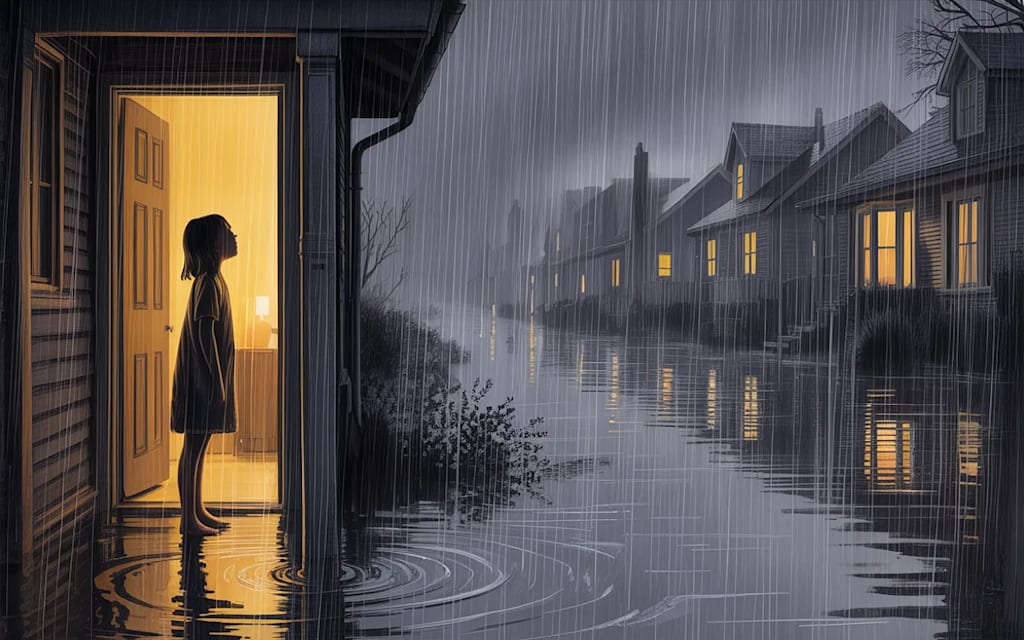
At first, no one thought much of it.
Rain in the town of Alder Creek was ordinary—expected, even. It came in soft gray curtains that blurred the mountains and tapped gently on rooftops like a polite visitor. People carried umbrellas without thinking, left boots by their doors, and spoke about the weather the way people always do: casually, as if it had no real power.
On the first day, children still played outside, stomping in puddles that reflected the pale sky. On the second, the streets glistened and gutters began to hum with rushing water. By the third day, the rain had grown heavier, more insistent, drumming against windows like it wanted to be let in.
By the seventh day, no one was smiling about it anymore.
Elena stood by the living room window, her fingers tracing the same path down the glass again and again, following the slow descent of raindrops as they merged and fell. The world outside had lost its edges. Houses across the street looked like fading memories, their shapes swallowed by mist.
“Still going?” her father asked from behind her.
She didn’t turn. “It hasn’t stopped once.”
He tried to laugh, but it came out thin. “Weather does strange things sometimes.”
But even he didn’t sound convinced.
The rain didn’t just fall—it lingered. It filled the air with a constant, low hush that seeped into everything. Conversations grew quieter. Nights felt longer. Days blurred together until time itself seemed to drip as slowly as the water from the eaves.
On the tenth day, the river overflowed.
At first, it crept politely over its banks, spilling into fields and low roads. But the rain did not ease, and the river grew impatient, swelling and pushing forward until it flooded streets, climbed porches, and pressed itself against doors like an uninvited guest that refused to leave.
Evacuation notices came. Some families packed their things and left, driving through sheets of rain toward higher ground. Others stayed, convinced it would pass—because things like this always passed, didn’t they?
Elena and her father stayed.
“This house has stood longer than both of us,” he said, as he moved furniture away from the walls. “It’ll stand through this too.”
She wanted to believe him. She really did.
But at night, she lay awake listening—not just to the rain, but to the subtle sounds beneath it. The creaking of wood. The shifting of water. The quiet groan of something being tested.
And sometimes, she thought she heard something else.
Something like a voice.
On the fifteenth day, the power went out.
The house fell into a strange, dim quiet, lit only by candles that flickered nervously in the damp air. Without the hum of electricity, the rain sounded louder than ever—endless, relentless, like the world had narrowed down to just that one sound.
Elena wrapped herself in a blanket and sat near the window again, though there was little left to see. The glass had become a moving wall of water, distorting everything beyond it.
“Dad,” she said softly.
He looked up from the radio he’d been trying to fix. “Yeah?”
“Do you ever feel like… it’s not just rain?”
He paused. “What do you mean?”
She hesitated, unsure how to explain something that didn’t quite make sense even to her. “Like it’s… staying on purpose.”
He gave her a long look, then forced a smile. “It’s just weather, Elena.”
But she noticed he didn’t go back to the radio right away.
That night, she dreamed of standing outside in the storm. The rain didn’t fall past her—it stopped just above her skin, hovering like it was watching. Waiting.
When she woke, the sound of the rain felt heavier.
On the twentieth day, the water reached their doorstep.
Her father moved quickly then, his earlier confidence cracking. He stacked sandbags, checked supplies, spoke less and less. The house felt smaller, as if the walls themselves were holding their breath.
“We might have to leave,” he admitted finally.
Elena nodded, but her gaze drifted back to the window.
She couldn’t shake the feeling that the rain was… aware.
Not alive, not exactly. But present. Like it had settled over the town and decided to stay, pressing down on everything with a quiet, patient weight.
That evening, she opened the door.
“Hey!” her father shouted from behind her, but she stepped out before he could stop her.
The rain hit her instantly—cold, heavy, soaking through her clothes in seconds. It blurred her vision, filled her ears, surrounded her completely.
For a moment, she couldn’t breathe.
Then, slowly, she lifted her face toward the sky.
“Why won’t you stop?” she whispered.
The question felt foolish the moment she said it.
But something shifted.
It was subtle. Almost nothing.
The rain didn’t stop—but it softened.
Just for a second.
Elena froze.
Her father pulled her back inside, scolding her, wrapping her in towels, but she barely heard him. Her mind clung to that tiny change, that almost-impossible moment.
The next day, she tried again.
And again, the rain softened.
Not enough for anyone else to notice. Not enough to change anything. But enough for her.
Days passed like that. Each time she stepped outside, each time she spoke—quietly, uncertainly—the rain seemed to listen.
Not obey.
But listen.
“People are leaving,” her father said one morning. “We can’t stay much longer.”
Elena looked at him, really looked at him, at the exhaustion in his face, the worry he tried to hide.
“I think it’s waiting,” she said.
“For what?”
She didn’t have a good answer. Only a feeling.
That night, she stepped outside one last time.
The water was higher now, creeping across the yard. The sky was a solid, endless gray.
She stood there, soaked to the bone, and closed her eyes.
“We’re leaving,” she said, her voice trembling. “Do you hear me? There won’t be anyone left.”
The rain continued.
She swallowed hard. “If you’re trying to hold on to something… it’s gone.”
For a long moment, nothing changed.
Then—
The sound shifted.
It didn’t stop. Not completely.
But it lessened.
The heavy drumming softened into something lighter, something almost like the rain Alder Creek used to know.
Elena opened her eyes.
The world was still wet, still gray—but it was no longer drowning.
Behind her, the door creaked open.
Her father stared at her, then at the sky.
“…It’s slowing,” he said, disbelief threading through his voice.
Elena nodded, though she didn’t fully understand it herself.
By morning, the rain had become a whisper.
By afternoon, it stopped.
Just like that.
As if it had never meant to stay so long at all.
Weeks later, the town began to rebuild. Mud dried. Water receded. People returned.
But something had changed.
Sometimes, when it rained again—soft, ordinary rain—Elena would stand by the window and watch the drops trace their slow paths down the glass.
And just once or twice, she could have sworn…
They paused.
As if remembering her.
About the Creator
Enjoyed the story? Support the Creator.
Subscribe for free to receive all their stories in your feed.
Comments
There are no comments for this story
Be the first to respond and start the conversation.