
Your Roast Duck Costs 20 Yuan in Feed. That Explains Everything.
Secret recipes don't set food prices. Fifty fen per bird does, and the fight over it is worth billions.
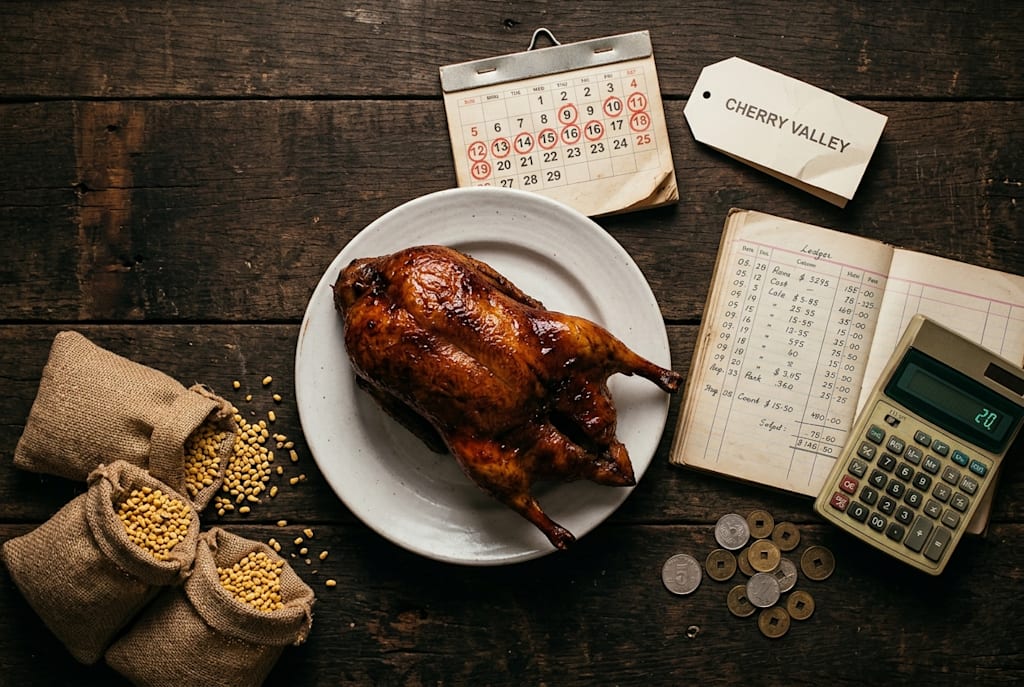
The least valuable thing in food is a secret recipe. The most valuable thing is the detail in execution, which mostly means cost control.
Many people talk about food in terms of "ancestral secret recipes" and "unique craft," as if behind every good dish there is a piece of paper never passed on. Anyone who has worked in industry knows the secret recipe is often not the hard part. The hard part is whether you can make the same thing reliably, push the cost down by fifty fen, and calculate the loss in every link at a scale of billions of birds.
A roast duck is a direct cost ledger.
The cost of a duck depends on days. Fewer days, cheaper. More days, more expensive. No breed name changes that.
Traditional Peking duck uses Beijing ducks, slaughtered at a little over 40 days. Forty days determines the cost structure. From the first day out of the shell to the 40th, how much feed the bird eats each day and how much it eats in total can be calculated, or back-calculated from body weight. Feed is the main cost. A little over 40 days comes to a little over 20 yuan.
Most roast ducks across the country use Cherry Valley ducks. Cherry Valley is an improved Beijing duck, more efficient at feed conversion. At the same 40 days, feed cost is under 20 yuan. One breed costs a little over 20 yuan, the other under 20. The difference is a few tenths of a yuan, and the market chose the second. Most roast duck people eat is Cherry Valley. A Cherry Valley duck at just over 30 days costs just over 10 yuan in feed.
Muscovy is the most expensive duck. An old male can cost more than 400 yuan. Again, days: it has to be raised for over a year. Muscovy is too lean for roasting. High-end Cantonese roast duck uses mule duck, Yidianhei, and similar breeds, names many people have never heard. Those birds are raised about 60 days. Twenty extra days raises feed cost sharply. Ducks increase their feed intake after 32 days. Before 32 days a duck is small and eats little. After that point, every extra day is money.
Deliciousness is sometimes simple: raise the bird a few more days. A few more days means a few more yuan. Those few yuan are not simple. If a new breed could save fifty fen per duck, capital would spend ten billion yuan on it. China produces more than four billion ducks a year. Fifty fen per bird is two billion yuan a year. In a few years, ten billion is paid back. Whoever saves that fifty fen can drive other breeding companies out and set the terms.
Capital will not spend several more yuan for "deliciousness." Not one mao.
One question keeps coming up: why do many people believe chickens and pigs are raised on feed? Is it true?
Raised on feed is true. Modern farming runs on compound feed. Many people then add: "The feed contains growth hormones." That part is wrong. In China and most other countries, growth-promoting hormones in farming are illegal, and they do not pay.
Four things make modern chickens and pigs grow fast. First, breeding. White-feather broilers and Cherry Valley ducks are themselves efficient at feed conversion and short in market cycle. Second, compound feed. Amino acids, vitamins, minerals, energy, and protein are formulated by stage. Chicks, piglets, growing chickens and pigs each have nutritional standards. Third, environment. Temperature, ventilation, density, light, and water: controlled well, animals get sick less and grow faster. Fourth, disease control. Good prevention keeps survival rates high, market readiness uniform, and costs down.
The duck ledger makes the point. Cost is set by breed, days, feed conversion rate, and detail management. A 40-day Cherry Valley duck costs under 20 yuan in feed. A 30-plus-day one costs just over 10. Twenty more days and the cost goes up. Chickens and pigs work the same way. Hormones are expensive, require injection, have unstable effects, carry legal risk, and offer no economic incentive at large scale. Capital counts fifty fen. It will not pay for hormones.
The misunderstanding has four sources. "Fast-growing chicken" reporting equates speed with abnormality, though faster feed conversion has been a breeding goal for decades. Free-range marketing sells high prices by calling feed-raised birds unsafe, which does not follow. Short videos have turned "feed" into a synonym for "hormones," though feed is an animal nutrition product. Legal additives such as vitamins, trace elements, amino acids, and enzymes get lumped in with growth hormones, though they are a different category.
Feed raising happens. Feed is not hormones. Growth-promoting hormones are banned in formal farming and do not pay.
Back to that duck. Consumers see a roast duck. They smell the aroma and taste crisp skin and tender meat. Industry sees a table: breed, days, feed, survival rate, feed-to-meat ratio, labor, energy, loss, channels. Secret recipes help. A secret recipe is not a moat. The moat is whether you can make a stable product at a stable cost.
A few more days may taste better. A few more days means a few more yuan. At four billion birds, a few more yuan is several billion. Most of the time, the market chooses cost.
The least valuable thing in food is a secret recipe. The valuable thing is detail in execution, which is cost control. A duck's cost depends on days. A chicken's cost depends on feed-to-meat ratio. The power to set terms in an industry depends on who can save that fifty fen.
Next time you hear "feed contains hormones," separate two claims. Feed raising happens. Hormone abuse is a different claim. Growing fast is mostly the progress of breed and nutrition. The complicated part is not the secret recipe. It is the breed, feed, management, and capital ledger behind that half yuan.
About the Creator
Jin
Writer of reamstories
https://reamstories.com/jin
Enjoyed the story? Support the Creator.
Subscribe for free to receive all their stories in your feed. You could also become a paid subscriber, letting them know you appreciate their work.
Comments
There are no comments for this story
Be the first to respond and start the conversation.