
Why the Tea Shop’s Cup Tastes Better Than Yours
It’s not the leaves. It’s water, grams, seconds, temperature, vessels, and attention.
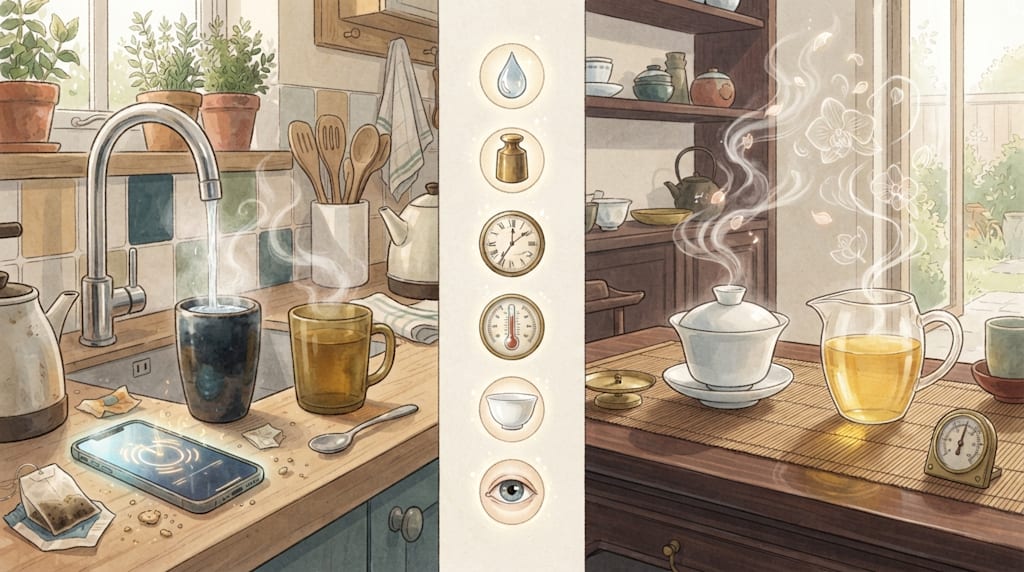
In a tea shop, a Phoenix Dancong smells like orchid on the gaiwan lid. By the third steep, the aftertaste is still there. At home, the same bag gives a short aroma and a thin body.
The tea did not change. The water, the grams, the seconds, the vessels, and your attention did.
Change the water first
Fill a kettle from the tap. Boil it. Brew the same green tea. The aroma sits under a lid. Chlorine and hard water press down the fragrance in aromatic teas.
The shop uses purified or soft water. That water is clean, steady, and quiet. It does not fight the tea.
A five-liter bottle of purified water costs little. Try one comparison today. Brew the same tea with tap water, then with purified water. Put the cups side by side. The tap cup smells flat. The purified cup carries a floral note. Your tongue will settle the argument.
Weigh the tea
At home, a finger pinch gives about 2.5 grams. In the shop, the scale gives 5 grams. For 150 milliliters of water, that is double.
Start with 5 grams per 150 milliliters. For green tea, use 3 to 4 grams. Weigh the first three brews. Learn what 5 grams looks like in your gaiwan. After that, your hand can get close.
Too little tea makes a thin cup. The aroma has nothing to stand on. Too much tea turns bitter, especially raw pu’er and aromatic oolong. Use less and brew more steeps.
Pour fast and do not leave the tea sitting
In the shop, tea goes in and comes out fast. For the first three steeps, pour water in and pour tea out within 10 to 20 seconds. Add 5 to 10 seconds for each steep after that. Do not leave water in the vessel.
At home, the common mistake is a two- or three-minute soak while you scroll on your phone. Bitter and astringent compounds flood the cup and cover the aroma. You taste strength and bitterness, nothing else.
Long steeping ruins tea because the aromatic compounds leave first. The bitter compounds follow. If the steep runs long, the fragrance that came out first gets caught by the bitterness that comes later. Even good tea suffers.
Set a timer on your phone. Pour out the first three steeps after 10 to 20 seconds. From the fourth steep, add 5 to 10 seconds. When the tea goes flat, change the leaves.
Control water temperature and vessels
A 10-degree difference changes the taste.
Green tea: 80 to 85°C.
Black tea: 90 to 95°C.
Light oolong: 95 to 100°C.
Raw pu’er: 100°C.
Ripe pu’er and dark tea: 100°C.
A temperature-controlled kettle with five settings beats guessing. Use a white porcelain gaiwan of 120 to 150 milliliters, a glass fairness cup, and a small cup of about 80 milliliters. Those three tools are enough.
Yixing clay absorbs aroma. It wastes highly aromatic oolong. A thermos is worse. High heat and long sealing make any tea taste cooked.
Rinse the gaiwan with boiling water. Pour when the water boils. Move the tea into the fairness cup, then divide it. Every cup gets the same strength.
Keep the water hot between steeps
A shop brews five steeps with controlled water temperature. At home, one kettle cools as you work. Later steeps drift.
Use a smaller pot. Brew as soon as the water boils. Do not pour too much water at once. Reboil between steeps. If you cannot reboil often, use less tea and pour faster.
Protect your attention
When the room is quiet and your phone is in another room, aroma and aftertaste register more clearly. Noise dulls taste. In a shop, you sit and drink slowly. Your attention stays on the tea. That is part of the taste.
For one serious cup, put the phone away for 15 minutes. Sit down. Smell the gaiwan lid. Take a sip. Wait three seconds. Take another.
A home sequence
Use purified or low-hardness mineral water. Skip tap water.
Weigh 5 grams of tea for 150 milliliters of water. Weigh the first three times.
Rinse the gaiwan with boiling water.
Heat water to the right temperature: green tea 80 to 85°C, oolong and raw pu’er 100°C, black tea 90 to 95°C.
Pour out the first three steeps after 10 to 20 seconds. Do not leave tea sitting in water.
Add 5 to 10 seconds from the fourth steep.
Pour into a fairness cup first, then into cups.
Write one note for each brewing method.
Starting points by tea:
Green tea: 80 to 85°C, first three steeps 10 to 15 seconds.
Black tea: 90 to 95°C, first three steeps 15 to 20 seconds.
Light oolong: 95 to 100°C, first three steeps 20 to 30 seconds.
Raw pu’er: 100°C, first three steeps 10 to 20 seconds.
Ripe pu’er and dark tea: 100°C, first three steeps 20 to 40 seconds.
Two adjustments
If the tea fades at the fourth steep, add 1 gram of leaves and raise the water by 5 degrees. Try again.
If the second steep is already bitter, cut the pour from 20 seconds to 10 seconds. Adjust before you change the tea. Two rounds of adjustment usually bring the cup back.
Four habits to drop
A thermos flattens every tea.
Sugar and milk rescue a drink, not a brewing problem.
Rinsing leaves removes dust and wakes the tea. It does not repair bad processing.
The shop’s tea is not automatically better. Same region, same grade, different variables.
Run one test
Brew the same tea with tap water and with purified water.
Brew it once by feel with a long soak, then once with 5 grams, 150 milliliters, and 10 to 20 seconds for the first three steeps.
Drink both. Write down what changed. After three days, you will have your own numbers.
The scale reads 5.0 grams. The timer reads 15 seconds. The cup is still hot.
About the Creator
Jin
Writer of reamstories
https://reamstories.com/jin
Enjoyed the story? Support the Creator.
Subscribe for free to receive all their stories in your feed. You could also become a paid subscriber, letting them know you appreciate their work.
Comments
There are no comments for this story
Be the first to respond and start the conversation.