
The Water Spinach Test
Why supermarket greens taste like nothing, and what a farmer’s basket taught me about nitrogen, time, and flavor
I
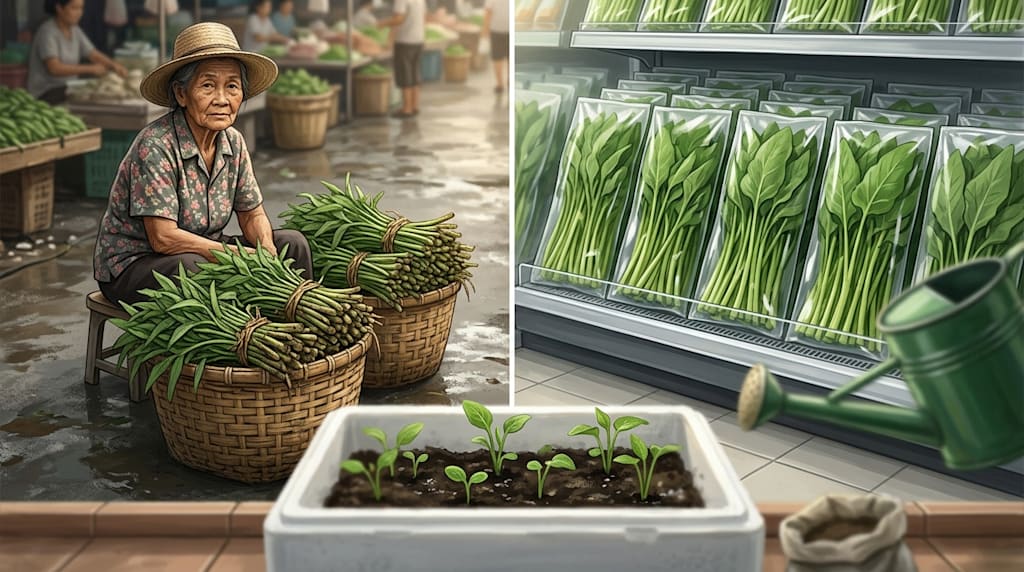
In summer, at the row of stalls against the wall in the vegetable market, an old woman sits at the back. She does not call out. Two bamboo baskets sit in front of her. One holds sweet potato leaves. The other holds water spinach. The spinach still has mud on its roots. The stems are as long as a finger. The leaves are thin as willow leaves. Each bunch is tied with straw. The bunches are not neat, but every stalk is firm. Pinch a stem and it snaps. A little juice shows at the break. Ask how she grows it, and she says: “When I turn the soil, I put in soybean meal fertilizer, and chicken manure too. Only after it is fully composted. Once true leaves come out, I water on compound fertilizer once. After that, just water. In the week before picking, I give it no fertilizer at all.”
She does not say organic. She does not say full-element. She does not say flavor compounds. She says, “No fertilizer at all.”
The supermarket nearby sells another kind of water spinach. The bundles are neat. The stems are long. The leaves are broad. It looks glossy and fresh, and it feels heavy in the hand. Take it home and stir-fry it over high heat with bean paste, garlic, soy sauce, and oyster sauce. It looks bright green on the plate. Pick it up with chopsticks and water seeps from the stems. Chew twice. It tastes soft and slippery, with little vegetable flavor. It is not bad. It just does not taste like much. However much seasoning you add, what you taste is mostly the seasoning.
The price is not the main difference.
II
Whether water spinach tastes good depends first on variety and spacing.
Narrow leaves usually taste better than broad leaves. Short stems usually taste stronger than long stems. When plants are spaced far apart, each one grows flat on the ground. It does not crowd its neighbor. It sits in the sun from spring to autumn. That is when flavor builds. The water spinach once common in Guangdong and Guangxi did not grow as fast as it does now. Its stems were short, a little like today’s willow-leaf or bamboo-thread types, but not as long. That kind worked stir-fried. It also worked served cold. Cold dressing depends on restraint. You cannot cover the vegetable with heavy seasoning. The vegetable has to carry the dish.
Most market spinach is broad-leaf and long-stem. It is grown in water or planted densely. It grows fast and yields high. It is tender, so it suits high heat. Bean paste, garlic, soy sauce, and oyster sauce can cover its weakness. Serve it cold and you ask too much of it. It was not bred to stand on its own flavor.
The second issue is fertilizer.
Leafy greens like nitrogen. Urea is nitrogen fertilizer. It is cheap, convenient, and fast. With urea alone, greens still look glossy green because the soil already holds some secondary and trace elements. But repeated harvests strip calcium, magnesium, sulfur, manganese, zinc, copper, boron, iron, and molybdenum from the soil. The losses add up. Nutrition and taste fall year by year. The full list matters: nitrogen, phosphorus, potassium; calcium, magnesium, sulfur; manganese, zinc, copper, boron, iron, molybdenum. A plant that gets the full list grows well and has a better chance at good flavor.
The part that worries people is the last few days before harvest.
III
Choy sum has the same problem. The most common green in Guangdong and Guangxi is probably choy sum, and it shows the effect of chemical fertilizer clearly. Leafy greens like nitrogen. Urea is cheap and convenient. Growers apply it ten days before picking, sometimes a few days before. Then they harvest three or five days later. The nitrogen has not had time to turn into sugars, proteins, and flavor compounds through photosynthesis. Nitrate builds up inside the plant. Osmotic pressure changes. Flavor changes with it. If the days are overcast, photosynthesis slows and conversion slows too. The problem gets worse.
You put it in your mouth and taste bitterness and astringency. Where is the sweetness you expected? Nitrate is not the only cause. Variety, lack of water, low temperature, and soil salinity can all play a part. But chasing nitrogen right before harvest and picking on gray days is a bad combination.
Nitrate itself has low acute toxicity. The trouble comes when it turns into nitrite. Cooked leafy greens left sitting, or eaten at the next meal, carry more nitrite. Eat them fresh. Keep them cold. Finish them. Do not leave them overnight. Blanching removes some nitrate and nitrite.
When a child refuses a green vegetable, it may not be fussiness. Children have more taste cells and greater sensitivity. Bitterness and astringency hit them harder. Habit, cooking method, and atmosphere also shape what they will eat. You cannot blame the vegetable for everything. But when a child frowns and spits out a green, an adult should take a bite. Maybe that plant did not grow well.
IV
I am not saying every commercial green is harmful. I am not saying every organic green tastes good. Composting, balance, stopping nitrogen before harvest, and freshness matter. Large growers rarely use organic fertilizer. Compound fertilizer with the main macronutrients already counts as good. Many use only urea. That habit pays off slowly, and commercial farms cannot wait.
If you can, grow a little yourself.
Leafy greens are not hard. Turn the soil. Mix in composted soybean meal and chicken manure. That is the base. Chicken manure must be fully composted and from a reliable source. Otherwise heavy metals, salt, and pathogens become problems. When two or three true leaves appear, water on compound fertilizer once. After that, just water. The first two tiny leaves are not true leaves. Do not fertilize then. It slows root growth. For leafy greens harvested over a long season, spray boron once in the middle or late stage. They stay tender longer and hold texture and flavor. Organic base plus one compound feed after true leaves is often enough. Repeated compound feed in the middle makes leaves tough.
Water spinach needs space, sun, and no nitrogen before harvest. Thin-leaf, short-stem types work cold or stir-fried. Broad-leaf, long-stem types need high heat and heavy seasoning. Choy sum should be picked and eaten fresh. Cooler weather often improves it. Growing your own saves little money. It gives you control over when plants feed, when they stop, and when they reach the table. You eat flavor that time has converted, not color pushed out by schedule.
V
I bought a bunch of the old woman’s water spinach once. At home I used no bean paste and no oyster sauce. I smashed two cloves of garlic. I heated the wok, added cold oil, and threw in the garlic until it sizzled. I dumped in the spinach, tossed it twice over high heat, sprinkled salt, and took it out. The stems were crisp. The leaves were soft. A thin layer of water sat at the bottom of the plate, not a pool. After eating, a little sweetness stayed in my mouth. It was not strong, but it did not fade.
Later I went again. The old woman was not there. A middle-aged man stood in her place. He sold the supermarket kind, neat bundles, glossy and fresh. I stood for a moment. Then I left.
On my balcony is a foam box. I turned the soil in spring. Soybean meal fertilizer and composted chicken manure are mixed in. The water spinach has two true leaves. It has no compound fertilizer yet. The watering can points at the roots, not the leaves. When two more true leaves show, I will feed once. After that, just water. In the last week before picking, no fertilizer at all.
Then I will pick a handful, smash two cloves of garlic, and that will be enough.
About the Creator
Jin
Writer of reamstories
https://reamstories.com/jin
Enjoyed the story? Support the Creator.
Subscribe for free to receive all their stories in your feed. You could also become a paid subscriber, letting them know you appreciate their work.
Comments
There are no comments for this story
Be the first to respond and start the conversation.