
The Night a Fist-Sized Kitten Dragged an Eight-Pound Duck Up a Hill
I raised fifty million Cherry Valley ducks. Their bodies are built to grow fast, and to be taken.
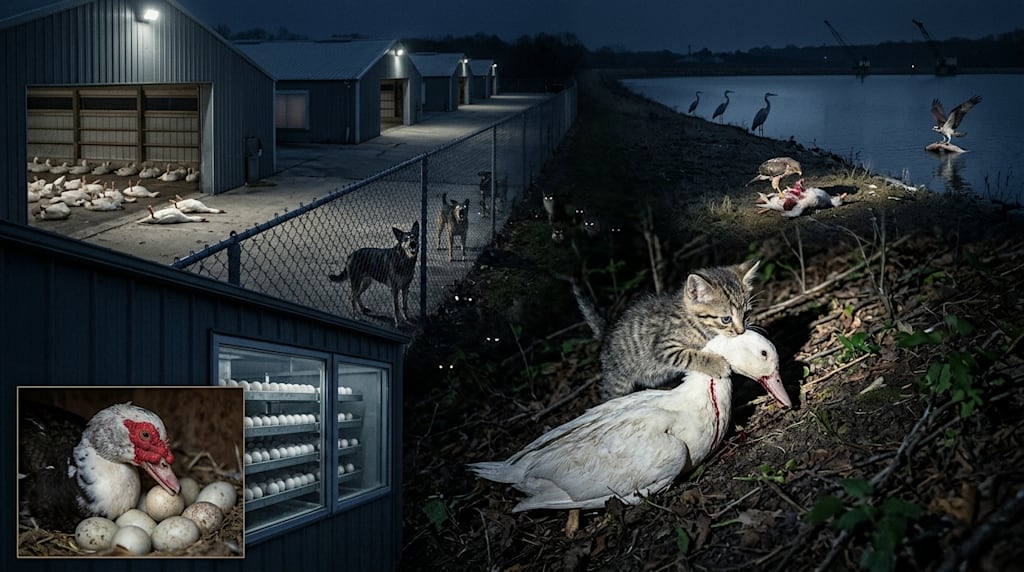
A kitten the size of a fist dragged away an eight-jin Cherry Valley duck.
I flicked the flashlight. The cat backed off. I walked closer. Blood was welling from the duck’s neck, a red line across the white feathers. It could not stand. Its head was lowered, as if it were accepting a fate. It had no fate to accept. Its neck was the rope in a tug-of-war. The creature dozens of times smaller dragged it little by little up the hill, more than twenty meters. I shone the light. The cat let go and backed into the bushes, eyes still shining.
I threw the duck into the woods. It could not stand. It had no commercial value. If I took it back, the kitten would return that night and drag away a healthy one.
I raised this duck for more than twenty years, fifty million of them. They are the duck necks you eat. Their bones are soft. Anyone can bite through them. Most people have never heard the name Cherry Valley, but it accounts for three billion of the four billion ducks China produces each year. In fifty days, at loading, they average more than nine jin. The breed is built for large-scale farming. It does not fight. It does not quarrel. It puts on meat.
It grows too fast. From hatching, over forty-odd days, it gains about two liang a day. At twenty-some or thirty-some days, it gains far more. Every system and every part grows at a different rate. Skeleton, flesh, nerves, organs, feathers. Each grows on its own. Sometimes the duck swells like a balloon. The skin stretches thin. The feathers have not caught up. The nervous system may not have caught up either. It is clumsy and heavy. The skeleton barely keeps pace, but it is not dense enough. One fall and the bones break. A kitten bites it, and it gets a chance to scream. A big feral cat bites it, and it dies at once.
At night, a splash means a cat has bitten one and dragged it away. One taken is a small matter. If no one deals with it, the next day the water’s edge is covered with ducks on their backs, feet in the air. Turn them over and they still cannot walk. If any cat walks past, they rush into the water. Along the way dozens end up on their backs, feet up, unable to rise. After about two hours, if no worker turns them over, they never walk again. They have no commercial value. This happens most often at twenty-some and thirty-some days.
Sometimes no one is tending it. It has no disease. It falls over dead while walking. It grows too fast. Its body has no time to learn how to carry itself.
The farm keeps duck-biting dogs inside wire fencing. When one sees a cat, it wants to chase. It barks desperately inside the wire, and the cat leaves. When a duck-biting dog sees a dog that does not bite ducks go after a cat, it jumps up in frustration. Who knows whether it regrets biting ducks then. You need at least ten. Without that many, at night you shine a powerful flashlight and see many cats’ eyes glowing. Then you set aside cull ducks for the cats in advance. In thirty thousand or fifty thousand Cherry Valleys, twenty or thirty cull ducks appear every day. If the cats do not get them, they are buried.
A small hawk weighing less than a jin will fly down and grab a Cherry Valley weighing several jin. It lifts the small ones. The big ones it eats on the ground. It pulls feathers as it eats, takes a bite, looks up a few times, and flies off when it sees a person. A reservoir has at most two small hawks, sometimes none. Herons and cranes are many, hundreds possible. An osprey weighing less than a jin will catch a big fish weighing several jin. It cannot fly up with it, and it cannot eat it. It floats with its wings spread, tries a few times, and flies away. Some big fish float at the surface with their mouths open, opening and closing to take in air. The osprey dives. Its talons pierce the fish’s skull. The fish dies and sinks. After one, two, or three days, it floats up and is blown back to the water’s edge. There you sometimes see big fish with wounds on the skull or back. Small fish are taken away at once and never blown back.
Muscovy ducks are different. A dog bites one, and it fights back even as it dies. At loading, workers are often scratched badly. Muscovy ducks are hard to farm at scale and hard to manage. They fight among themselves. They fly away. Muscovy ducks can fly. Cherry Valleys do not hatch their own eggs. The eggs go into machines. Muscovy ducks hatch their own. They turn the eggs with their beaks, over and over, carefully. Put your hand underneath and it is warm, hot even. The duck will bite you. Most Muscovy eggs are machine-hatched too. Humans keep trying to change them. Humans do not want wildness. Humans want meat.
Machine-hatched ducks do not know their companions are ducks. They treat companions as food. At twenty-some days, they like to eat their companions’ wings. Ducklings raised by a mother learn from her. They learn how ducks speak to one another. Their feelings are stronger. They seem more like living beings. Their happiness is easier to see.
I threw that eight-jin Cherry Valley into the woods. Its neck was bleeding. It could not stand. The kitten had backed off, but it would return. It knew there were things here with big bodies and little resistance. If the flashlight did not find it, it could drag a duck up the hill little by little. The farm knew this too. That is why there are duck-biting dogs, powerful flashlights, and twenty or thirty culls set aside every day. The system is not surprised by death. It only asks whether death affects loading.
Cherry Valley bones are soft. Anyone can bite through them. Most people have never heard the name, but they have eaten the duck necks. The duck reaches more than nine jin in fifty days, gaining about two liang a day, and far more at twenty-some and thirty-some days. It grows too fast. Its systems fall out of step. The skin is thin. The feathers lag. The nerves lag. The skeleton is not dense enough. It may fall dead while walking, die at once when a cat bites it, or end up on its back after rushing into water. Docile. It does not fight. It does not quarrel. It puts on meat.
It is built for large-scale farming.
And it is built to be taken.
About the Creator
Jin
Writer of reamstories
https://reamstories.com/jin
Enjoyed the story? Support the Creator.
Subscribe for free to receive all their stories in your feed. You could also become a paid subscriber, letting them know you appreciate their work.
Comments
There are no comments for this story
Be the first to respond and start the conversation.