
The Meal You Would Never Find on a Restaurant Menu
A Simple Bowl of Rice, Cold Barley Tea, and the Taste of a Japanese Summer.

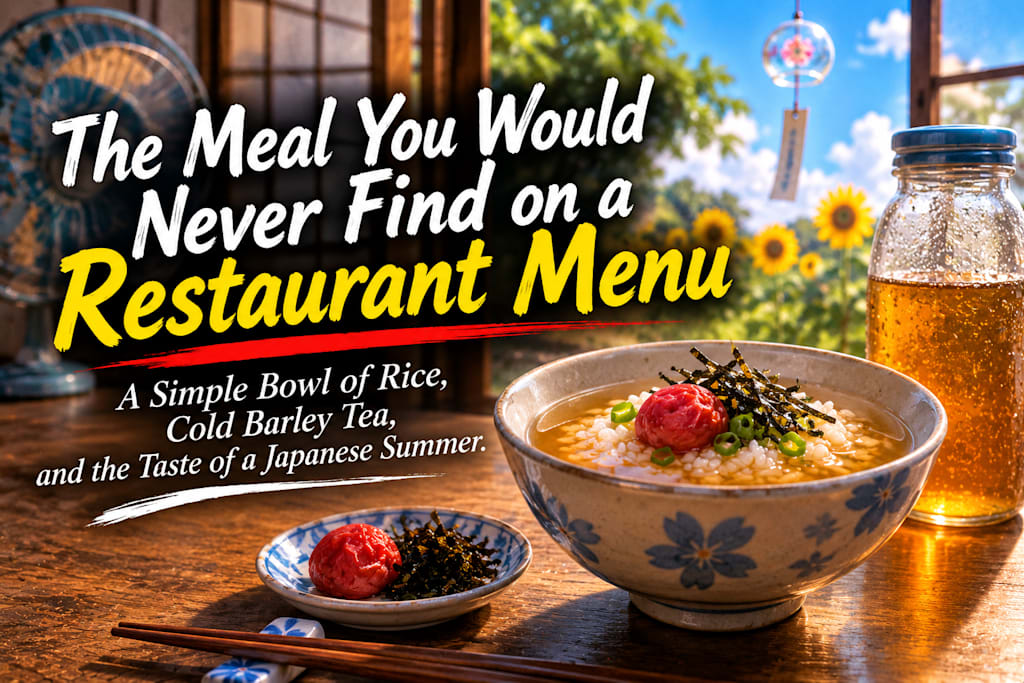
Cold barley tea poured over leftover rice, a little salt, and a memory that never quite fades.
There are meals you remember because they were expensive.
There are meals you remember because they were served in beautiful restaurants, prepared by famous chefs, and presented like works of art.
And then there are meals that nobody would ever think to put on a menu.
For me, one of those meals is a simple bowl of cold rice soaked in barley tea.
In Japan, we call it mugicha chazuke—although there is no strict recipe, and every household seems to have its own version.
It sounds strange if you have never tried it. Cold tea poured over rice? No elaborate broth, no carefully arranged ingredients, no expensive seafood.
Just rice, barley tea, and whatever happens to be left in the refrigerator.
But somehow, it tastes like summer.
A Kitchen in the Heat
I remember the kind of summer evenings when the air inside the house seemed almost as hot as the air outside.
The cicadas were still screaming in the trees. The electric fan turned slowly in the corner, pushing warm air around the room. Somewhere in the distance, a television was playing.
Dinner had already been eaten, but I was hungry again.
There wasn't much left in the kitchen. A little cold rice sat in the rice cooker. There was a bottle of barley tea in the refrigerator, along with some pickled vegetables, a few pieces of salted kelp, and an umeboshi—a Japanese pickled plum.
Nothing looked particularly appetizing.
Nobody was preparing a special meal. There was no recipe to follow.
I put the rice into a bowl, poured cold barley tea over it, and added the leftovers.
That was it.
The first spoonful was surprisingly refreshing.
The barley tea had a roasted, slightly nutty flavor. It was not sweet, and it didn't taste like ordinary iced tea. The rice was soft but still had enough texture. The pickled plum added a sharp, salty sourness, while the kelp brought a deeper taste.
It was simple.
Almost ridiculously simple.
And yet, I kept eating.
The Secret Was in the Leftovers
The interesting thing about this meal was that it never tasted exactly the same twice.
Sometimes there was a little grilled fish left over. Sometimes there were pickles, leftover vegetables, or a piece of dried seaweed.
If there was nothing else, a pinch of salt was enough.
It was not a dish designed by a chef. It was created by circumstance.
In Japanese households, food is often built around small leftovers. A little rice from yesterday, a side dish that nobody finished, a piece of fish saved for later. Instead of throwing everything away, people find ways to turn it into another meal.
This bowl was the perfect example.
There was no correct way to make it. You simply used what you had.
And perhaps that was why it felt so satisfying.
A restaurant can give you a carefully prepared dish, but it cannot easily reproduce the feeling of opening your refrigerator on a hot evening and discovering that you have just enough ingredients to make something wonderful.
Why Barley Tea?
For readers unfamiliar with Japan, barley tea is a common drink in Japanese homes.
It is made by steeping roasted barley in water. Unlike black tea, it contains no caffeine naturally, and many families keep a pitcher of it in the refrigerator during the summer.
Children drink it after playing outside. Adults drink it with meals. It is often served cold, especially during the hottest months.
For many people, its smell is part of the memory of summer.
That roasted aroma is what makes it work surprisingly well with rice.
It doesn't overpower the other ingredients. Instead, it brings everything together in a gentle, earthy way.
It is not fancy cooking.
It is practical cooking.
And sometimes practical cooking is exactly what you need.
A Taste That Doesn't Need a Menu
If I saw this dish written on a restaurant menu, I might hesitate before ordering it.
It would probably be described as something like:
Cold barley tea rice with pickled plum and salted kelp.
That sounds much more sophisticated than the actual meal.
But I doubt it would taste the same.
The original version belongs in a quiet kitchen, with the refrigerator door still open, the fan turning in the background, and the last light of the summer evening coming through the window.
It belongs to a moment when nobody is trying to impress anyone.
There is something comforting about that.
We often talk about food as an experience. We travel to taste local specialties, search for famous restaurants, and photograph beautifully presented dishes.
But some of the strongest food memories come from meals that were never meant to be remembered.
A bowl of rice.
A little cold tea.
A pickled plum.
Nothing special, really.
Except that, years later, the taste can still take you back to a particular evening.
And that is something no restaurant menu can promise.
The Best Meals Are Not Always the Most Beautiful
I don't know whether everyone would enjoy cold barley tea over rice.
Some people might find the combination unusual. Others might wonder why anyone would pour tea over perfectly good rice.
That's fair.
But I think food is about more than flavor. It is also about where you were, who was nearby, the weather outside, and how you felt when you took that first bite.
The most memorable meal isn't necessarily the one that costs the most.
Sometimes it is the one you make because you are hungry, the refrigerator is almost empty, and you don't feel like cooking.
And sometimes, years later, that ordinary bowl becomes a memory you would never trade for a five-star dinner.
Maybe the best food stories are not about what we ordered.
Maybe they are about what we found in the kitchen when there was almost nothing left
About the Creator
Takashi Nagaya
I want everyone to know about Japanese culture, history, food, anime, manga, etc.
Enjoyed the story? Support the Creator.
Subscribe for free to receive all their stories in your feed.
Comments
There are no comments for this story
Be the first to respond and start the conversation.