
The KFC and McDonald's Secret Recipe Is Public. Here's Why You Still Can't Copy It.
Supplier lists are online. Same fries are in the supermarket. What's actually stopping you from opening the third big one? It's not the spices. It's four things you can see but can't move.
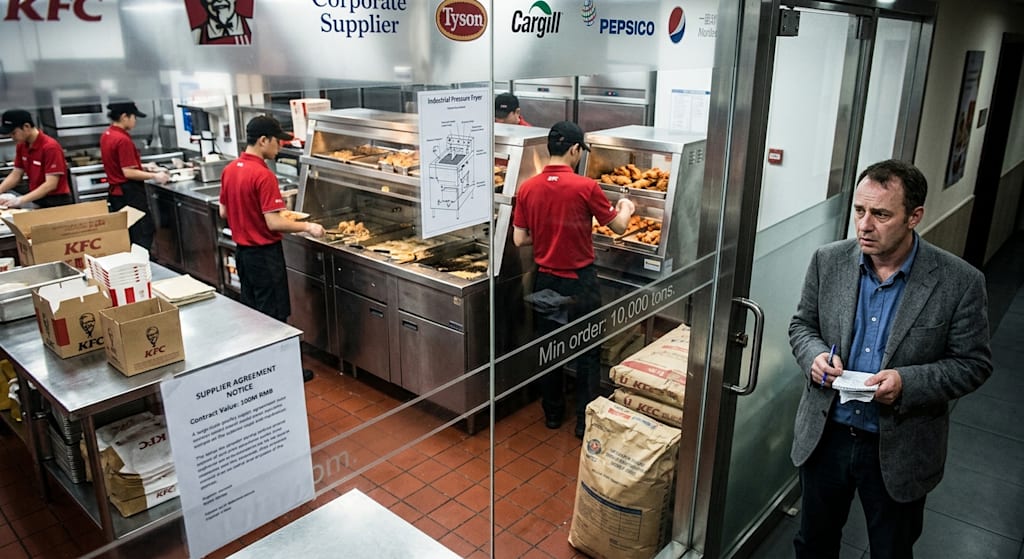
The Real Secret Recipe of KFC and McDonald's: It's in Plain Sight, and You Can't Copy It
KFC's official China website lists its major suppliers. Sunner, Beijing Capital Agribusiness, Nestlé, Coca‑Cola—they're all there.
In the frozen food aisle of any large supermarket, you can buy retail packs of frozen fries and chicken nuggets from CP Group, Tyson, or Sunner. Those come from the same production lines that supply KFC's back kitchens.
If the "secret recipe" existed on a piece of paper, it would have leaked already. Employees sign non‑disclosure agreements. That's standard labour compliance. The contract doesn't stop anyone who actually wanted to steal something.
The real question is different: When all the raw materials are in plain view, why hasn't anyone copied KFC or McDonald's?
The answer lies in four things: supplier priority, customised kitchen equipment, the inventory game behind the menu, and purchase orders in the hundreds of millions of yuan. All four are public information. You can look them up. You cannot replicate them.
I. The Store Manual Is Public. The Supply Chain Is Not.
A KFC store operations manual says: "Evenly coat the chicken pieces with the seasoning mix, place them in the pressure fryer, and set the temperature and time."
Hand that manual to a university‑town fried‑chicken shop owner. They follow it exactly. The result will taste nothing like KFC's. It's not a skill problem. The manual doesn't mention the preconditions.
What grade of salt goes into that seasoning mix? In 1987, when the first KFC opened in Beijing, the salt was imported. Locally available salt at the time was too coarse to blend evenly with the other spices. It took years for domestic suppliers to meet KFC's standard.
What model is that pressure fryer? It's a pressure vessel, subject to safety regulations. That's why most KFC outlets in high‑speed railway stations don't serve Original Recipe chicken. The equipment physically cannot be installed in those buildings. It's not that the staff don't know how to make it.
Anyone can buy a used operations manual online. But the equipment, the ingredient specifications, and the building codes eliminate 99.9% of would‑be copycats.
Supplier priority is the bigger barrier.
Sunner, one of KFC's largest chicken suppliers in southern China, also runs its own fast‑food brand called Meiqile. Meiqile has outlets in many county‑level towns in Fujian. Their fried chicken tastes close to KFC's.
But only close. Sunner's production lines are prioritised for KFC: KFC's national network of thousands of stores gets served first. Remaining capacity goes to Meiqile and other clients. Meiqile can use Sunner's chicken, but it cannot match KFC's price or supply stability. If capacity tightens, the self‑branded channels are the first to be cut.
The supplier list is public. The supplier's capacity allocation table is not. That table is determined by order value and contract duration. The slot labelled "KFC" is off‑limits to outsiders.
II. Read the Menu. It Shows You the Supply Chain.
The menu differences between McDonald's and KFC show their supply‑chain philosophies.
Order a Grilled Chicken Burger at McDonald's. Bun, chicken thigh patty, lettuce, sauce. That same grilled chicken patty appears in the breakfast Grilled Chicken McMuffin, both single and double layer, and as a standalone item with eggs. One raw material feeds multiple products. One equipment setup supports multiple lines.
McDonald's product development follows this principle: if the American supply chain can produce it stably in China, it goes on the menu. That's why McDonald's sells beef, chicken, pork, and fish—ham‑and‑egg McMuffins, pork patty burgers, Filet‑O‑Fish. These are categories the US‑style supply chain already knows.
McDonald's does not sell fresh cucumber strips and spring onion shreds, like those in KFC's Old Beijing Chicken Wrap. Not because they wouldn't taste good. Because McDonald's American‑style cold‑chain system has no category for "short‑shelf‑life, refrigerated, fresh‑cut vegetables." The system has no slot for them.
KFC takes a different path.
KFC China sells soymilk, youtiao (fried dough sticks), rice rolls, pancakes, xiaolongbao (soup dumplings). In recent years it also sold salted‑egg‑yolk pork dumplings and crayfish burgers. McDonald's doesn't sell these. Not because they're inferior. Because McDonald's supply chain has no way to handle "short‑shelf‑life refrigerated dough products" or "seasonal freshwater crustaceans."
KFC's parent company, Yum! Brands, partners with local Chinese suppliers and designs its menu around what those suppliers can provide. The refrigerated short‑shelf‑life supply system in Fujian, Guangdong, and Zhejiang is mature. KFC often tests new products in eastern and southern China first, then rolls them out nationally after the logistics are proven. Sunner, based in Nanping, Fujian, supplies within a 700‑kilometre radius first, where delivery costs are low and supply is stable.
The result: McDonald's menu is globally standardised; KFC's menu is locally sourced. Neither is better. Each is bounded by its supply chain's physical capabilities. Look at their menus side by side. You can read the supply chain behind them. The "recipe" is just the last step.
III. The Tender Beef Wufang Is Not Hunger Marketing. It's Inventory Clearance.
KFC's "Tender Beef Wufang"—a spicy beef and tortilla wrap—has appeared on the menu at distinct points:
2008, first launch
Around 2012, second run
2016, third run
Several sporadic returns since
Now check the parent‑company timeline:
In 2008, Taco Bell—Yum!'s Mexican‑style brand—withdrew from the Chinese market for the first time. The Tender Beef Wufang (beef, tortilla, spicy sauce) directly used the leftover supply‑chain inventory from Taco Bell.
In 2016, Taco Bell re‑entered China (and later withdrew again). The Wufang returned at the same time.
This is supply‑chain inventory transfer.
KFC's new‑product advertisements often quote a specific, non‑round sales volume. Not a vague "limited availability." A precise figure like "1,000,000 portions nationwide." That's because the purchase order was already placed with the supplier for that exact quantity. When it sells out, it's sold out. No restock.
If a product sells well, KFC places additional orders. It may become a regular or annual returning item. If sales are mediocre, it runs its planned course. Surplus inventory is written off. The product disappears. A product leaving KFC's menu doesn't mean it failed. It means its supply‑chain mission is complete.
The advantage: multiple Yum! brands (KFC, Pizza Hut, Taco Bell, East Dawning) share a unified procurement system. When one brand discontinues a product, its inventory or capacity can be transferred to another brand. New‑product development risk is spread across the supply chain.
The cost: some genuinely popular items do vanish abruptly. Customers call it hunger marketing. In reality, the inventory is exhausted. The minimum order quantity for a new production run exceeds the projected remaining demand. The numbers don't work.
Every time the Tender Beef Wufang returns, KFC tweaks the recipe and often partners with an IP collaboration. That tells you there is no fixed supply chain for this product anymore. Each return is a temporary setup—get enough raw materials together, fry a batch, sell out, disband. There is no secret recipe. Only a temporary purchase contract.
IV. One Million Versus One Hundred Million. Whom Does the Supplier Listen To?
A college‑town entrepreneur runs four fried‑chicken shops. Annual turnover: one million yuan. That's a decent local business.
He approaches a chicken supplier for an annual contract. The supplier receives him politely but will not offer long‑term price locking. His one million yuan in purchases amounts to about two hours of production on one slaughterhouse line. The supplier cannot adjust its schedule for him, let alone plant a special potato variety to his specification.
KFC's order for a single SKU, over three months, is one hundred million yuan.
For that, the supplier will build a dedicated production line, plant potatoes of the variety KFC specifies, cut fries to its dimensions, and grow tomatoes to its required Brix level. Contracts run three years. The factory expands capacity accordingly. When the market price of chicken breast rises by twenty cents per catty, KFC's locked‑in contract continues to execute. The independent shop's cost already tracks the spot market.
That is the cost‑structure gap. No secret marinade can close it.
How did Wallace (Huáláishì), the domestic Chinese fried‑chicken chain, get its start? Not by cracking KFC's seasoning formula. By opening hundreds of stores until it qualified for supplier negotiation. When you have three hundred outlets, suppliers start listening. Wallace never tried to mimic KFC's flavour exactly. It chose a different supply‑chain route: cheap enough to build its own volume.
The recipe is a product problem. The supply chain is a survival problem. The former can be hacked. The latter requires store count, purchase contracts, and logistics networks—built inch by inch.
If someone obtains KFC's entire recipe set but only opens one store, their per‑ton chicken purchase price will be 1.3 times KFC's price for a thousand‑ton order. They have already lost on cost before they open.
V. Equipment Is Another Lock
Back to that pressure fryer.
KFC's Original Recipe chicken uses dedicated pressure fryers—not ordinary commercial open‑fryers. These machines are:
Pressure vessels, subject to safety certification
Bulky, requiring floor space and ventilation
Highly customised and not available off‑the‑shelf
That's why most KFC outlets in high‑speed railway stations do not serve Original Recipe chicken. It's not that KFC doesn't want to sell it. Building codes prohibit large pressure vessels in passenger waiting areas.
McDonald's Grilled Chicken Burger follows similar logic. Its texture comes from a specific clamshell grill. McDonald's has refined this grill over many generations, with different output capacities for different store volumes. You cannot replicate that moisture‑locking effect on a standard flat griddle.
None of this equipment is secret. You can see similar products at commercial kitchen equipment expos. But they are expensive, require stringent installation, and need original‑manufacturer parts for maintenance. For a single store, the outlay is prohibitive. KFC and McDonald's amortise these costs across thousands of locations. The per‑store burden is negligible.
Equipment determines how good the product can be. It also determines how much a competitor must spend to match that quality.
VI. Visible, but Unmovable
Back to the original question.
The recipe hasn't been leaked because there is no recipe to leak.
KFC's and McDonald's core assets are all in plain sight:
Supplier lists are on their websites.
Kitchen equipment models appear at industry trade shows.
The ingredients of every menu item can be reverse‑engineered.
Purchase volumes, store counts, and site‑selection strategies are publicly available.
Assembled together, they form a system that is extraordinarily difficult to replicate.
A company that wants to rebuild KFC or McDonald's from scratch does not need a marinade formula. It needs:
A cold‑chain map covering the entire country
A capital budget for thousands of stores' customised equipment
Three‑to‑five‑year locked‑price procurement contracts with upstream suppliers
A supply‑chain coordination system that can transfer discontinued‑brand inventory into new KFC products
These are harder to obtain than a spice list.
You can buy KFC's same‑brand fries in the supermarket. You cannot get the locked‑in price contract that goes with them. You can see KFC's supplier names on its official website. You cannot get their priority production slot.
The recipe doesn't need to be kept secret. The truly guarded information is never written on paper: the unit prices in supplier contracts, the tolerances on equipment drawings, the temperature logs of the logistics network. These are not protected by NDAs. They don't need to be. They never leave the KFC or McDonald's system.
Business moats are overt, not covert. You can see exactly what they are. The threshold is built on ten years of operation, thousands of stores, and purchasing power in the hundreds of billions of yuan. The door is not locked. The threshold is too high.
About the Creator
Jin
Writer of reamstories
https://reamstories.com/jin
Enjoyed the story? Support the Creator.
Subscribe for free to receive all their stories in your feed. You could also become a paid subscriber, letting them know you appreciate their work.
Comments
There are no comments for this story
Be the first to respond and start the conversation.