
The Incredible Shrinking Mars Bar
How a British chocolate favourite became smaller while its price continued to rise
Introduction
For generations, the Mars Bar was promoted as a substantial chocolate snack that provided energy and satisfied hunger. The familiar black wrapper has remained broadly recognisable, but the bar hidden inside it has become considerably smaller.
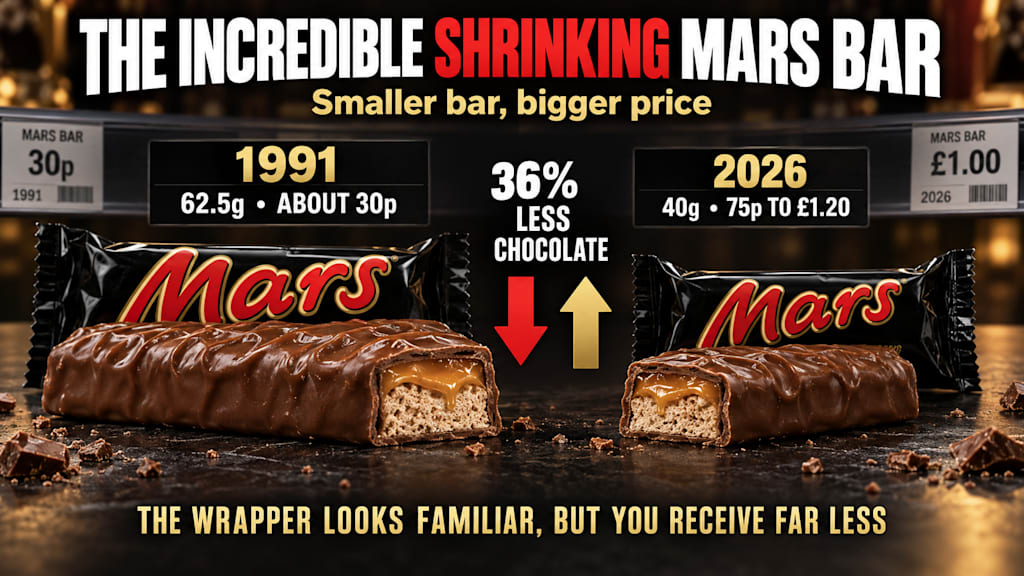
A standard British Mars Bar weighed 62.5 grams in 1991, while the version sold in many British shops during 2026 weighs only 40 grams. At the same time, the typical price has risen from approximately 30 pence to between 75 pence and £1.20, depending upon the retailer.
A Remarkable Discovery
The shrinking Mars Bar attracted renewed attention in August 2026 after a cleaner discovered an unopened bar during a house clearance in Scunthorpe. The wrapper carried a best-before date from 1991 and stated that the bar weighed 62.5 grams.
When the old bar was placed beside a modern 40-gram version, the difference was immediately visible. The 1991 bar was 22.5 grams heavier and appeared considerably longer and more substantial.
The old bar was approximately 56 per cent heavier than the present version. Viewed from the opposite direction, the modern bar contains 36 per cent less product than its 1991 predecessor.
This was not somebody relying upon an uncertain childhood memory. The old wrapper provided physical evidence that consumers once received much more chocolate, caramel and nougat in a standard bar.
How the Bar Became Smaller
The change did not happen through one dramatic reduction. Mars gradually reduced the weight over several years, which made each individual change less noticeable.
The standard bar weighed approximately 62.5 grams during the 1990s. Its weight was reduced to 58 grams in 2008 and then to 51 grams in 2013.
The reduction from 51 grams to 40 grams represented another substantial loss. A customer buying the smaller version received approximately 22 per cent less than someone buying a 51-gram bar.
Different pack formats can contain bars of different sizes, so shoppers may still encounter multipack, fun-size or older 51-gram versions. However, the modern 40-gram single bar demonstrates how far the traditional product has retreated from its earlier size.
The Price Has Travelled in the Other Direction
A Mars Bar reportedly cost about 30 pence during the early 1990s, although prices differed between shops. The same amount would be worth approximately 71 pence in 2026 after allowing for general inflation.
Modern prices range considerably because supermarkets, convenience stores, vending machines, garages and railway outlets apply different mark-ups. A 40-gram bar might cost around 75 pence in one shop but as much as £1.20 elsewhere.
The lowest present price is therefore close to the inflation-adjusted cost of the older bar. However, the customer receives only 40 grams instead of 62.5 grams.
If a 40-gram bar costs 75 pence, the price is approximately 1.88 pence per gram. If it costs £1.20, the price reaches 3 pence per gram.
A 62.5-gram bar sold at those modern rates would cost approximately £1.17 or £1.88, respectively. Comparing only the price printed on the wrapper therefore conceals much of the real increase.
What Shrinkflation Means
Shrinkflation occurs when a manufacturer reduces the amount of product within a package while maintaining or increasing its price. The customer pays a similar amount at the till but receives less for the money.
Manufacturers often prefer reducing a product’s size to imposing a highly visible price increase. Many customers remember the approximate price of a chocolate bar, but relatively few examine its weight every time they buy one.
A small reduction of several grams can be difficult to notice when the wrapper retains similar colours, lettering and proportions. Once several reductions have accumulated, the difference can become striking.
The 1991 Mars Bar exposed this process because thirty-five years of gradual changes could be seen in a single comparison. The modern wrapper still said Mars, but the product had lost more than one-third of its former weight.
Why Manufacturers Reduce Sizes
Chocolate manufacturers face genuine increases in the cost of cocoa, sugar, milk, energy, packaging, transport and wages. Poor cocoa harvests in West Africa have contributed to sharp increases in international cocoa prices, while manufacturers have also experienced wider supply-chain pressures.
Mars has said that product sizes and pack formats are reviewed in response to consumer demand, manufacturing costs and other external factors. The company has also argued that size changes allow it to preserve the expected quality and taste of its products.
Retailers determine the final selling price, which explains why the same bar can cost 75 pence in one location and considerably more elsewhere. Nevertheless, the manufacturer determines how much chocolate is placed inside the wrapper.
Portion control has sometimes been presented as another reason for making confectionery smaller. A 1991 bar contained approximately 270 calories, while the modern 40-gram version contains about 177 calories.
A smaller portion may help someone reduce their calorie intake, but consumers may reasonably question whether health is the primary motive when the price remains unchanged. Portion control benefits the customer only when the smaller quantity and its price are both clearly understood.
The Packaging Effect
Packaging plays an important part in disguising shrinkflation. Manufacturers can slightly alter the wrapper, reshape the bar or change the spacing within a multipack without making the reduction immediately obvious.
A shorter bar might also become slightly wider or thicker, creating the impression that little has changed. The printed weight reveals the truth, but it is usually far less prominent than the brand name.
Consumers are encouraged to compare prices per 100 grams rather than relying upon the price of an individual bar. Supermarket shelf labels often provide this information, although the small printing can make comparison inconvenient.
Multipacks require particular attention because they may contain much smaller bars. A four-pack costing less than four individual bars may appear economical, but the bars inside might weigh fewer than 40 grams each.
More Than Nostalgia
People sometimes remember childhood products as being larger because their hands were smaller. That explanation cannot account for the Mars Bar because surviving wrappers and published weights confirm that the product has genuinely shrunk.
The change also matters beyond a single chocolate bar. Similar reductions have affected biscuits, breakfast cereals, coffee, washing products, ice creams and many other household purchases.
When hundreds of products become slightly smaller, the effect upon household finances can be significant. Official inflation figures attempt to account for changing package sizes, but consumers experience the difference directly when products run out sooner.
The Mars Bar has become an easily understood symbol of the process. Almost everyone recognises the product, and comparing 62.5 grams with 40 grams requires no complicated economic theory.
Has the Recipe Changed?
The fundamental combination of milk chocolate, caramel and nougat remains familiar. Nevertheless, recipes, proportions, manufacturing techniques and nutritional targets can change over long periods.
A smaller bar may not taste exactly as somebody remembers from several decades ago. Memory is unreliable, but thinner chocolate layers, altered ingredient proportions or different production methods can affect texture and sweetness.
The most easily measured change remains the weight. Whatever differences may exist within the recipe, customers can be certain that the standard bar contains substantially less material than it once did.
How Consumers Can Respond
Shoppers can check the weight printed on the wrapper and compare the price per 100 grams. This method reveals whether a promotional multipack genuinely offers better value.
Buying larger packs can reduce the price per gram, but only if the chocolate is actually eaten and not wasted. Supermarket own-brand products may also provide comparable ingredients at a lower cost.
Consumers can refuse to buy when the price seems excessive, and manufacturers pay close attention when sales decline. Brand loyalty is powerful, but it becomes less valuable when customers feel that a familiar product no longer represents fair value.
Conclusion
The Mars Bar has not merely become more expensive because of ordinary inflation. It has also become substantially smaller, falling from 62.5 grams in 1991 to 40 grams in 2026.
A modern customer can therefore pay up to £1.20 for a bar containing 36 per cent less product than the version sold thirty-five years earlier. Rising cocoa and manufacturing costs help explain the change, but they do not make it any less noticeable.
The wrapper remains familiar, and the ingredients still promise chocolate, caramel and nougat. However, the shrinking bar inside provides a memorable example of how consumers can pay more while quietly receiving less.
Editor’s Note
I used ChatGPT to help locate, organise, and examine information relating to the subject. I also used ChatGPT to create the accompanying image.
I wrote the final article in my own words, using the research gathered with ChatGPT's assistance, along with my own interpretation, selection, and presentation of the material. The finished article therefore represents my own work and editorial judgement, with ChatGPT used as a research and image-generation tool.
About the Creator
Alan Spencer
Have been an author and writer for over 20 years. Have been a journalist, editor, proofreader, and a designer and presenter of training courses. Have written over 100 articles, two books, and around 20 training courses.
Enjoyed the story? Support the Creator.
Subscribe for free to receive all their stories in your feed. You could also become a paid subscriber, letting them know you appreciate their work.
Comments
There are no comments for this story
Be the first to respond and start the conversation.