
The “Hormone Chicken” Panic Is Backwards
A pharmacist who raised chickens explains why fast growth isn’t the scandal, and why antibiotics are the thing to watch.
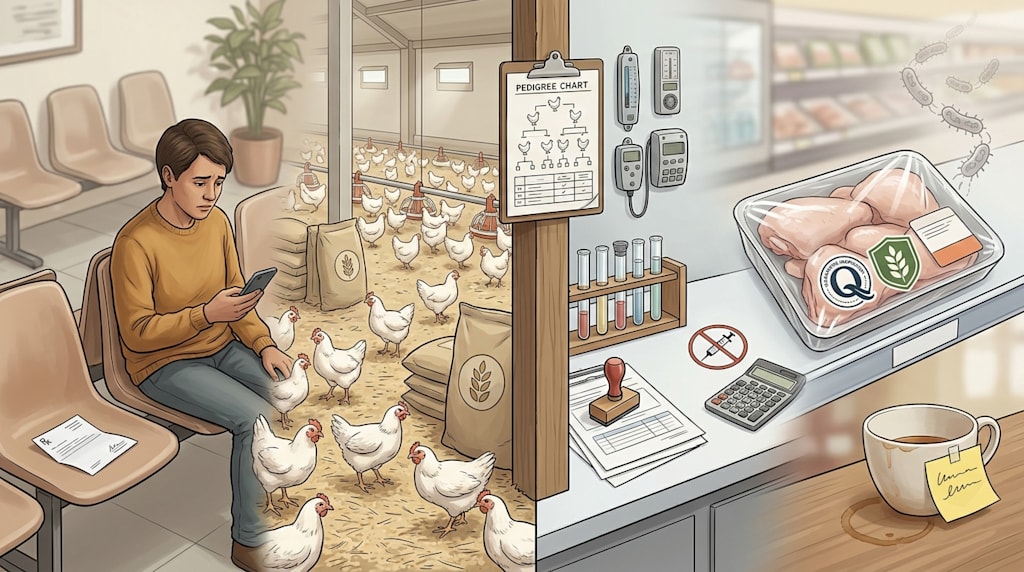
That sentence in the clinic stayed with the parent all the way home.
The child’s snacks, soft drinks, and caffeine were all cut out. The doctor gave detailed instructions, then added one last point: “It’s best to avoid chicken, too. Most of what’s sold now is fast-grown and pumped full of hormones.” On the way home, the parent searched “hormone chicken” on the phone. The posts that came up were more certain than the last: Forty days to market. If that’s not hormones, what is? They can’t test for it, so it can be sold openly.
The logic sounds airtight. One part of it is backwards.
The industry insider graduated from the School of Pharmacy at China Pharmaceutical University. He spent twenty-three years in pharmaceutical manufacturing and three years raising chickens. He first said a fair word for the doctor: he meant well; he understands human pharmacology and metabolism, but not animal physiology or the business side. Then he explained something that reversed the “hormone chicken” causal chain. Fast-growing chickens do not grow fast because they are given hormones. They grow so fast that the intuition “they must be given hormones” seems reasonable.
During the three years he raised chickens, the biggest expenses on the farm were feed and disease prevention, not drugs. White-feathered broilers reach market weight in forty-two days, at over three kilograms, consuming only 1.5 to 1.6 kilograms of feed per kilogram of gain. Decades ago, no one would have dared imagine such a figure. It comes from generations of selection by breeders pushing the trait of meat-growth efficiency to its limit. In 2021, three independently developed breeds, Shengze 901, Guangming No. 2, and Wode 188, passed national approval. That ended the long-term dependence on imported white-feathered broiler breeding stock. A chicken that reaches three kilograms in forty-two days is the result of a program written into its genes being fully realized through feed, temperature, lighting, and disease prevention. There are no syringes in a breeding facility, only measuring instruments and pedigree records.
He had done the math on growth hormone. It is a peptide. Taken orally, it is broken down by stomach acid and proteases into amino acids, so it can only be injected. Its half-life in chickens is only a few tens of minutes, so it would have to be injected daily. Catching chickens one by one for injections carries a labor cost. Even if a fast-growing chicken were injected for only ten days, the added cost would be enough to make the farmer lose money. Economics is more reliable than morality here: if a practice makes producers lose money, it is unlikely to become a widespread industry behavior. Sex hormones and glucocorticoids are orally effective and could in theory be mixed into feed. But a chicken’s endocrine system has a negative feedback mechanism. Continuous input of exogenous hormones suppresses its own secretion, and the immune system is also suppressed by glucocorticoids. Crashing both the endocrine and immune systems just to speed growth would bring losses from higher mortality and culling rates far beyond the uncertain gain in weight. Even tiny doses of thyroid hormone make chickens agitated, raise their heart rate, and make the meat tough. The risk of large-scale heat deaths is enough to deter any rational farmer. As for lean meat powder drugs, that is a red line within a red line. Getting caught means criminal liability, and no one dares touch them.
Regulation is clear too. In the ban list issued by the Ministry of Agriculture and Rural Affairs, sex hormones, anabolic hormones, and beta-adrenergic receptor agonists are listed explicitly. In the 2025 national routine monitoring of agricultural product quality and safety, chicken passed at a rate of 99.8%, among the highest for livestock and poultry products. In an earlier monitoring report, 1,010 chicken samples showed none detected or none exceeding the limit for anabolic hormones and other items. The claim that hormone-tainted food cannot be tested ignores a basic fact. China has national standards for maximum residue limits of veterinary drugs in food, corresponding testing methods, and continuous sampling inspections. Whether a substance is permitted for use and whether it is monitored are two different questions from whether it can be tested. The hormones on the ban list are managed by prohibition rather than by residue limits because they can be tested and traced.
At this point, the industry insider paused. He mentioned that when he was raising chickens, what he feared most was not hormone inspections but antibiotics. The thing to watch is more complex and less visible than hormones. Antibiotics are used in farming to treat and prevent disease and were historically also used as growth promoters. The consequence of irregular use is not an acute, visible hormone side effect. It is a hidden, slow evolution of antimicrobial resistance. Resistant bacteria or resistance genes may spread through the food chain and the environment, narrowing the options for treating human infectious diseases. This problem is hard to tackle because it is not dramatic or conspicuous.
Difficult does not mean unsolvable. Sweden banned antibiotics as growth promoters in feed as early as 1986. The early years of the ban brought pain. Post-weaning mortality in piglets rose for a time, necrotic enteritis in broilers increased somewhat, and therapeutic antibiotic use rebounded in the first few years. By improving husbandry management, adjusting feed formulations, and improving hygiene, the health problems in pigs and chickens were largely resolved within a few years. Total veterinary antibiotic use kept falling. By 2001 it was only 34% of the 1984 level. Denmark later went further with finer-grained measures. In 2010 it introduced the yellow card system, setting upper limits on antibiotic use on pig farms. Exceeding the limit triggered intervention. By 2024, the proportion of pigs receiving daily antibiotic treatment had fallen from about 3.7% when the system was introduced to 3.3%. These experiences do not show that banning antibiotics will collapse production. They show that reducing antibiotic use is a systemic project requiring upgraded management. There is pain along the way, but the pain can be absorbed.
China is also moving along this path. The Technical Specification for Antibiotic-Free Livestock and Poultry Products, issued and implemented in 2024, defines antibiotic-free farming as not using antibiotics or synthetic antibacterial drugs during a specified farming period for livestock and poultry. It sets out systematic requirements for feed, drinking water, disease prevention and treatment, processing, and labeling. Chicken products bearing antibiotic-free certification marks have already appeared on the market. The mark means production does not rely on antibiotics during farming, rather than merely stopping drugs before slaughter and waiting for them to clear. Antibiotic-free certification is currently one option in a segmented market, not the default status of all chicken. It at least gives consumers a path to vote with their feet.
Returning to the parent’s situation, the doctor’s advice to avoid chicken was motivated by protecting the child. The reason given rests on an invalid attribution. If chicken is excluded from the child’s table entirely because of a misunderstanding about hormones, what is lost is a meat source with an extremely low feed conversion ratio, high protein quality, and an affordable price. White-feathered broilers became one of the cheapest sources of high-quality animal protein worldwide because of their genetic potential and feed conversion efficiency, not some shady chemical trick. What needs to be done is not to avoid chicken but to take one extra step in choosing and handling it. Prioritize products from formal channels with inspection and quarantine marks. If conditions allow, look for options with antibiotic-free certification. Cook thoroughly so that any bacteria present are inactivated. These actions target proper antibiotic use, not a ghost created by an inverted causal chain.
After saying all this, the industry insider glanced down at his phone, said there was still something to take care of at the chicken farm, and left first. After he left, a half-finished cup of tea remained on the table, a ring of tea stain clinging to its wall. The parent deleted the saved post about hormone chickens from the phone and replaced it with a note: when buying chicken, check the inspection mark; cook it thoroughly; don’t panic.
Fast growth is not evidence of guilt. A chicken that reaches three kilograms in forty-two days is the product of decades of work by breeders, nutritionists, and farm managers. Reading this efficiency as forced out by hormones both underestimates the power of scientific breeding and overestimates the feasibility of hormones in commercial farming. What warrants vigilance has always been the hidden and slow-moving things: irregular drug use, the accumulation of resistance, and the risks brought by rough management. Watching those matters more for the safety of a child’s table than watching the word hormone.
About the Creator
Jin
Writer of reamstories
https://reamstories.com/jin
Enjoyed the story? Support the Creator.
Subscribe for free to receive all their stories in your feed. You could also become a paid subscriber, letting them know you appreciate their work.
Comments
There are no comments for this story
Be the first to respond and start the conversation.