
The Green Vegetable That Smells Like Spring and My Childhood
Why luhao, a crisp stalk from Anhui and Nanjing’s Baguazhou, still tastes like home, work, and every season in between.
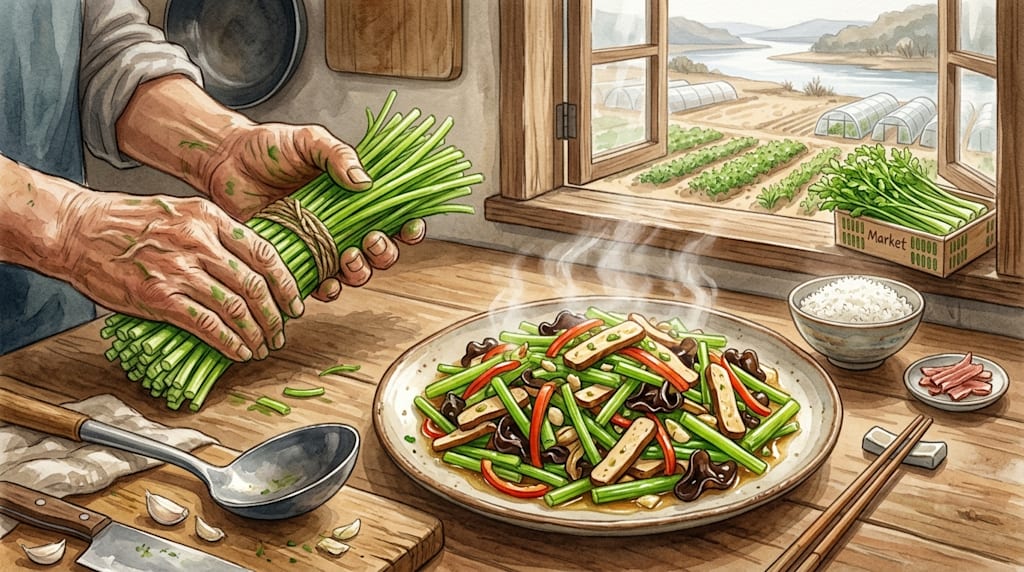
When luhao appears in the market, the vegetable stalls get a particular green. It is bright and watery, and it smells of damp soil and spring rain on a river island. It also carries the restraint of something in season. These days it arrives earlier and earlier. Greenhouses have spread, and luhao reaches the market months ahead of time. Before winter has really gone, it is already lying in the crates, tender and fresh. So I think of that saying again: greenhouses have thrown the seasons out of order.
Taste has memory, though. Plastic sheeting can rearrange the calendar. The old days on the tongue do not move so easily.
When I was small in Anhui, luhao was rare. Farmers with contracted land built greenhouses to grow it, and growing it was hard work. After the autumn harvest, the village went to the greenhouses to help pick it. A day’s work came with one meal. For the villagers it was a lively occasion and a tiring one. The greenhouse was stuffy. The luhao grew in crop after crop, and people bent low to pick it. Stripping the leaves was the worst part. The juice stained your hands green and was hard to wash off. After a while it turned black. That color seemed to press spring into the lines of your palms. It stayed for a while, and even the cracks under your nails held the smell of leaves.
The owner always stir-fried a big plate of luhao for the people who came to help. When the dish reached the table, it glistened green, and a fresh fragrance rose with the steam. You picked up a chopstickful and put it in your mouth. It was crisp and tender and full of juice. You could almost hear your teeth bite through the stalk. I thought: how can a vegetable taste like this? The crispness was alive, the kind that holds water in it. The tenderness had a little backbone and a little clarity. After a day’s work, sitting around the table with a mouthful of luhao, the fatigue seemed to dissolve in that touch of green.
Later I went to Nanjing to work and found that luhao was a household name there. Baguazhou, especially, is known as “China’s Hometown of Luhao.” The whole river island grows it, and it is a national geographical indication product. The island’s river-sand soil is loose and moist, which suits luhao. The luhao grown there has little fiber and a tender texture. Other places can grow it, but they lack that river wind, that layer of sand, that particular patch of water and earth. Food sometimes depends on where it comes from. The same seed, moved somewhere else, tastes subtly different.
On my days off, I used to buy luhao already stripped clean of leaves. I did not want to do that work myself. Stripping the leaves takes forever. You have to pick over the tender ones one by one and pinch off the tough ones, and after a while you lose patience. The green smell left on your hands does not go away, and I am not used to it. The tender leaves can be eaten. Old people say their nutritional value is even higher than the stalks, though they carry a bit of astringency. Most people strip the leaves and keep only the crisp stalks for stir-frying. That slight astringency is like the leaves’ stubbornness, and also like a reminder from the season: good things take a little extra work.
The classic Nanjing way is luhao stir-fried with stinky dried tofu. Stinky dried tofu has its own fragrance. People who love it love it deeply, but I cannot get used to it. Its flavor is too domineering and would press down the fresh cleanness of the luhao. I prefer luhao stir-fried with pressed dried tofu, with a little wood ear mushroom and some red pepper for color. The dried tofu brings a bean fragrance, the wood ear a crisp chew, the red pepper a bright touch of heat, and the luhao remains the main character. Put together, the colors win first: green, black, red, yellow, like a small plate of spring landing on the stove.
In the restaurant kitchen where I work, we blanch the luhao first. The time must be very short. The point is to keep the crisp texture and preserve the bright green color. The water is wide and the fire fierce. The luhao goes in, rolls over once, and comes out. A moment later and it loses its backbone. After blanching, take it out and drain it well. Then heat oil in the wok, add the dried tofu, wood ear, and red pepper, and stir-fry briefly. Then add the luhao. For seasoning, use only a little salt and a pinch of MSG. Luhao has its own clean fragrance, and heavy seasoning would steal the show. Keep the whole thing over high heat and stir-fry fast. Toss until evenly mixed and take it out at once. If it is overcooked, it goes limp and dull, and when you pick it up it droops. It loses its crispness, and that counts as a failure. Before taking it out of the wok, drizzle a little oil over it, and the dish will be even brighter.
This dish is a bite of freshness snatched from time. Short heat, quick hands, light seasoning. Only then can the plate hold the luhao’s crisp tenderness and green brightness. A stew can wait slowly. A braise can reduce and reduce again. Luhao cannot. It is an impatient vegetable, and the person cooking it must be quick too. A few turns of the spatula, the fragrance just rising, and it is time to take it off the heat. A little more and it is old. A little less and it is raw. The instant of just right is the plainest kind of skill in a kitchen.
Now luhao sells all over the country. It is no longer limited to Jiangsu. In winter, stir-frying it with shredded cured pork is also good. Cut the cured pork into fine shreds and render the fat first, until the edges curl slightly and the salty fragrance rises. Then add the blanched luhao, toss over high heat a few times, and take it out. The fat of the cured pork coats the luhao stalks, and the fresh cleanness of the luhao cuts the richness of the meat. One salty, one fresh. They meet in the wok and come out as a very good dish for winter rice.
Sometimes I think food is a strange thing. It is only a plate of vegetables, yet it can carry a person back to long ago. Back to the greenhouses in Anhui, back to hands stained with green juice, back to the hot meal after a day of helping with the picking, back to the surprise of first eating Baguazhou luhao in Nanjing, and back to the heated wok and the quickly moving spatula in the restaurant kitchen. Greenhouses have thrown the seasons out of order, and luhao no longer belongs only to early spring. Taste has not been thrown off. That one bite of crisp, tender, juicy freshness still, on some ordinary dinner table, suddenly leads a person back into the old days.
A plate of luhao stir-fried with pressed dried tofu arrives, green and brimming, steam rising faintly. You pick up a chopstickful. It is still crisp and tender, and it still carries that green smell that will not quite disperse. The seasons have been stretched by greenhouses. Hometown has been pushed far away by the city. This taste is still here. It lies quietly on the plate, like an unfinished spring, waiting for someone to take it up, chopstick by chopstick, and slowly continue it.
Today I cooked another plate of luhao with pressed dried tofu. After eating, I put the plate in the sink. A little luhao juice had stained the back of my hand. I brought it close and smelled it. Still that green smell. I did not rush to wash it off.
About the Creator
Jin
Writer of reamstories
https://reamstories.com/jin
Enjoyed the story? Support the Creator.
Subscribe for free to receive all their stories in your feed. You could also become a paid subscriber, letting them know you appreciate their work.
Comments
There are no comments for this story
Be the first to respond and start the conversation.