
The Dish That Never Had a Name
It was made from leftovers, instinct, and whatever happened to be in the kitchen

If you asked me what the best meal of my childhood was, I could not give you the name of a restaurant.
There wasn't one.
I couldn't even give you the name of the dish.
It never had one.
My grandmother simply called it "what's left."
That description did not sound promising.
It usually began on a Sunday evening, after lunch had stretched far beyond noon and the table had slowly emptied of plates, bottles, bread crumbs, conversation, and relatives.
Sunday lunch at my grandparents' house was not an event anyone formally organized. It simply happened.
People arrived.
Someone brought wine.
Someone else brought bread.
A cousin appeared without warning.
A neighbor sometimes stayed.
Chairs were found.
Plates were added.
Nobody counted portions very carefully.
By late afternoon, the kitchen looked as though a minor festival had taken place there.
And then, somehow, everyone became hungry again.
That was when my grandmother opened the refrigerator.
She never followed a recipe.
Recipes seemed to irritate her.
If someone asked how much butter she used, she would say, "Enough."
How long should it cook?
"Until it's done."
How many eggs?
"Depends who's here."
This was not particularly useful instruction, but her food was always better than anything produced by people who measured things precisely.
Her leftover dish began with potatoes.
Usually boiled potatoes from lunch.
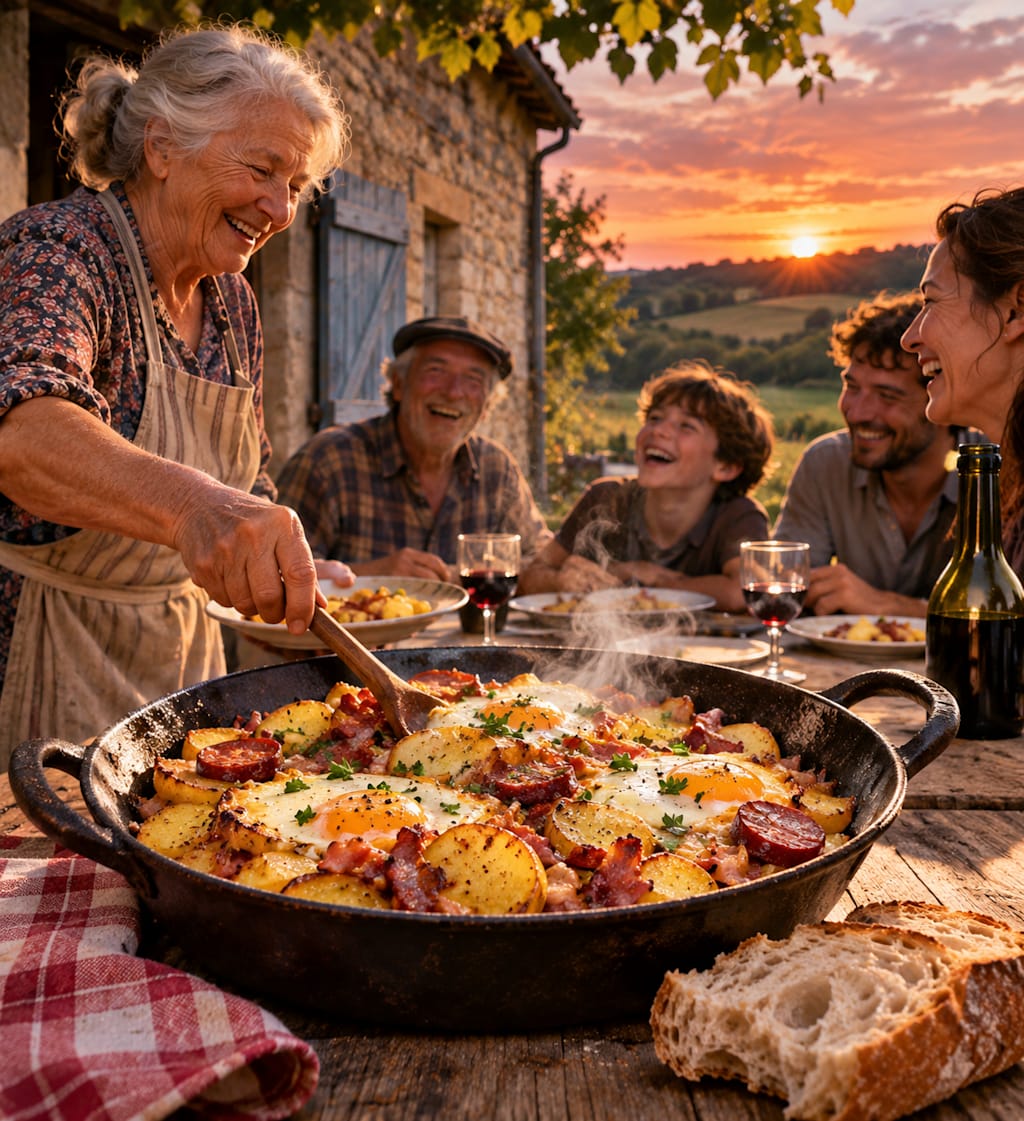
She sliced them directly into an old black frying pan that seemed heavy enough to survive a war.
Then came whatever meat had escaped the midday meal.
A piece of sausage.
A little bacon.
Sometimes roast pork.
Once, I am almost certain, there was duck.
My grandmother denied this later.
Memory and leftovers share the same problem: after enough time, nobody knows exactly what went into them.
She added onions.
Always onions.
Then garlic.
A scandalous amount of garlic according to my grandfather, who complained every time and ate everything anyway.
The pan would begin to hiss.
That sound is probably what I remember best.
Not the taste.
Not even the smell.
The sound.
Potatoes touching hot fat.
A wooden spoon scraping iron.
The quiet crack of eggs against the edge of the pan.
Conversation continued around her while she cooked.
Nobody watched.
Nobody photographed the meal.
Nobody asked whether it looked good enough to post anywhere.
There was nowhere to post it.
Food still had the strange freedom of being allowed to exist without evidence.
When the potatoes had browned and the pieces of meat had developed crisp edges, she made small spaces in the pan and broke eggs into them.
The whites spread between everything else.
The yolks remained bright and soft.
She added salt.
Pepper.
Sometimes parsley from the garden.
Sometimes something else we never identified.
Then she carried the entire pan outside and placed it in the middle of the table.
No presentation.
No garnish arranged with tweezers.
No explanation from a waiter.
Just a large, battered frying pan full of food that technically should not have been a dish at all.
Everyone served themselves.
There was always bread.
You needed bread for the yolk.
This was understood.
Someone poured the last of the wine.
The sun was lower now.
The adults had loosened into that particular mood created by a long day spent eating and talking with people you know too well.
Stories were repeated.
Arguments from twenty years earlier resurfaced and were reconsidered with no greater chance of resolution.
My grandfather told jokes we had heard before.
We laughed anyway.
The food disappeared.
That is the strange thing about this memory.
The meal itself was completely ordinary.
Nobody celebrated it.
Nobody said:
"Remember this moment."
Nobody knew it would matter.
Had a restaurant served the same dish, we might have complained.
Too rustic.
Too greasy.
Too inconsistent.
One evening there was too much onion.
Another time the potatoes were nearly burned.
Once the eggs cooked too long and my grandmother blamed everyone else for talking to her.
The dish was never identical twice.
That was part of it.
Restaurants depend on consistency.
Memory doesn't.
Memory prefers imperfection.
Years later, I tried to make it myself.
Potatoes.
Onions.
Bacon.
Sausage.
Eggs.
Garlic.
Salt.
Pepper.
A little parsley.
I knew every ingredient.
I knew roughly how it had been cooked.
The result was good.
Very good, actually.
But it wasn't the same.
I tried again.
More fat.
Less onion.
Different potatoes.
A heavier pan.
Still not the same.
Eventually I understood the problem.
I was trying to reproduce a recipe.
There had never been a recipe.
The missing ingredients were not in the pan.
They were sitting around the table.
My grandmother standing beside it with her wooden spoon.
My grandfather complaining about the garlic.
Someone tearing bread instead of cutting it.
A bottle of red wine with barely enough left for two glasses.
The smell of evening in the countryside.
The knowledge that nobody needed to leave yet.
You cannot buy those ingredients.
You cannot measure them.
And you certainly cannot put them on a restaurant menu.
Perhaps that is why some meals remain unforgettable.
Not because they were exceptional.
Because they belonged completely to one place, one moment, one group of people.
Today, a restaurant might call the dish something attractive.
Rustic skillet potatoes with farmhouse sausage and eggs.
They might serve it in a small cast-iron pan.
Add microgreens.
Charge twenty-two euros.
It might even taste better.
I would still choose my grandmother's version.
The one made from leftovers.
The one that changed every time.
The one nobody bothered to name.
Because sometimes the best thing you ever eat is not really food.
It is a table you can no longer sit at.
About the Creator
Alain SUPPINI
I’m Alain — a French critical care anesthesiologist who writes to keep memory alive. Between past and present, medicine and words, I search for what endures.
Enjoyed the story? Support the Creator.
Subscribe for free to receive all their stories in your feed. You could also become a paid subscriber, letting them know you appreciate their work.
Comments
There are no comments for this story
Be the first to respond and start the conversation.