
The Beer I Was Embarrassed to Admit I Liked
How alcohol-free beer went from a joke at my local to the best thing in my fridge, and why a whole generation is drinking differently than our parents did.
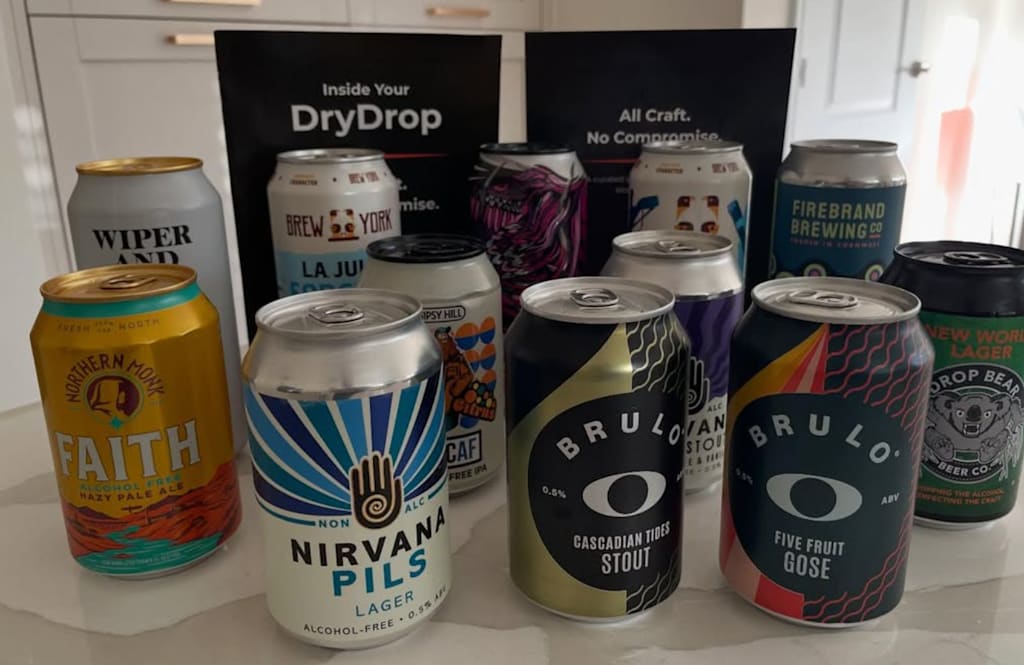
The first time I ordered an alcohol-free beer in a pub I apologised for it.I was driving that evening.
It was a Thursday.
The barman looked at me the way you look at someone who's just asked for a ham sandwich in a vegan café.
"We've got one. I think. Somewhere."
He eventually produced a dusty bottle of something that tasted like beer-flavoured water, charged me the same as the full-strength stuff, and I drank it in three long resentful gulps while my friends drank actual beer and looked at me like I'd broken some kind of unspoken pact.
That was 2019.
I now drink alcohol-free beer most evenings.
I have a fridge drawer dedicated to it. I know the names of breweries in Norway, Denmark, and Australia that nobody I grew up with has ever heard of. I've tasted over two hundred different alcohol-free beers and kept notes on every one of them. And somewhere between that dusty bottle in 2019 and the can of Northern Monk Heaven AF Chocolate Maple Stout I had with my dinner last night, an entire category of drinking changed. And I mean changed, not "got a bit better."This is the story of why, and what it means for the rest of us.
When did alcohol-free beer actually get good?
The honest answer is: somewhere around 2022, and most people haven't caught up yet.
For decades, alcohol-free beer was made by one of two methods, both of which produced something that tasted like a disappointment wrapped in regret. Either you made a normal beer and then boiled the alcohol out of it (which destroyed all the flavour), or you made a deliberately weak beer and called it a day. Either way, what you got tasted like a beer that had been explained to rather than brewed.
Then three things changed.
First, the technology caught up. Vacuum distillation — which removes alcohol at low temperatures, preserving most of the flavour compounds — became affordable enough for mid-sized breweries. Reverse osmosis became standard. Arrested fermentation techniques got sophisticated.
Second, specialist NA-only breweries started appearing. Athletic Brewing in Connecticut. Lucky Saint in London. Big Drop in Ipswich. These breweries don't make alcoholic beer at all — every decision they make, every grain they select, every hop variety they choose, is optimised for making the best possible non-alcoholic beer. That changes everything. You're not taking something good and stripping it down. You're designing something new from scratch. Third, and this is the bit that most people underestimate — the consumer changed. Gen Z drinks around 20% less alcohol than millennials did at the same age. Millennials are moderating harder than any generation before them. Pregnant women, designated drivers, people training for things, people on medication, people who've just stopped enjoying being hungover at 37 — the potential market expanded dramatically, and breweries took it seriously.
The result is that if you haven't tasted an alcohol-free beer in the last two years, you haven't tasted alcohol-free beer.
What nobody tells you about buying it
So here's where my personal learning curve got painful, and expensive. Knowing that the category had improved is one thing. Actually finding the good stuff is another entirely. Because here's the problem — the bad beers and the brilliant beers all sit on the same shelf at Tesco. They're roughly the same price.
The cans often look similar. And unlike wine or spirits or full-strength beer, there are almost no review sites, no cultural shortcuts, no "oh, it's like a good Pinot" frames of reference that help you navigate.So what happens is what happened to me. You buy four cans. Maybe one of them is any good. You pour the other three down the sink and tell yourself you'll never try it again.I estimate I spent somewhere between £300 and £400 on beers that ended up in the sink during my first year of genuinely trying to drink alcohol-free. That's not a figure I'm proud of. But it's also, I've since discovered, extremely common.
The reason I mention this isn't to complain. It's because solving this problem — the discovery problem — is basically the one thing that's still broken about the category, and it's the reason I ended up building a website called Unhopped.
Unhopped is, basically, the notebook I wish I'd had three years ago. It's a free site where you can browse 245+ alcohol-free beers, filtered by style, country, brewery, and calorie count. Every beer has a proper review, tasting notes, flavour profile, and community score. You can filter by indie breweries only if you're bored of the big guys. You can explore by country if you want to get adventurous.
It exists because I couldn't find anything like it when I wanted one, and because the NA category deserves a Vivino of its own.
But this post isn't really about the site. It's about something that matters more.
Five alcohol-free beers that will change how you think about the category
If you're sceptical — and you should be, because I was — here's what I'd recommend buying next time you're at the supermarket or ordering online. Not the most expensive, not the most obscure.
Just five beers that do the best job of showing how much the category has changed.
Lucky Saint Unfiltered Lager is the benchmark. If you've only ever had one good alcohol-free beer, it's this. Brewed in Bavaria using the traditional unfiltered method, it has real body and complexity. I drink it most nights. It's the beer I hand to sceptical friends and say "try this, tell me what you think." Nine times out of ten they say some variant of "oh."
Athletic Brewing Run Wild IPA is the beer that kicked off the modern NA craft revolution in America. Citrus, pine, proper hop aromatics. If someone served this to me blind I'd guess it was a session IPA from a good American craft brewery. That's the benchmark it clears.
Big Drop Paradiso Citra Pale Ale won "world's best low alcohol pale ale" which sounds like faint praise until you actually taste it. Tropical, bright, beautifully balanced. Works with almost any food. My go-to for weekends.
Guinness 0.0 has done something genuinely impressive. For decades the joke was that you couldn't make a proper non-alcoholic stout. Guinness just quietly did it. It's not identical to the original — nothing is — but it's recognisably Guinness. And at 16 calories per can, it's virtually free, calorically speaking.
Mikkeller Drink'in the Sun is from a Danish brewery that's been making world-class beer for over a decade, and their alcohol-free range is genuinely as good as their full-strength stuff. This one's a wheat beer, cloudy, citrusy, summer-evening perfect.None of these cost more than £3 a can.
All of them are stocked in UK supermarkets or online.
If you try all five and still think alcohol-free beer is pointless, we can talk about it. But I'll bet you that at least two of them end up in your regular rotation.
What's actually happening to drinking culture
Zoom out for a second.
Something quietly enormous is happening to how we drink. According to recent UK data, alcohol-free beer sales in pubs and bars rose 26.4% in 2025, on top of a 22% increase the year before. Over half of Gen Z drinkers "often or sometimes" opt for an alcohol-free option when socialising. Almost half of all Brits planned to cut down their alcohol consumption in 2025. The shift is real, it's permanent, and it's accelerating.
What this isn't: a sobriety movement.
Very few people drinking alcohol-free beer have completely given up. What it is: a generation that has stopped viewing alcohol as mandatory.
I have friends who'll have two pints of Guinness 0.0 on a Monday and two pints of the real stuff on a Friday. I have friends who drink NA beer during the week because they sleep better, and normal beer at weekends because they enjoy it. I have friends who've stopped drinking alcohol entirely for reasons ranging from medication to pregnancy to training to "I just got tired of being tired."What unifies all of them is that five years ago, their only real option at a pub, a wedding, a dinner party, or a barbecue was Coca-Cola or a lime and soda. Now they've got options. Good options. Options that taste like beer. That is, genuinely, a cultural shift. And we're all living through it.
Where this is going
If I had to predict the next five years of alcohol-free beer: Every major supermarket chain will have a full aisle dedicated to alcohol-free, not just half a shelf. Every major pub chain will have at least three alcohol-free options on tap.
Dry January will stop being a thing because the idea of needing a specific month to moderate will feel quaint. The line between "people who drink" and "people who don't drink" will blur completely — because most people will just drink both.
Specialist NA breweries will take market share from the big lager brands' NA versions, because they're just making better beer. Indie craft NA will become its own sub-scene the way craft beer did a decade ago.
Somewhere around 2028-2029 there'll be a breakout NA brewery that becomes a genuine cultural phenomenon, the way BrewDog did for craft beer in the 2010s. And somewhere in there, a few of us will have built the infrastructure — the discovery platforms, the review sites, the community spaces — that makes navigating the category as easy as navigating wine.
I'd like Unhopped to be one of those, obviously. But even if it's not, somebody's going to build it. Because the category deserves it, and because drinkers want it.
The quiet confidence of a good alcohol-free beerI went to a barbecue last weekend. My friend Tom asked if I'd been drinking.I said, "no, this is one of those alcohol-free ones."He gave me the look — the one I used to get in 2019 — and then picked up my can and looked at the label. "Oh, this is the Lucky Saint one. My sister said this stuff was actually decent."I gave him one of mine. He drank it. He asked for another. His wife had one. Then his brother had one. Then the four of us sat in Tom's back garden on a Sunday afternoon, drinking alcohol-free beer because it was nice, because we liked it, because there was no reason not to.That's the future.No apologies. No explanations. No dusty bottles from the back of the cellar.Just people drinking good beer that happens to have no alcohol in it.Unhopped.co.uk — 245+ alcohol-free beers reviewed, rated, and ranked. Free to use. UK-built.Rich lives in Manchester, runs Unhopped, and has strong opinions about stout.
About the Creator
Enjoyed the story? Support the Creator.
Subscribe for free to receive all their stories in your feed.
Comments
There are no comments for this story
Be the first to respond and start the conversation.