
The 20-Second Rule That Saves Dried Nori From Turning to Mush
A failed pot of pork-rib soup taught me when to add seaweed, and when to turn off the heat.
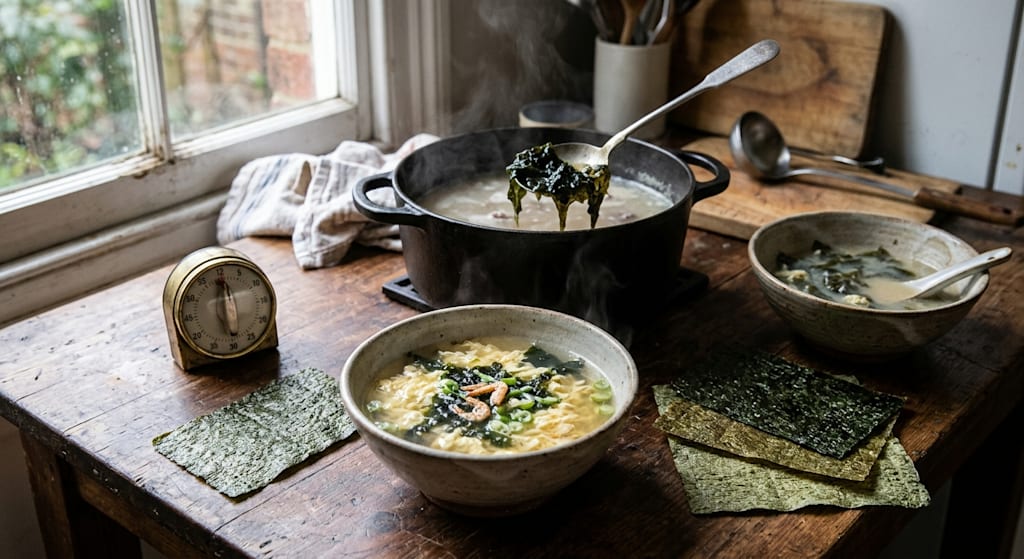
Dried nori sits in the palm almost weightless. Break off a piece and it is crisp, with uneven edges, shedding fine dark-green flecks. It is not like shiitake with its thick cap, nor like dried shrimp with its own salty fishiness. It is a thin layer, and after drying its fibers are so fine they are almost invisible.
That thinness decides how it should be used.
1. It Cannot Stand Boiling
I once made nori and pork-rib soup. The ribs had simmered for forty minutes and the broth had turned milky white, so I threw in a handful of nori to boost the umami. The nori fell into the rolling broth and softened in less than two minutes. Five minutes more, and when I lifted it out it was like a wet rag. Chopsticks could not pick it up. I had to use a spoon. The broth turned from milky white to grayish green. One sip, and the meaty aroma of the ribs was pressed down by a dull fishy smell. In the end I poured the pot out.
After nori is dried, its fibers are very thin. Stir-frying over high heat makes it scorch and break apart quickly. Long boiling makes it mushy and sticky. Its umami is released fast, but it cannot withstand repeated cooking. Brief blanching in boiling water for tens of seconds lets the leaves reabsorb water and unfurl, preserving their silky texture. Any longer, and it falls apart.
So when making soup with nori, add it late and blanch it briefly. In egg soup or tofu soup, throw in a small handful and the umami rises immediately. No MSG or chicken bouillon is needed. That umami is not intense. It gently holds up the base flavor. When tofu soup is almost done, tear in a handful of nori, stir twice, and the broth darkens a shade. One taste, and the beaniness has been covered.
2. Nori in Old Books
In the Ming dynasty, the Bencao Gangmu recorded nori’s form, ways of eating it, and uses in dietary therapy. In ancient times it was boiled in water to soothe the throat, and also used to prevent goiter. These records carry the flavor of dietary-therapy experience, and they show that nori entered the Chinese soup bowl very early.
But nori and egg drop soup became a home-style quick dish only after the 1960s. The technique of streaming egg into soup had existed for a long time, but in those days it was usually paired with bamboo shoots, mushrooms, or dried shrimp, and rarely with nori. After nori was no longer precious, nori and egg drop soup, simple to make and quick to cook, spread. A pot of water comes to a boil, one egg is beaten, a small handful of nori is blanched, and it is on the table in minutes.
3. First, Second, and Third Harvests
After seawater cools, the first harvest of nori is called first-harvest nori. First-harvest nori has thin leaves. When torn, the edges are neat. After soaking, it is thin enough to let light through, with a clean aroma. The second crop is second-harvest nori: the leaves grow wider, the flesh is thicker, and the aroma declines. After the third harvest, the leaves are coarse and old, with more impurities and less umami. They are better suited to processing into roasted seaweed. Third-harvest nori, once soaked, has thick veins like used tea leaves. It does not give enough umami for soup, and its texture is coarse.
When buying dried nori, look at the color. Good nori is blackish and purplish brown. If the dried product is a bright, vivid purple, it has mostly been stored too long and has oxidized and spoiled. Do not buy it. Nori keeps well, but not forever. Its aroma dissipates, its color changes, and its umami fades. Once bought, seal it, keep it away from light and moisture, and use it as soon as possible.
4. Nori and Egg Drop Soup
Crack the eggs into a bowl and beat thoroughly, breaking the egg strands until the liquid is smooth with no lumps. Bring clear water to a boil in a pot. Once it is boiling over high heat, immediately turn to the lowest heat, letting the surface become slightly calm rather than rolling vigorously. Use a spoon to stir the soup gently clockwise, creating a whirlpool, and slowly stream the egg liquid along the edge of the pot. Let it sit for 5 to 8 seconds. Do not stir right away. The egg sets under the heat into large, thin ribbons.
Add torn nori and small dried shrimp, blanch for 10 to 20 seconds, and turn off the heat immediately. Season with a little salt, a touch of white pepper, and a few drops of sesame oil. Scatter scallion and cilantro over the top, and add a little light soy sauce to boost umami. Nori must be added late. Turn off the heat decisively. The residual heat is enough to let it soften, and longer cooking instead brings out a fishy smell. In a bowl like this, the egg ribbons are thin, the nori is slippery, and the broth is clear.
5. Nori, Shrimp Surimi, and Egg Drop Soup
Shrimp surimi was originally an ingredient for Cantonese and doulao hot pot. After 2000, frozen pre-made shrimp surimi went into mass production and appeared everywhere in supermarkets, and ordinary people began using it to make soup. Nori has its own seafood aroma, shrimp surimi is sweet and savory, and egg is mild. Three layers of umami stack together, and almost no MSG is needed.
Add the shrimp surimi to warm water. Bring to a full boil. When all the shrimp surimi floats, skim off the foam and cook for two minutes until fully done. Turn to low heat, slowly stream the egg liquid along the edge of the pot, and let it sit for a few seconds to form spread-out egg ribbons. After turning off the heat, immediately add torn nori and let the residual heat soften it for 15 seconds. Nori must never be cooked long. Add a little salt, a little white pepper, and a few drops of sesame oil. Scatter scallion over the top and serve.
6. A Bowl of Soup on the Table
The nori unfurls in the bowl, floating thinly. The egg ribbons scatter beside it. The shrimp surimi sinks at the bottom. The spoon touches the rim of the bowl and makes a sound. The soup is clear. One sip, and the umami travels from the tip of the tongue toward the back. It is not heavy, but it is always there. As the nori slips down the throat, it is almost imperceptible, yet its taste is everywhere in the soup.
About the Creator
Jin
Writer of reamstories
https://reamstories.com/jin
Enjoyed the story? Support the Creator.
Subscribe for free to receive all their stories in your feed. You could also become a paid subscriber, letting them know you appreciate their work.
Comments
There are no comments for this story
Be the first to respond and start the conversation.