
Short & Strong
Plastic Parsely, Blue Lights and Flat Whites

Written in response to/entry for the 'Not on the Menu' challenge.
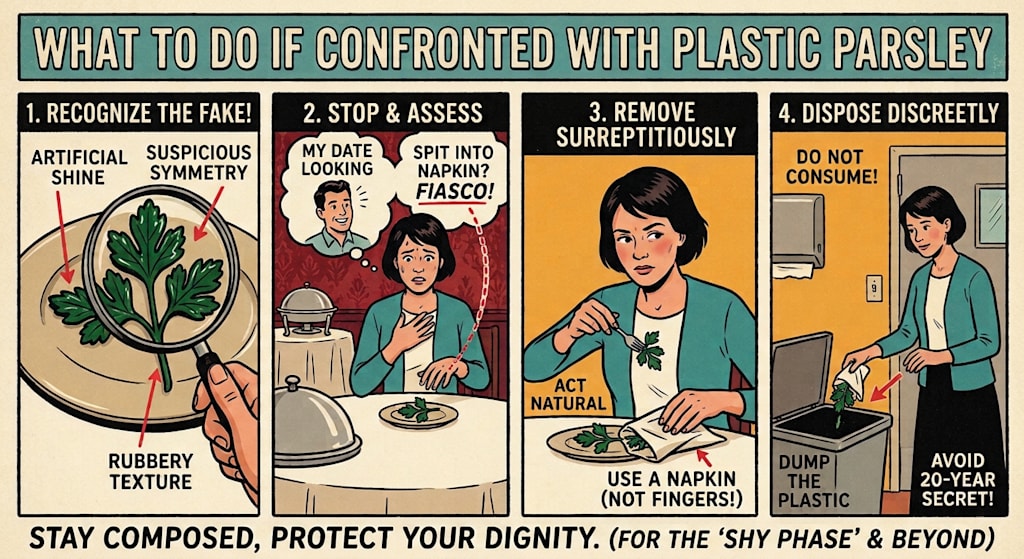
The first (and hopefully only) thing I ever swallowed out of sheer politeness was a sprig of plastic parsley.
It was one of my earliest dates with my now-husband, Mick. We were sitting in a dimly lit Indian restaurant. It is what we British think of as the traditional kind. It had flocked wallpaper, starched napkins, and tea-light food warmers. I was still in the shy phase of our early romance, where every gesture was overthought and every date still felt like an audition. When the food arrived, a vibrant sprig of bright green parsley sat perched on top of my starter.
Without looking too closely, I popped it into my mouth.
My teeth met with rubbery resistance. I realised very quickly that no fresh herb has that kind of texture. I chewed once, twice, and embarrassment and anxiety flared together. If I spat it into my napkin, Mick would see. If I fished it out with my fingers, any illusion of composure would shatter. I panicked and swallowed it whole.
I didn’t tell Mick for about twenty years. When I finally confessed, he predictably laughed, though he couldn’t understand why I hadn't just spat it out. More than occasionally, the thought still crosses my mind that somewhere deep inside me, that tiny green garnish remains entirely intact.
After years of sitting at restaurant tables, and now working behind them, I’ve realised that the things we take away from a meal rarely appear on the menu. Sometimes we swallow plastic. Sometimes we swallow our pride. And sometimes we witness moments of real life that stay with us long after the plates are cleared.
Years after our first curry, the parsley story resurfaced during dinner at a Lebanese restaurant with Mick and our friends, Viv and Stu. We ordered drinks and settled on several plates of mezze, bread, and chips to share. While we waited, a dish of olives sparked memories of our early dating blunders, Mick once mistaking a huge clove of raw garlic for a pickled onion, and me choking down that plastic.
As conversations sadly these days often do, ours drifted toward a newly released Jimmy Savile documentary. Stu called him "pure evil," and Mick mentioned the cover-up and the pain of the victims just as the restaurant manager walked through the front door and came straight over to our table.
"I hear you are talking about that great man, Jimmy Savile," he beamed. "I loved him. A really funny man, with his big cigar…"
We froze mid-sip, along with several surrounding tables. After breezily asking if we had ordered and calling him "a great man" one more time, he wandered off to seat a family. We stared at each other in stunned silence before Stu whispered, "What the actual fuck?" Grasping for logic, I suggested maybe he’d only ever seen old clips of Top of the Pops. We knew he hadn’t lived in the UK very long.
Our food arrived, and we tried to move on while the manager stepped out on a delivery run. When he returned near the end of our meal, he looked noticeably pale and came straight back over.
"I meant he was a dreadful man," he stammered quickly. "I want you to know I don’t support what he did in any way."
Surrounded by empty bowls of hummus, we nodded stiffly through an excruciating apology for an accidental endorsement of a monster. Once again, out of sheer British politeness, we swallowed the awkwardness whole, smiled tightly, and left a generous tip. Afterall the food was amazing.
As mentioned, now I work on the other side of the pass, however, awkwardness is the least of what gets served up in a dining room.
Recently, I was working a busy November shift when a local church group came in for their annual (and our very first of the year’s) Christmas dinner of the season. The room was buzzing with elderly friends in festive jumpers, chattering and drinking gin and tonics. Everything was running smoothly, with the kitchen doing an amazing job getting thirty lunches out simultaneously, until the atmosphere at one table suddenly changed.
One of the elderly ladies was grey, clutching her chest as an angina attack hit.
In an instant, the background hum of clinking cutlery and Christmas music vanished. Nobody orders an emergency, and there are no instructions printed next to the specials board, yet suddenly you are clearing space around a chair, reassuring a table of frightened friends, and dialling 999. My manager, though clearly terrified, held the woman in her arms while I begged the call handler for an ambulance faster than the expected over an hour wait.
Thankfully, within minutes, the dining room windows were flashing with blue lights. Watching the paramedics wheel her out into the cold rain, I was reminded that restaurants aren’t sealed bubbles separate from the outside world. People bring their fragile, unpredictable lives right through the front door. I am still puzzled (and strangely proud) of how the rest of her table barely flinched after their initial shock. They simply carried on with their lunches, even asking for more drinks while I stood nearby frantically trying to remember how to do CPR.
I told my manager how moving and practical her hold had looked. Having worked most of my life in the care and community sector, I’ve done annual emergency first-aid training and had never seen that technique. She confessed she’d copied it from Disney’s The Little Mermaid, specifically, the scene where Scuttle the seagull cradles Prince Eric’s foot to check for a pulse. I am both relieved and slightly gutted that she didn't do that part.
Other days, customers bring a quieter kind of weight through the door.
A few weeks ago, an older gentleman who for this story, I will call Samuel, walked into the restaurant. Wonderfully elegant, he approached the counter and asked me very simply for a coffee.
"Of course, what type would you like?"
Right there in the middle of the floor, his eyes filled with tears.
"I don’t know," he said softly. "I haven’t really been out for four years."
He explained that he had spent those past years at home caring for his wife, who has Alzheimer’s. Only recently had it become too much to manage alone, forcing him to make the heartbreaking decision to move her into a local nursing home. While he had been devoted to her, the outside world had moved on, including the lengthy, confusing vocabulary of modern coffee menus.
I guided him away from the bustle to a quiet corner table. "Just sit here," I told him. "Let me finish the coffees I’m making, and we’ll have a chat."
A few minutes later, I pulled up a chair beside him. Together, we talked through the menu, explaining the difference between a latte and a cappuccino, an Americano and a cortado, until we found what sounded right. He decided he wanted something "short and strong."
I made him a flat white.
That cup of coffee has become a weekly ritual. Sometimes Samuel orders a sandwich, once a slice of cake, and on one memorable occasion, a martini. Yet no matter what else he tries, he always has his flat white. Short and strong.
Looking back on all the meals I have eaten and served, none of the moments that truly stuck with me could ever be listed on a menu, and there are many many more. You can't order the surreal comedy of a manager backpedalling over Jimmy Savile while your flatbread goes cold, the sudden flash of blue lights interrupting a church Christmas lunch, or the quiet courage of a man stepping back into the world one flat white at a time.
About the Creator
Alyson Smith
Neurodivergent, working-class writer and artist diagnosed with Bipolar. Based in Newcastle-upon-Tyne. MA in Creative Writing. Currently waitressing while finishing my novel.
Enjoyed the story? Support the Creator.
Subscribe for free to receive all their stories in your feed. You could also become a paid subscriber, letting them know you appreciate their work.
Comments
There are no comments for this story
Be the first to respond and start the conversation.