

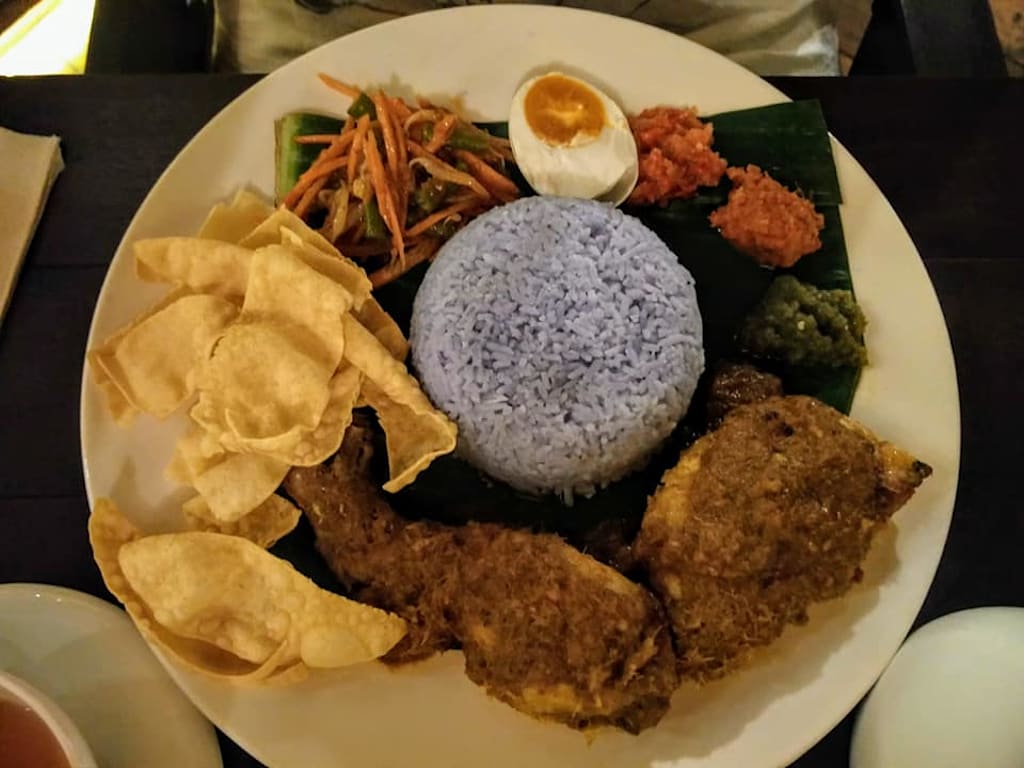
There are dishes you try, and then there are dishes that claim a piece of your heart. For Gosia, that dish is nasi kandar. The picture tells part of the story: a plate of striking blue rice, surrounded by a constellation of curries, vegetables, and a perfectly cooked egg. But the picture cannot capture the aroma—the warm embrace of lemongrass, the gentle heat of spices, the promise of something extraordinary.
The eye-grabbing blue rice is the first clue that this is no ordinary nasi kandar. The colour comes from telang flowers (butterfly pea), crushed and mixed into the rice during cooking . The result is visually stunning a vibrant, almost otherworldly hue that fades to a soft lavender when a squeeze of lime is added. But the colour is not merely cosmetic. The flowers impart a subtle, earthy flavour that complements the richness of the curries without competing with them .
The Architecture of a Plate
Nasi kandar is not a fixed dish; it is an assembly. The rice whether white, blue, or sometimes coconut-infused serves as the canvas. Around it, the cook arranges a selection of curries, vegetables, proteins, and condiments. The surrounding toppings may include:
Curry (often a choice of fish, chicken, beef, or mutton, each with its own spice profile)
Okra (lady's fingers, simmered until tender but still with a slight bite)
Papadum (a crisp, disc-shaped cracker that adds texture)
Egg (hard-boiled, fried, or sometimes soft-boiled omnipresent in Malaysian cuisine for good reason)
Sambal (a spicy chili paste that varies in heat from stall to stall)
The chicken in the restaurant where Gosia discovered her love for nasi kandar had been marinated in lemongrass . The result was a revelation: the chicken remained juicy on the inside, while its exterior achieved a perfect crunch. The lemongrass did not overpower; it elevated, adding a citrusy brightness that cut through the richness of the curry .
The Origins: A Dish Born of Necessity
Nasi kandar is a typical Indian Muslim dish originating from northern Malaysia, close to the Thai border . Its roots lie in practicality. In the past, travelling cooks would approach people working in the fields and offer to prepare lunch on the spot. They carried all their ingredients with them—pots of curry, baskets of rice, fresh vegetables, and spices—and would quickly mix a meal tailored to each customer's preferences.
The name "kandar" refers to the wooden pole these cooks used to balance two containers of food on their shoulders as they walked from village to village . It was street food before street food had a name, a mobile kitchen that brought sustenance to those who could not leave their work.
That heritage is still visible in modern nasi kandar restaurants, where diners point at the dishes they want and watch as the cook assembles their plate with practised efficiency. The process is fast, but the flavours suggest hours of simmering and careful spicing.
Why Gosia Loves It
Gosia's affection for nasi kandar is not merely about taste, though the taste is undeniable. It is about the experience: the ritual of choosing from a dozen curries, the anticipation as the rice is scooped onto the plate, the first bite that somehow manages to be comforting and exciting at the same time.
"It's the perfect meal," she says. "You have the crunch of the papadum, the creaminess of the curry, the freshness of the cucumber, the richness of the egg. Every bite is different. You never get bored."
She also appreciates the dish's honesty. Nasi kandar does not pretend to be anything other than what it is: a hearty, unpretentious plate of food designed to satisfy. There are no foam emulsions, no deconstructed elements, no edible flowers that taste of nothing. There is rice, curry, and the quiet confidence that this is enough .
Where to Find It
The best nasi kandar is often found in the most unassuming places: a bustling restaurant in Penang's Little India, a roadside stall in Alor Setar, a 24-hour shop in Kuala Lumpur's Brickfields. The dish varies by region Penang's version is famously more spicy, while Kedah's leans sweeter but the essence remains constant.
For Gosia, the restaurant where she first fell in love with nasi kandar holds a special place. The blue rice, the lemongrass chicken, the attentive service all of it conspired to create a memory that she carries with her, even now, thousands of kilometres away. "I think about it when I'm hungry," she admits. "And even when I'm not."
Nasi kandar is not the most famous Malaysian dish. That honour belongs to nasi lemak. It is not the most photogenic; the curries can blur together into a brownish smear. But it is, for Gosia and millions of Malaysians, one of the most satisfying. It is the food you crave after a long flight, the meal you introduce to visiting friends, the dish that tastes like home even when you are far from it.
The blue rice catches the eye. The curries capture the heart. And the lemongrass chicken? It lingers in the memory, a reminder that the best dishes are often the simplest, the most honest, the ones that have been perfected over generations of travelling cooks balancing pots on wooden poles, bringing lunch to the fields .
About the Creator
Mark Lim
Hi I am mark an automotive student and a car, tech and food enthusiast ! Im gonna try and post daily & hope you enjoy what I write and do share my page with people you know. I would gladly appreciate it! Cheers
Enjoyed the story? Support the Creator.
Subscribe for free to receive all their stories in your feed. You could also become a paid subscriber, letting them know you appreciate their work.
Comments
There are no comments for this story
Be the first to respond and start the conversation.