
I Stopped Trusting Viral Restaurants. Here Is the Checklist I Use Instead
Wait a year. Watch the renovations. Follow the lunch crowd. Order what the city cooks best.
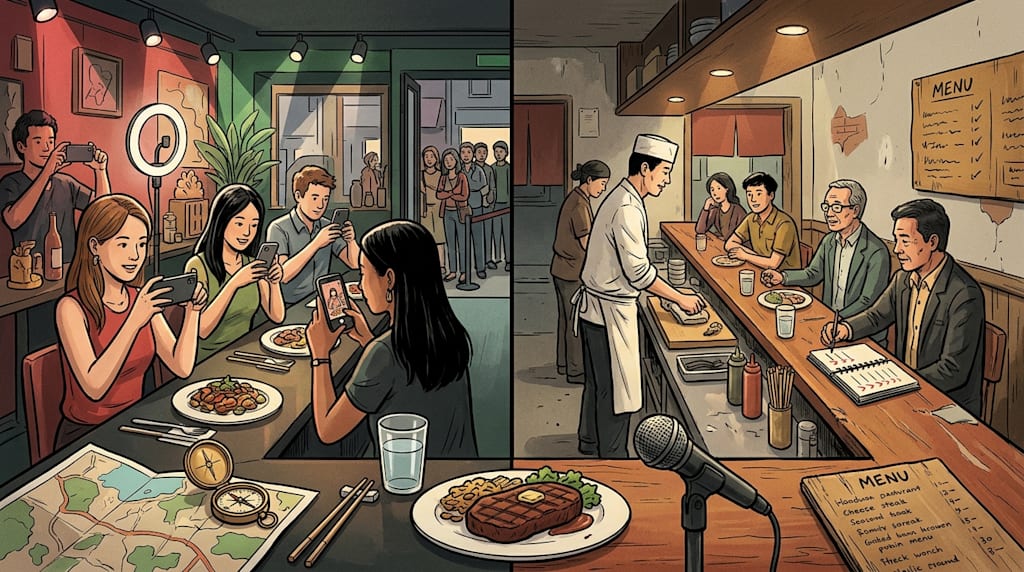
I am not eager to use the phrase “viral restaurant” to write off a place with one stroke, but I am unwilling to stake my expectations for a meal on one. Unusually hot, unusually photogenic, unusually queued, unusually cheap, yet unable to explain where repeat business comes from. A place like that probably has not done something right. It has been pushed in front of you by something else.
I prefer old places, small workshops, and restaurants where the chef is still watching the stove. Unless I am meeting someone to talk business, or a female friend and I are eating together and need photos, I basically do not touch viral restaurants. The problem is not snobbery. I have been burned. The lighting is designed for phones, the menu for spreading, the servers’ scripts for good reviews, the dish names like advertising slogans. Good places accumulate, renovate, and bring old customers back. Viral places run the people, goods, and venue playbook: opening day is the traffic peak, then they watch retention, recoup the investment, exit, open the next one, and manufacture another new concept. If you happen to catch one tasting good one day, that is incidental. Its main selling point is still “the phone eats first.”
People, goods, and venue are neutral in themselves. Capital using that framework to calculate traffic conversion is not wrong. What consumers need to watch is this: you are paying far more than the food is worth for photo spots, decor, concepts, and queue heat. If atmosphere is clearly priced and you are buying atmosphere, pay according to the atmosphere ledger. Do not judge it by a gourmand’s standards. If you are going for taste, watch the chef’s presence in the kitchen, the supply chain, menu depth, staff turnover, and repeat-business structure.
Time is the cheapest due diligence. Wait a year for a new place. For an old place, look at whether it renovates and upgrades, not merely whether it is still there. I often use Gudao Honten in Chongqing as an example. In 2016 that decor was quite refined for an inland city. The staff spoke Japanese and wore kimono, and you could get relatively fresh sea urchin and bluefin tuna. Ten years ago that was not as common as it is now. But I did not go until the second year. Over all these years, it still does counter-style service, renovates the interior, greets guests, and the owner still replies to you on Dianping. It has been open ten years, business is still decent, and people still go back to eat. In Chongqing it is hard to survive outside hotpot, especially for high-priced places that do not lean on gimmicks or borderline tricks. After ten years it is still at 4.8. That 4.8 was slowly built through repeat business, renovations, and the owner replying to comments. It is not the same as a 4.8 rushed out in the first three months after opening. Old places also benefit from nostalgia filters and can survive on community inertia, so “still there” and “still upgrading” need to be looked at separately.
Choosing the time is choosing the chef’s attention. For Japanese food, go either at lunch or right at 5 p.m. when it opens. Do not go late at night, especially to a place where the chef is absent but a big name is attached. In Philadelphia back in the day, Morimoto had the biggest name, Zama and Shiori Hana came next, and Hana was the oldest. If you pick the most expensive Morimoto, chances are it flops. The chef is watching the New York store, is not in Philadelphia, and the decor is viral nightclub style. It is for looking, not eating. At Hana, the second floor is tatami, and the output is much steadier. A place like that easily gives you the illusion of “it is just so-so.” Given its positioning, it will not have great fish, but it holds the floor. The second- and third-best places in a region often produce more steadily, because they do not have the hard constraint of a famous place whose chef’s attention has been pulled away.
Signals need to be layered. Hard to fake: the chef’s presence in the kitchen, low staff turnover, a short but deep menu, interaction with regulars, the proportion of local middle-aged and elderly customers at lunch, whether the decor has been renovated, whether negative reviews are specific. Easy to fake: kimono and Japanese-speaking staff, pointed chopsticks, bone china, Fiji water, rosewood, viral nightclub decor. These are low cost, performable, and unable by themselves to prove the food is good. A high proportion of middle-aged and elderly customers, and a live singer, are weak signals. They are strong for community restaurants, dim sum, and Shanghainese food. They are weak for high-end Japanese. A live singer is sometimes compensation for atmosphere. But at Bridget in the Philadelphia suburbs, you often see white-bearded old men eating steak by the firepit: aged steak with Martell, a live singer doing “Highway to Hell,” livin’ easy, lovin’ free, season ticket, on the one way ride. That picture itself shows it has a stable floor.
For domestic places, which open and close and open again, the difficulty of judgment rises exponentially. Use multiple AIs combined with local recommendations for cross-validation, and make the final call yourself. AI can cluster reviews, summarize negative reviews, and compare menus and price bands. Do not trust it completely. Review pollution, platform ecosystems, and hallucinations will all mislead. An experienced eater will look at whether the china is Japanese, Chinese, or English bone china; whether the chopsticks are pointed or round; whether the fork is 18/10 or ordinary bulk goods; whether it is rosewood or synthetic resin; whether the water is tap water, filtered water, or Fiji, Arkansas spring water, or Kunlun Mountain water. Viral restaurants come off an assembly line. They cannot tell the difference between texture and style, and the feeling of “I do not get it, so it must be impressive.” These are plus points, not deciding factors. You cannot forgive an unfresh fish just because of a pair of pointed chopsticks.
If you are just there for the atmosphere, do not be so particular. With modern food flavorings and seasoning as a base, even a viral restaurant is unlikely to be hard to swallow. Above average is probably there. Eat for the mood. Hey brother, let us have one. Cheers. Take photos if you want. Huachu is average at best, with no premium ingredients. Its highest is M7 Australian beef, and it does Sichuan-style baked snails. But it is in IFC, usually with two floors. If you are treating a female friend or thanking someone for a favor, just take photos for them. Why care so much about taste? Good decor, good taste, and no compromise have a cost. In the US the tip might be 25%, and you still have to tip the doorman who opens the door and holds an umbrella for you. In China they will probably tack on a service charge too. It is unsustainable. If you do not understand all this, you might be better off.
Cities and categories are harder than restaurants. Gudao is a pretty good Japanese restaurant for Chongqing, but Chongqing itself is not suited to Japanese food: inland, with purchasing power that will not rise, a dead end. If you really go head-to-head with Shanghai, it cannot compare. Try to eat local specialties. The floor is extremely high and the odds of a flop are low. The peak of Japanese food in China, Zeta, is in Shanghai’s Huangpu. Authentic Shanghai food is in Changning and Jing’an. Chongqing’s main selling point is Jianghu cuisine and related places. It is hard for them to taste bad, and you should not expect too much from anything else. Food has to be made in volume and backed by strong purchasing power to be done well and last long. Iterative feedback, round and round.
My rule of thumb: wait a year for a new place, check the renovations on an old one. At lunch look at locals, at dinner look at the chef. For ratings look at the negative reviews, for the menu look at depth. For an atmosphere place pay by the atmosphere ledger, not the taste ledger. Do not turn anti-viral into anti-new. Short-term anomaly may be innovation. Long-term anomaly means something is off.
About the Creator
Jin
Writer of reamstories
https://reamstories.com/jin
Enjoyed the story? Support the Creator.
Subscribe for free to receive all their stories in your feed. You could also become a paid subscriber, letting them know you appreciate their work.
Comments
There are no comments for this story
Be the first to respond and start the conversation.