
I Raised Chickens for Three Years. The “Free-Range” Egg Label Is Not What You Think.
The protein numbers are close. The cholesterol numbers are not. And the carton in your supermarket is telling you less than you think.
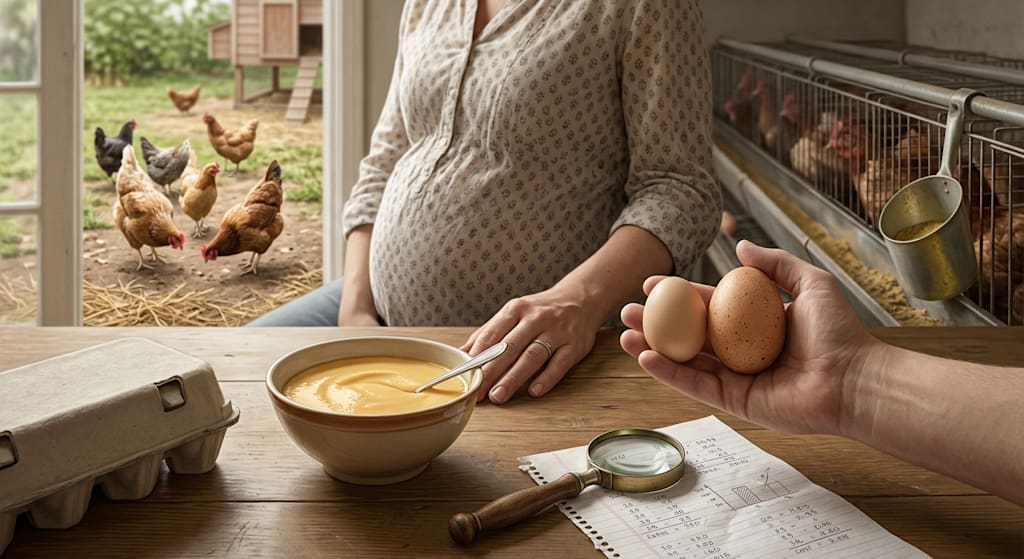
On the New Year trip home, a relative set a bowl of steamed egg custard in front of the pregnant woman. “These are free-range eggs,” she said. “They’re nutritious. I saved them for you.” I took a bite and said nothing. After three years of raising chickens, I knew half of that sentence was right. The other half never got said.
Nutrition tests: the numbers side by side, the gap is small
The National Food Quality Inspection and Testing Center has run comparisons. Across more than 40 major nutrients in commercially sold eggs, it found no significant difference between free-range eggs and regular eggs. I copied the two numbers onto paper: about 13.3 to 14.4 grams of protein per 100 grams in free-range eggs, and about 12.9 to 13.3 grams in regular eggs. Side by side, the gap is less than a gram. An expert committee of the Chinese Nutrition Society also measured 17 amino acids and concluded there was no obvious difference.
Amino acids are the building blocks of protein, and they matter for children’s growth and fetal development. On this measure, free-range eggs do not have an overwhelming advantage.
So why do they taste better? Free-range chickens move more and get more sun. Their eggs may have slightly more inosine monophosphate and some umami amino acids, and possibly more vitamin D. That is where the taste difference comes from. That does not mean free-range eggs win across the board nutritionally.
Cholesterol: my finger paused on the paper
When I looked through the China Food Composition Tables, the free-range egg column said: cholesterol 1,177 milligrams per 100 grams. Regular eggs: 509 milligrams. My finger paused on the paper.
For a 45-gram free-range egg, that comes to about 530 milligrams of cholesterol per egg. A regular egg is about 230 milligrams. Older dietary guidelines recommended no more than 300 milligrams of cholesterol a day. Newer versions have relaxed that for healthy people, but people with high blood lipids still need to watch it.
A single egg won’t put anyone over the limit. The risk comes from a common habit: because people believe free-range eggs are more nourishing, they give a child or a pregnant woman two or three a day. Added up, that cholesterol load matters.
Free-range eggs are fine to eat. There is no need to treat them as a nutritional supplement and pile on more every day.
The yellow fat I felt when slaughtering chickens
In the years I raised chickens, I kept mostly roosters, with about 10% female chicks mixed in. I usually had more than 100 hens. Once a free-range hen and a cage-raised hen are slaughtered, you know by touch.
A free-range chicken’s yellow fat is a bright yellow slab stuck to the abdominal wall. The intestines are clean, with strong motility. A cage-raised chicken’s fat mostly clings to the intestines in a clump. No movement, poor gut motility, and the fat grows along the intestines. This is a trace left by the farming method. You cannot judge it simply by yolk color.
Free-range chickens move a lot, so part of the energy they eat is spent on activity. Their laying rate is lower, usually one egg every two days. Cage-raised chickens lay one egg a day, and feed costs are lower. Different cost structures naturally make different prices.
The math I worked out squatting in the market
In the supermarket, “free-range eggs” at 12 to 15 yuan per jin are small, 10 to 12 eggs per jin, about one yuan each. Does that price hold up? It depends on what kind of “free-range” it is.
Farmers who really free-range their chickens and do not make eggs their main business keep only a few hens. The eggs get eaten locally. They do not even need to be sold at the market. But once free-range eggs become a business, pure free-ranging stops making sense: low laying rate, eggs laid everywhere, spoiled by rain, eaten by wildlife, all losses. So the common practice is to put native-breed hens in cages or confinement. The difference between 15 yuan and 5 yuan is often just the difference between “cage-raised fast-growing chickens” and “cage-raised native-breed chickens.”
I did the math myself. For real free-range eggs, after adding brooding, the slow start of laying, losses, labor, packaging, transport, storage, and sales, below 2 yuan per egg is hard to sustain commercially in the long run. So when you see very cheap “free-range eggs,” ask a question. When you see very expensive ones, know that expensive does not necessarily mean real free-range.
Dyes and uniformly golden chickens
Free-range eggs have a market because their flavor has value. Where there is the real thing, there are fakes. A common shortcut is adding tartrazine to feed to yellow the yolk. Add too much and the white turns slightly yellow too. That yellow tends to be a flat, dull yellow, not a natural bright yellow. In the market, if you see a chicken, duck, or fish that is golden all over, be careful. Natural things are rarely that uniform.
Old hens are the same. Free-range chickens and culled cage-raised hens may both have yellow fat when slaughtered, and both take two hours to stew. The difference is where the fat is: free-range chickens have a slab of fat stuck to the abdominal wall, with clean intestines; cage-raised chickens have fat clinging to the intestines in a clump. You feel this by hand, not by reading a label.
Pick up an egg and shake it
For choosing eggs for children and pregnant women, my advice is simple.
First, choose fresh regular eggs or branded eggs with reliable hygiene. Large-scale farms have unified feed control and hygiene management, so microbial safety is usually more stable. Free-range environments actually carry higher risks of exposure to pesticides, pollutants, and Salmonella. “Natural” does not mean safe.
Second, free-range eggs can be a treat for taste, not a nutritional necessity. Children and pregnant women need steady high-quality protein and a balanced diet. One regular egg a day, along with meat, milk, beans, and vegetables, is more reliable than believing “free-range eggs are more nourishing.”
Third, if you eat free-range eggs, watch the amount. If you like the flavor, eating them occasionally and in moderation is fine. Do not add two or three a day just because “expensive means good.”
Fourth, do not pay too much of a premium for a label. When you cannot trace the source, what you buy with expensive “free-range eggs” is likely just a taste preference and a cholesterol load.
Pick up an egg and shake it. Listen for water sound. Check the shell for mold spots. Freshness and safety are worth paying for more than whether an egg is “country” or not.
Back to that bowl of egg custard
Later the relative brought another bowl, and I took it again. I took a bite and said to her, “This is tasty. Once in a while is fine. For everyday, one regular egg a day is enough. Fresh and clean is better than anything.” She paused for a second. “So the cheap kind in the supermarket is okay too?” she asked. “Yes. Shake it. No water sound, no mold spots on the shell, and it’s fine.”
She didn’t ask again. Steam rose from the bowl of egg custard. The pregnant woman took a spoonful and said it was good. I didn’t say anything more.
About the Creator
Jin
Writer of reamstories
https://reamstories.com/jin
Enjoyed the story? Support the Creator.
Subscribe for free to receive all their stories in your feed. You could also become a paid subscriber, letting them know you appreciate their work.
Comments
There are no comments for this story
Be the first to respond and start the conversation.