
I Did the Calorie Math on a Kaiseki Dinner. The “Tiny” Portions Are Not a Scam.
Eight courses, a dozen little bowls, and 800 to 1,000 calories: why traditional Japanese meals look stingy and still leave you full.
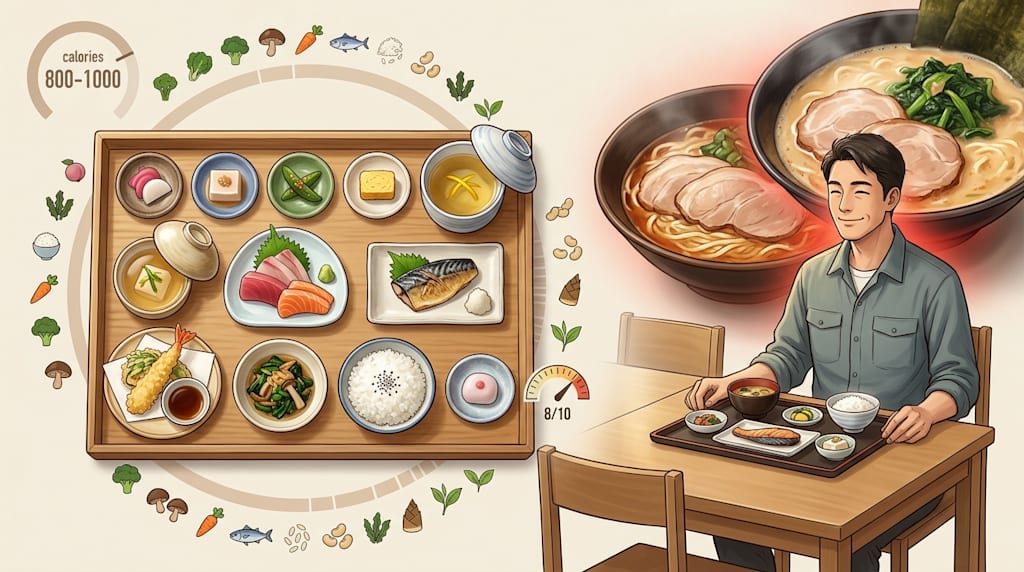
A full kaiseki set looks like a tasting menu for Borrowers. Eight courses, each one or two bites. It still adds up to 800 to 1,000 calories.
That number matters. For adults 18 to 49 with light activity, Japan’s Ministry of Health, Labour and Welfare and China’s dietary guidelines put daily needs at about 1,800 to 2,000 calories for women and 2,250 to 2,400 for men. Split 3:4:3 across three meals, lunch is about 700 calories and dinner about 600 for women. A kaiseki set already passes the lunch or dinner mark. The portions feel tiny because the meal is split into eight presentations that each look like a snack.
Satiety also comes from pace. A kaiseki meal can run one to two hours. Courses arrive with gaps. The stomach empties slowly, and fullness signals build. By dessert, you may not be stuffed, but you are probably not hungry. A bowl of ramen eaten in five minutes gives you a different ride: blood sugar spikes, then drops.
The eight courses, one by one
The first course is an appetizer plate. Clockwise from the left: lily-bulb tofu, marinated greens, simmered butterbur, and monkfish liver. Four small items, a bite each. That is already four ingredients. Taste from light to rich.
The second course is the main soup, or wan-mono. Spring brings a clear salted sea bream soup. Autumn often brings matsutake dobin-mushi. Other seasons get a clear soup with shrimp shinjo, a seafood dumpling. One bowl, but it carries seafood, dashi, and a sense of the season.
The third course is sashimi, eaten from light to rich: white-fleshed fish first, then shellfish, then fatty tuna. Two or three slices, three or four kinds. Small in quantity, high in protein and flavor.
The fourth course is grilled food, such as pomfret Saikyo-yaki with yuzu-scented grilled scallop. The pink hajikami ginger on the side is edible. It works like the pickled ginger served with sushi: it cleans the palate and cuts richness before the next course.
The fifth course is fried food, often tempura: shrimp, Japanese whiting, long green pepper, pumpkin. This is where plating plays a trick. At a group meal, I might take four or five pieces of sweet-and-sour pork from a shared plate. Empty everyone’s share of tempura onto one big platter and it stops looking tiny. Individual plating creates the illusion of a small portion.
The sixth course is simmered or steamed food, such as simmered seasonal vegetables. As a Lingnan girl who cannot do a meal without greens, I have to say this amount of cooked vegetables is not enough. Across a whole kaiseki, vegetables are not the strong point. A vegetable stomach will complain.
The seventh course is the staple: sushi, or a bowl of rice with miso soup. The eighth is dessert: fruit with Japanese sweets, or sometimes Western-style pudding with fruit.
Eight courses, 800 to 1,000 calories. Each course looks small on its own. Together they pass the calorie mark for lunch or dinner. “You won’t go hungry through the whole sequence” has a calorie ledger behind it, not just psychology.
Teishoku is the everyday answer
Kaiseki is not daily food in Japan. The teishoku set meals ordinary people eat most often are normal in size. A worker’s lunch teishoku at 800 to 1,000 yen, about 33 to 43 yuan, comes with rice, one main dish, miso soup, pickles, and a small side dish. That is roughly 700 to 900 calories, with enough protein and carbohydrates. You finish neither stuffed nor hungry. The 750-yen set meal at a university cafeteria, about 32 yuan, also left me full.
Teishoku and kaiseki use two different satiety designs. Teishoku is everyday and efficient: one tray arrives, and the calorie and nutrient balance is clear. Kaiseki is slower and experience-driven: it trades pacing for fullness and variety for total volume. Both share one idea. Small portions, many ingredients, total calories on target.
Thirty ingredients a day drives the small-plate style
Japanese official guidance recommends 30 kinds of ingredients a day. It sounds like a slogan. In practice, it means small portions, many kinds, and total calories on target. A 30-ingredient bento may look tiny, but it contains 30 ingredients, provides half the vegetables you need in a day, and hits the calorie target.
The eight-course kaiseki structure is an ingredient-variety machine. Four appetizer items, a soup, three or four kinds of fish and shellfish, a grilled dish with ginger, a tempura platter, a simmered dish, a staple, and dessert. A single set easily passes 20 ingredients. Add breakfast natto, miso soup, nori, and rice, and 30 a day is not hard. Each item is smaller so the variety can be larger. The larger the variety, the broader the nutritional coverage.
The counterexample: iekei ramen
Japanese food also has high-calorie branches. One bowl of rich iekei ramen is 850 calories. Add rice or another side and it heads for 1,500 calories, well past what the body needs. Tonkatsu teishoku, all-you-can-eat sukiyaki, and heavy ramen sets are the same story: they look normal and hit hard.
“Japanese food equals light and small” is a lazy label. The set structure and the pace of eating do the work, not the broad category. Kaiseki’s tiny portions are structural restraint. Iekei ramen’s normal-looking bowl is calorie density. Both are Japanese food. Their logic runs in opposite directions.
Hara hachibu
Japan has a household health saying: hara hachibu. Eat until you are eight-tenths full, and you will live long without illness. Traditional Japanese food takes this idea seriously. The small bowls and small plates in a university cafeteria have calorie control built in. Binge eating is hard.
Hara hachibu is not only about eating less. It leaves two-tenths for digestion and activity. Modern research on calorie restriction and the smoothing effect of eight-tenths fullness on post-meal blood sugar swings lines up with the old saying. The “not sleepy after eating” feeling of a Japanese set meal comes largely from controlled carbohydrate proportions and slower eating.
The takeaway
In a world of calorie overflow, restraint that looks tiny is hard to achieve. It takes ingredient pairing, plating, pace, and calorie math working together so each course looks small and the whole set lands just right. Next time you see Japanese food in little dishes and small bowls, do not rush to call it stingy. Count the ingredients. Do the calorie math for the whole set. You may find that the meal is not trying to leave you hungry. It is trying not to leave you too full.
About the Creator
Jin
Writer of reamstories
https://reamstories.com/jin
Enjoyed the story? Support the Creator.
Subscribe for free to receive all their stories in your feed. You could also become a paid subscriber, letting them know you appreciate their work.
Comments
There are no comments for this story
Be the first to respond and start the conversation.