
Engine Block Stew
A frozen Kansas night, a dented ammo can and the best terrible meal I ever ate

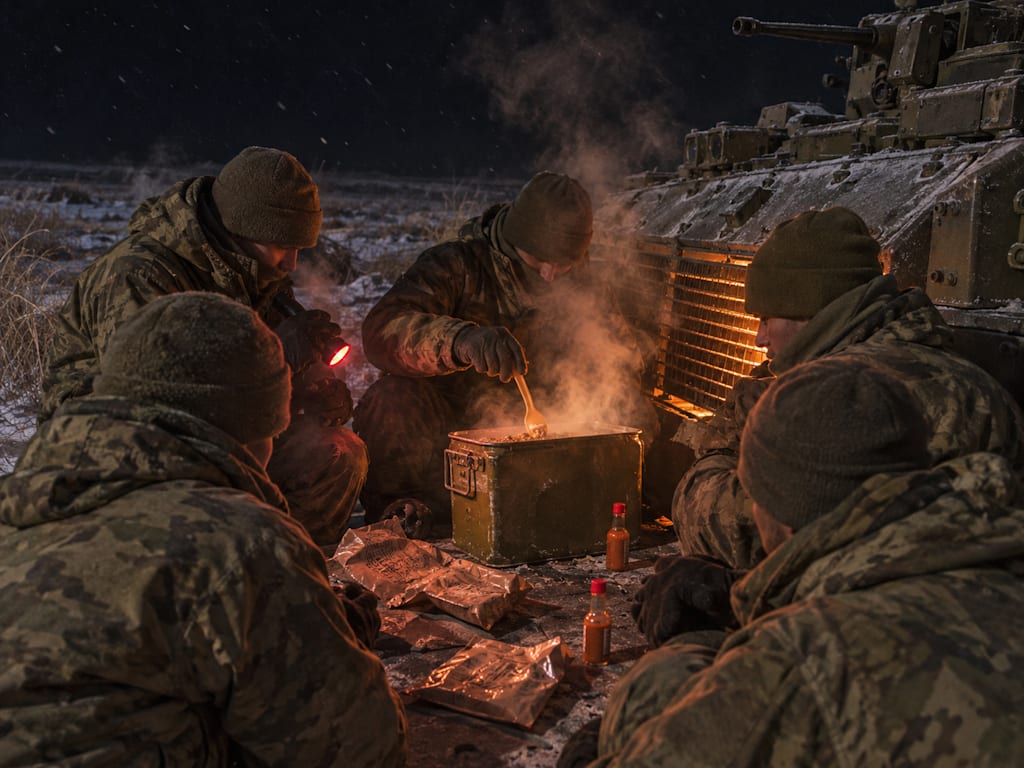
There is no restaurant in America that will serve you a meal cooked on the engine deck of a Bradley Fighting Vehicle. No health inspector would sign off on it. No chef would put his name on it. And no menu could describe it honestly without scaring off the customers.
But I have eaten a lot of meals in my life, in a lot of places, and that one still ranks near the top.
The Cold
It was a winter field exercise at Fort Riley, Kansas, the kind of week the Army seems to schedule on purpose. If you have never spent January on the Kansas prairie, let me describe it for you. The wind does not blow so much as it searches. It finds the gap between your collar and your neck, the seam at your wrist, the spot where your boot laces cross. It comes from Nebraska with nothing in its way, and it has opinions about you.
We had been out for days. The temperature hovered somewhere around ten degrees, and the wind chill pushed it well below zero. The ground was frozen hard enough that digging in felt like chipping at a sidewalk with a spoon. Everyone was tired in that deep, gray way that sleep does not fix, because nobody was getting real sleep anyway.
And we were eating MREs. Meals, Ready-to-Eat. Three of them a day, every day, pulled cold from a cardboard case that had been sitting in the back of a vehicle overnight.
People who have never eaten an MRE tend to joke about them. People who have eaten a lot of them tend not to. An MRE is a marvel of engineering and a modest achievement in cuisine. It will keep you alive. It will give you the calories you need to keep moving. What it will not do, in a Kansas wind at ten degrees, is make you feel human.
The flameless ration heaters help, when they work. You add a little water, slide the pouch in, and wait for the chemical reaction to warm your food. In that cold, though, the heater fought a losing battle. You would end up with an entrée that was hot on one side, frozen in the middle, and lukewarm everywhere else. It was like eating a meal that couldn't make up its mind.
The Specialist
Every unit has a soldier like the one I am about to describe. He was a young specialist from somewhere in the rural South, the kind of kid who could fix anything with a multitool and a roll of hundred-mile-an-hour tape. He did not talk much in formation. He talked a lot around a vehicle. He was the one who knew which panel rattled, which seal leaked, and exactly how long the engine had to run before the grille got hot.
That last piece of knowledge turned out to matter.
On the fourth or fifth night, I came around the back of his Bradley and found him and three other soldiers huddled on the downwind side, crouched close to the engine compartment. There was steam rising into the dark. For a moment I thought something was wrong with the vehicle. Then I smelled it.
It smelled like food. Real food. Hot, savory, peppery food.
"What are you doing, Specialist?" I asked, in the voice a senior noncommissioned officer uses when he already suspects the answer and has not yet decided whether to be angry about it.
He looked up, completely unbothered, and said, "Making stew, Sergeant Major. You want some?"
The Recipe
I need to be clear that there was no recipe. What I watched was closer to an improvised engineering project than to cooking.
He had taken an empty metal ammunition can, cleaned it out as well as anyone can clean anything in the field, and set it in a spot near the engine where the heat came off strongest. Into that can went the contents of every MRE the crew could spare.
Beef stew went in. So did chili with beans. Somebody contributed a pouch of chicken and noodles. Someone else added the beef ravioli, which drew a few objections and was overruled. Then came the cheese spread, squeezed out in thick orange ribbons. Then crackers, crumbled up to thicken it. Then the hot sauce, every little bottle anyone had, because MRE hot sauce is the closest thing a soldier has to currency.
A packet of instant coffee went in. I asked about that one. He told me it "deepened the flavor." I still do not know if he was serious.
There was a packet of peanut butter. He held it over the can, thought about it for a long moment, and then put it in his pocket instead. Even he had limits.
He stirred the whole thing with a plastic MRE spoon that bent every time he hit a thick spot. The Bradley's engine idled behind him, throwing off warmth into the freezing air, and the stew slowly went from cold paste to something that bubbled.
I have been asked before what it tasted like. The honest answer is that it tasted like everything, all at once. It was salty and smoky and spicy. The chili gave it body. The cheese made it rich. The crackers gave it a texture somewhere between gravy and wet cement. The ravioli, against all odds, held together and showed up now and then like little surprise dumplings. And under it all was a faint metallic note that I have decided, after many years, to attribute to the ammo can and not think about any further.
The Moment
Here is the thing that the menu would never capture.
I stood there with five or six soldiers in the dark, behind a thirty-ton armored vehicle, passing around one hot can and taking turns with a couple of spoons. Nobody was in charge of the line. Nobody counted portions. The youngest private got the first full bite because the specialist told him to go first. Rank did not matter much in that circle. Cold does a good job of leveling people.
For a few minutes, nobody complained about the wind. Nobody talked about the training schedule or how many more days we had. One soldier told a long, terrible story about his uncle's fishing boat. Another one described, in loving detail, the barbecue place back home he planned to visit the moment he got leave. We laughed harder than the stories deserved, because that is what tired people do when they are finally warm.
I have been to formal military dinners with white tablecloths, polished silver and toasts to the President. I have eaten in mess halls on three continents. I have shared bread and tea with soldiers and leaders in places where I did not speak the language, where the meal itself was a kind of negotiation and a kind of trust. Many of those meals were memorable.
But that ammo-can stew taught me something I carried through the rest of my career. Leadership is not only about the big decisions. A lot of it happens in small moments like that one, when a young soldier solves a problem nobody assigned him and then turns around and offers the result to everyone else. He did not make that stew for himself. He made it for his crew. When I walked up, he made room for me too.
The Lesson
As a senior noncommissioned officer, I was supposed to care about standards. And I did. Somewhere in a regulation there was probably a line about not cooking food on the engine of a combat vehicle. I am fairly sure there was a line about using ammunition cans for their intended purpose.
I had a choice that night. I could correct him on the spot, or I could pick up a spoon.
I picked up a spoon.
Later, quietly, we talked about safety. We talked about keeping it away from anything that could catch fire and making sure the vehicle was in a safe spot. He listened, nodded and adjusted. The next night, the stew was back, a little farther from the exhaust and with better ventilation. That is how good soldiers respond to a correction. They do not stop solving the problem. They solve it better.
What I did not do was take that meal away from them. Morale in the field is not built by speeches. It is built by warmth, by laughter and by the feeling that somebody is looking out for you. That specialist understood that better than most leaders twice his age. All I had to do was recognize it and protect it.
Why I Still Remember
Years later, I have forgotten the name of that exercise. I could not tell you which training objectives we hit or missed. I do not remember the briefings, the after-action reviews or the slides.
I remember the stew.
I remember the steam rising off that can into the black Kansas sky. I remember the way the engine's low rumble felt through the soles of my boots. I remember the hot sauce burning my lips and the cheese sticking to the roof of my mouth. And I remember the faces of those young soldiers, red from the wind, grinning around a meal they had invented out of nothing.
You will never find engine block stew on a restaurant menu. You would never want to. It was a mess. It was probably a safety violation. It was, by any objective standard, a terrible dish.
It was also one of the best meals I have ever eaten.
Because the best meals are not really about the food. They are about who is standing next to you when you eat it, how cold it is outside, and who decided to share.
Somewhere out there, that specialist is probably a grandfather now. I hope he is still making stew. And I hope he still hands the first bite to the youngest person in the room.
About the Creator
Charles V Sasser Jr
Retired U.S. Army CSM, SOFREP defense analyst, and author of the thriller Led by Love of Country. I translate military doctrine into strategic insights on global conflicts, defense technology, and executive leadership.
Enjoyed the story? Support the Creator.
Subscribe for free to receive all their stories in your feed. You could also become a paid subscriber, letting them know you appreciate their work.
Comments
There are no comments for this story
Be the first to respond and start the conversation.