
Corn Starch Market Is Entering a Bigger, Smarter Growth Phase
From food processing to biodegradable packaging, corn starch is moving far beyond the kitchen and into the center of industrial innovation.

A quiet ingredient with a loud future
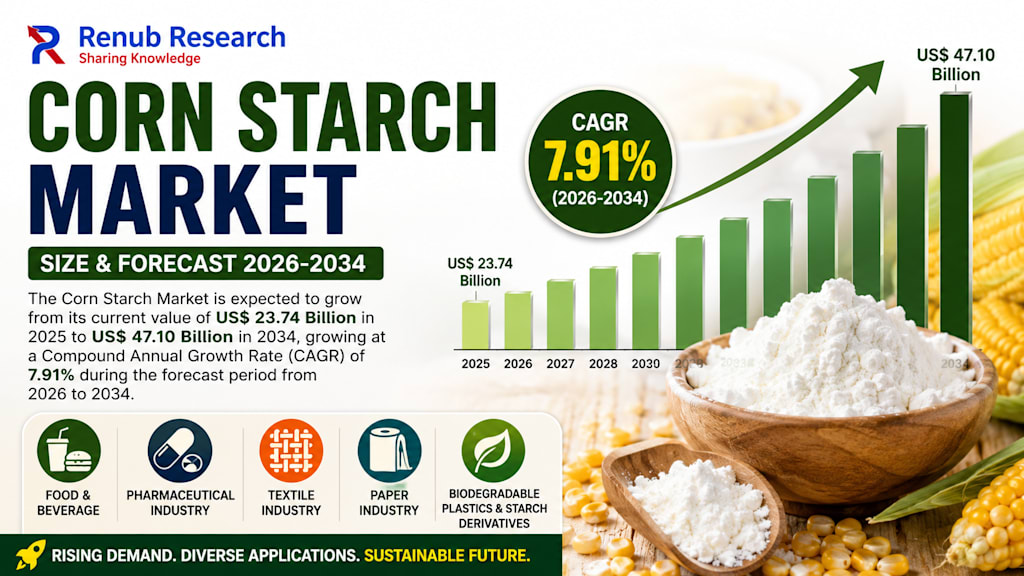
Corn starch rarely gets the spotlight, yet it is one of those ingredients that quietly powers a wide range of products people use every day. It thickens soups and sauces, helps tablets hold their shape, strengthens paper and textiles, and is increasingly being explored for biodegradable materials and other sustainable applications. According to Renub Research, the Corn Starch Market is expected to rise from US$ 23.74 Billion in 2025 to US$ 47.10 Billion in 2034, expanding at a CAGR of 7.91% between 2026 and 2034. That trajectory reflects how widely corn starch is used across food, pharmaceuticals, industrial manufacturing, and packaging.
What makes the market especially interesting is that corn starch is no longer being viewed as a simple commodity ingredient. It is increasingly positioned as a functional, plant-based, and adaptable raw material that fits several modern trends at once: convenience food demand, clean-label preferences, sustainability goals, and industrial efficiency. As processed food consumption rises and manufacturers look for more versatile ingredients, corn starch continues to gain relevance across North America, Europe, Asia, and emerging markets.
Why corn starch remains so important
Corn starch is derived from the endosperm of corn kernels and is typically produced through wet milling. It is valued for thickening, binding, and stabilizing properties, which explain why it is used in soups, sauces, gravies, puddings, pie fillings, baked goods, confectionery, and snacks. Its use is not limited to food. In pharmaceuticals, it works as a tablet binder, while in cosmetics it can serve as an absorbent material. In industrial settings, it supports paper, textile, adhesive, and biodegradable packaging production. That broad functional base is one of the main reasons it remains in steady demand.
Its appeal also lies in its practicality. Corn starch is affordable, plant-based, and flexible enough to serve multiple industries without major reformulation. In a market where companies are trying to balance cost, performance, and sustainability, that combination is hard to ignore. The more the global economy shifts toward processed foods and environmentally friendly materials, the stronger the case becomes for corn starch as a dependable ingredient and industrial input.
Processed food demand is still the biggest engine
One of the strongest growth drivers for the market is the expanding processed and convenience food industry. Rising populations, urban lifestyles, and higher demand for ready-to-eat meals are pushing food manufacturers to rely more heavily on functional ingredients such as corn starch. It helps deliver the texture, stability, and thickness that modern food products need, especially in soups, sauces, dairy products, confectionery, frozen meals, and meat-based prepared foods.
Quick-service restaurants and frozen food consumption are also reinforcing this trend. In practical terms, corn starch solves multiple product-development problems at once: it improves mouthfeel, supports consistency, and helps products hold up across storage and cooking conditions. That is why it remains an important choice for food formulators, particularly in markets where packaged food consumption continues to climb. Renub Research’s report also notes that Ingredion launched NOVATION Indulge 2940 in February 2024, a non-GMO native corn starch designed for gelling and co-texturizing dairy and alternative dairy foods, showing how innovation is expanding the ingredient’s role in clean-label food applications.
Sustainability is turning corn starch into a strategic material
The second major growth story is sustainability. With regulatory pressure increasing around plastic waste and climate concerns intensifying across industries, corn starch has found a new opening in biodegradable materials and bio-plastics. The report highlights corn starch as a key component in bio-plastic manufacturing, and that is important because it places the material directly inside the broader shift toward circular-economy solutions.
This is not just a theory about the future. The report points to developments such as CornNext’s renewable corn starch-based material, which is described as biodegradable and designed for diverse applications, as evidence that the innovation pipeline is already moving. As companies look for alternatives to conventional plastics, corn starch is increasingly being studied not only as an ingredient but also as a base material for packaging and performance-driven sustainable products.
Pharmaceuticals and industrial use are widening the demand base
Beyond food and sustainability, corn starch is also gaining traction in pharmaceuticals and industrial manufacturing. In tablets, it functions as a binder, disintegrating agent, and filler. That matters because the growth of healthcare and generic drug production creates steady demand for pharmaceutical-grade starch. DFE Pharma’s launch of starch-based excipients in 2022, including native, slightly pre-gelatinized, and fully gelatinized corn starch variants, reflects this specialized demand.
Industrial use is equally important. Corn starch is used in paper, textiles, adhesives, and corrugation, where it contributes to strength, bonding, and surface finish. The report also notes that industrialization in Asia-Pacific and Latin America is supporting demand in these sectors. In other words, corn starch is not dependent on a single market. It has a diversified demand structure, which gives the category more resilience than a narrowly used ingredient would have.
Native corn starch and modified corn starch are serving different needs
The market is also being shaped by the split between native and modified corn starch. Native corn starch is growing steadily because it aligns with clean-label and minimally processed product trends. Since it is directly extracted from corn and does not undergo chemical modification, it fits well in food products that need a natural positioning. It is commonly used in soups, sauces, bakery products, confectionery, and dairy products, while also serving textile and paper applications.
Modified corn starch, on the other hand, is gaining speed because industries need better stability, heat resistance, acid tolerance, and shear resistance. That makes it especially useful in frozen foods, ready-to-eat products, adhesives, coatings, textiles, and biodegradable plastics. As manufacturers increasingly need starches with tailored performance, modified corn starch is becoming a high-growth part of the market. The report suggests that this segment should continue expanding as product development becomes more specialized.
Food and beverage still leads the end-user landscape
Among end-user segments, food and beverage remains the largest consumer of corn starch. It is used to thicken soups, sauces, gravies, desserts, beverages, bakery products, and confectionery items without changing taste. That is a major advantage in food formulation because it gives manufacturers the ability to improve texture and stability while preserving flavor. Rising consumption of packaged and convenience foods, along with the popularity of gluten-free diets, is strengthening this segment further.
Animal feed is another notable area. Corn starch serves as a carbohydrate source that supports energy and digestibility in livestock, poultry, and aquatic animal nutrition. As global demand for meat, dairy, and poultry increases, feed production rises too, which supports starch consumption. Paper and board also remain important because corn starch helps with surface sizing, fiber bonding, tensile strength, and surface finish, especially in packaging-related applications.
Regional markets are adding their own momentum
The United States stands out as a mature but strong corn starch market because of its reliable corn production base. The food and beverage industry drives a large share of demand, but pharmaceuticals, paper, textiles, and adhesives also matter. The report points to the country’s strong raw-material position and ongoing interest in bio-based products and modified starch as important advantages.
The United Kingdom is being shaped by food processing, convenience foods, clean-label demand, and sustainable packaging, while India is seeing rapid growth due to industrialization, packaged-food adoption, and expanding usage in textiles, paper, and pharmaceuticals. The report also notes a March 2025 Cargill corn milling plant inauguration in Gwalior, tied to rising demand from confectionery, infant formula, and dairy industries. Saudi Arabia, meanwhile, is showing steady growth through food processing expansion, economic diversification, and the rising appeal of sustainable packaging materials.
The market is promising, but not without pressure
The corn starch market is not growing in a vacuum. Raw material price volatility remains a real challenge because corn prices can shift due to weather, crop disease, trade policy, ethanol demand, and agricultural subsidies. That can squeeze margins, especially for smaller manufacturers that lack the scale to absorb sudden swings in input costs.
Competition from alternative starches such as potato, tapioca, wheat, and rice starch also creates pressure. In some food applications, tapioca or other starches may be preferred for texture, flavor, or clean-label positioning. In industrial use, synthetic binders and chemical additives can also compete on cost or performance. The result is a market that must keep innovating, especially through modified starch and specialty formulations, in order to defend and expand its share.
Final thoughts
Corn starch may not be a glamorous market, but it is one of the most versatile and strategically useful materials in the ingredient economy. Its growth is being driven by several powerful forces at once: convenience foods, clean-label demand, biodegradable materials, industrial applications, and pharmaceutical use. Renub Research’s forecast of US$ 47.10 Billion by 2034 suggests that the market is not only resilient but also expanding into higher-value applications.
That is the real story here. Corn starch is evolving from a basic thickener into a multi-industry solution that touches food innovation, sustainable materials, packaging, and health-related manufacturing. As companies continue to seek cost-effective, plant-based, and performance-driven ingredients, corn starch is likely to remain a quiet but powerful winner in the years ahead.
About the Creator
Enjoyed the story? Support the Creator.
Subscribe for free to receive all their stories in your feed.
Comments
There are no comments for this story
Be the first to respond and start the conversation.