
A Virus Didn’t Wipe Out the Taste of Your Childhood Tomatoes
Whiteflies, breeding trade-offs, green harvests, and a supply chain that never put flavor first
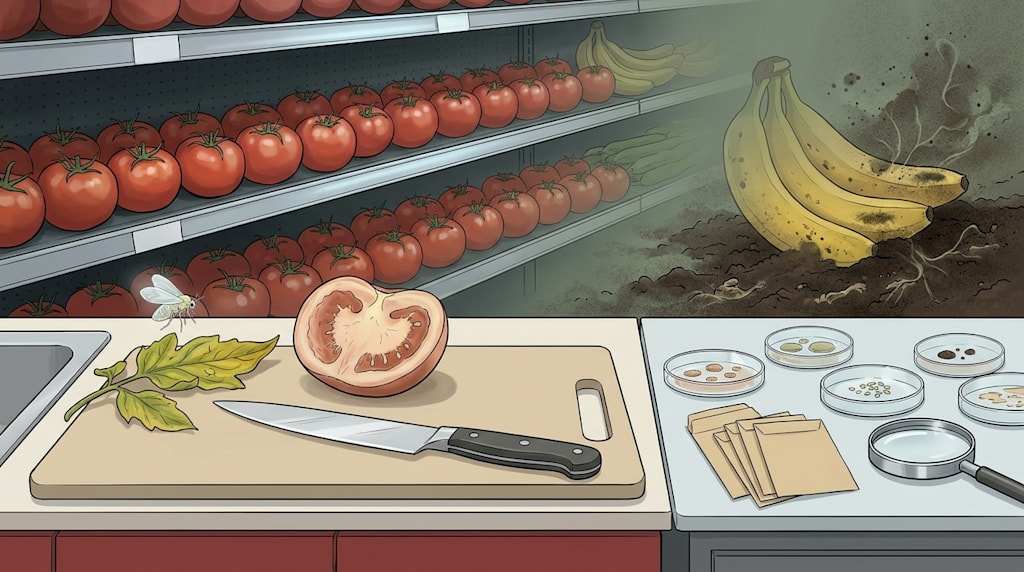
The vendor handed me a tomato. I squeezed it. Tight skin, hard fruit. At home I cut it open. The knife came away dry. Inside, an empty ring, few seeds, flesh that looked tired. It worked in scrambled eggs. After two bites raw, I stopped.
A story circulates online: a virus swept the world twenty years ago and wiped out the juicy, sandy tomato of childhood. The market now sells disease-resistant replacements, and that is why they taste like nothing. The story has a factual background. Several key links are wrong, and the wrong links are the scary ones.
Whiteflies spread the virus. They are not flying AIDS needles.
TYLCV, tomato yellow leaf curl virus, is transmitted by whiteflies. The Q-biotype whitefly is efficient at it. A viruliferous adult can feed on a healthy plant for a few minutes and send the virus in. The virus multiplies inside the tomato. Leaves curl, thicken, and yellow. Flowers and fruit drop. Severely affected fields lose obvious yield. No pesticide directly kills the virus. Control depends on resistant varieties, insect-proof netting, isolated seedlings, and lower vector populations.
The original story turns this into “a mosquito bites someone with AIDS, becomes permanently infected, and passes the virus through its eggs to the next generation of mosquitoes.” Research on TYLCV vertical transmission in whiteflies is colder. Viral DNA can be detected in eggs and nymphs. It usually is not detected in adult progeny. Even in the TYLCV and Q-biotype whitefly combination, only 2 to 3 percent of adult progeny carry the virus. First-generation adults that develop from viruliferous eggs cannot infect plants. The researchers’ judgment is that this low-frequency vertical transmission has limited significance for field epidemiology.
Field spread depends on large numbers of viruliferous adults feeding. It does not depend on hatching a next generation of permanently infected insects. Writing this link as a horror movie distorts the transmission story.
Old tomatoes were not globally wiped out.
TYLCV spread in China in the mid-to-late 2000s. Disease-resistant breeding then changed the structure of commercial varieties. That part is factual. Commercial mainstream varieties were replaced. The tomato species was not wiped out. Neither were all old varieties’ genetic resources. Global tomato germplasm exceeds 75,000 accessions. Landraces, heirloom varieties, and breeding materials are preserved in genebanks and in farmers’ and community seed systems. Saying “the childhood tomato was wiped out by a virus for more than twenty years” turns replacement of mainstream commercial varieties into species extinction. It skips genebanks, community preservation, and breeding materials.
Market tomatoes became worse-tasting for more than one reason. Traditional sandy-fleshed tomatoes have thin skins, soft fruit, and a tendency to crack. They suit local short-distance sales or home consumption. Modern commercial varieties must pass several filters: firmness, shipping tolerance, shelf life, and visual uniformity. Once safe arrival at the table becomes the precondition, flavor moves back. Long-distance supply chains also harvest at the green stage, when flavor compounds have not accumulated fully. The tomato you bite into and the tomato ripened on the vine are different objects.
Flavor loss has a chemical ledger.
A 2017 Science study examined flavor-associated compounds in 398 modern varieties, heirloom varieties, and wild materials. Many key flavor compounds in modern commercial varieties are lower than in older varieties. That includes sugars, acids, and multiple volatiles. Later research identified reductions in 13 important flavor volatiles in modern varieties. “Today’s tomatoes have no tomato flavor” has a chemical basis.
A resistance gene does not automatically destroy flavor. A 2025 study introduced Ty-1, a TYLCV-resistance gene, into traditional Muchamiel-type tomatoes. The presence of Ty-1 was associated with lower organic acid concentration. Hybrids performed better than homozygous lines. Soluble sugars and some secondary metabolites showed no observed negative effect. Disease resistance and flavor involve trade-offs in trait combinations. Once resistance becomes an entry requirement, breeders have less room to defend the flavor baseline.
Some domestic breeding teams are already trying to recombine the old flavor profile with disease resistance and shipping tolerance. They have released new lines that passed variety registration. The path is slow. A breeding cycle runs seven to ten years. Flavor can move back. It will not return to the version in memory that never went through supply-chain filtering.
Bananas show what uniformity does to an industry.
Gros Michel bananas left global commercial export cultivation in the 20th century because of Fusarium oxysporum f. sp. cubense TR1. They did not disappear. Smallholder systems in Central and South America and Africa still grow them. Genebanks preserve them. Cavendish took over. Cavendish tolerates TR1, which allowed commercial planting on TR1-contaminated land. Cavendish is highly susceptible to TR4. TR4 spores survive in soil for decades. In 2019, Colombia, a major South American production area, confirmed TR4. The industry pressure is measurable.
Global commercial export bananas sat in a single clonal line for decades. TR1 arrived. The industry had no genetic buffer. Cavendish took over. The same structure repeated. Uniformity amplifies risk. The pathogen finds the amplifier. Humans have over a thousand banana varieties and germplasm resources. The question is whether an alternative combination can work at industrial scale with acceptable disease resistance, yield, and taste.
Putting flavor back in the queue
Market tomatoes taste bad because several filters stack on top of one another: disease-resistance admission, commercial selection, long-distance transport, and green-stage harvest. Flavor has long ranked low in this sequence. TYLCV created pressure. It accelerated the replacement of old varieties by resistant ones. The “virus wiped out the childhood tomato” story compresses a complex breeding dilemma into a disaster thriller. It skips germplasm resources, flavor chemistry, and supply-chain choices.
Scientists repeatedly emphasize genetic diversity. The reason sits in banana soil. Uniformity lets a pathogen succeed once and amplify into an industry crisis. Tomato breeders are trying to recombine disease-resistance backgrounds with flavor. Consumers can make “tasting good” have a price on the shelf. Both things are slow.
I put the half-cut tomato into a zip-top bag. The price tag clipped to the bag says “TY-resistant.” I put it back in the fridge. Tomorrow, scrambled eggs.
About the Creator
Jin
Writer of reamstories
https://reamstories.com/jin
Enjoyed the story? Support the Creator.
Subscribe for free to receive all their stories in your feed. You could also become a paid subscriber, letting them know you appreciate their work.
Comments
There are no comments for this story
Be the first to respond and start the conversation.