
The Door Was Unlocked: What Parents Can Give a Daughter When They Have Little Money but Clear Rules
A story about repair, retreat, and the quiet kind of home that lets a woman leave without shame and come back without punishment.
Chen Sui was thirteen when her parents argued in the kitchen.
A bowl knocked against the sink. She stood in the doorway, fingers curled around the frame. Her mother turned. “This is grown-up business. Go do your homework.” Her father said nothing. He put out his cigarette. She went to her room. They kept arguing. No one called her in to decide who was right.
She finished two questions, then listened again. Her mother opened the door, set down a glass of water. “Your father and I will handle our own things. You have a dictation test tomorrow.”
She didn’t ask who was wrong. Her mother didn’t make her pick a side.
A sheet of paper hung on the fridge. Last one out locks the door. Saturday morning, mop the floor. Money lived in a tin box. Take what you take, write it down. Her parents said things straight. They didn’t slam doors and sigh.
Once her father promised the zoo, then got called in to work. He phoned. “We can’t go today. Next Saturday, eight in the morning. I switched shifts.” The next Saturday he waited by the door. She took forever with her shoes. He didn’t yell.
The rules were clear. She didn’t have to guess whether she was allowed to smile.
Relatives came for dinner. A distant uncle patted her shoulder. “What’s the point of a girl reading so many books?” She shrank back. After he left, her father asked, “What did he do just now?” She said, “He patted me. And he said that.” Her father said, “If you don’t like him, stay away. He’s my relative, not yours.”
Her mother called from the kitchen, “Food’s ready.” No one made her go out and toast him.
She could dislike someone without proving first that he was bad.
The summer after eighth grade, classmates signed up for tutoring. Her mother asked, “Are you going?” She said, “No.” Her mother said, “Then don’t. But you tell your teacher yourself. And you finish your summer homework.”
She called the teacher. Her voice shook. The teacher asked why. She said, “I want to do it at home myself.” The teacher paused. “All right.”
Her mother mopped the living room. She didn’t make the call for her.
She could ask for something without crying first.
For Grandma’s birthday, her mother used to remind everyone. Her mother bought the cake. Her mother pushed everyone to call. That year her mother turned the calendar to the date. “This year I’ll keep track. You focus on school.” Chen Sui said, “Then who reminds Aunt?” Her mother said, “Your aunt can remember herself. If she can’t, forget it.”
When something ran out at home, her mother wrote it on a fridge note. Whoever saw it bought it. No one was born to notice the tissues were almost gone.
She didn’t have to be the family’s eyes.
Before she left to work in another city, her father took a card from a drawer and put it on the table. “There’s thirty thousand in it. If you lose your job, come home. First three months, no living expenses. After that, five hundred a month. That’s all this family can do.”
Her mother said, “Your room will be here. You clean it yourself.” Her father added, “If something urgent happens, call. Call in the middle of the night.”
He didn’t say, “Home will always be your backup.” He gave numbers, months, five hundred yuan.
She put the card in her wallet.
The first time she applied for a passport, her mother walked her to the door of the passport office. “I’ll wait outside. Fill out the form yourself. If you make a mistake, ask the information desk.” She stood in line twice. First time, the photo failed. Second time, her signature went outside the box. When she came out, her face was red.
Her mother handed her a bottle of water. “Coming again next time?” She said, “Yes.”
Later she applied for visas, rented apartments, got deposits back, argued with agents. Her mother said on the phone, “If you can’t win, come back. I’ll send your father.” Her father shouted from the side, “I’m not going. She can handle it.”
She hung up and kept arguing.
During her internship, a guy in her group took her proposal and presented it. She called home, voice muffled. Her father was fixing a fan. The screwdriver stopped in the air. He said, “Find the emails. Screenshot the chat. Tomorrow, copy your supervisor on the email. It’s not your fault. Don’t fix yourself.”
Her mother said, “Eat first.” On the table was a plate of scrambled eggs with tomatoes. The eggs were a little overcooked. She ate two bowls of rice.
The next day she sent the email. Her supervisor told her to present again. She didn’t become more obedient.
Her father had once called her “good-for-nothing” in public. That year she did poorly on the college entrance exam. Relatives at dinner asked about her score. Her father had been drinking. He said, “Good-for-nothing.” She put down her chopsticks and left.
Later, one weekend, her father asked her to come home for dinner. The relatives were there. Her father held a cup of tea, stood up, and said, “Last time I said Chen Sui was good-for-nothing. I was wrong. I take it back.”
The relatives laughed it off. Her father didn’t smile. He sat down and drank the tea.
No one brought it up again at that meal. He didn’t buy a cake or slip her pocket money. He said that sentence.
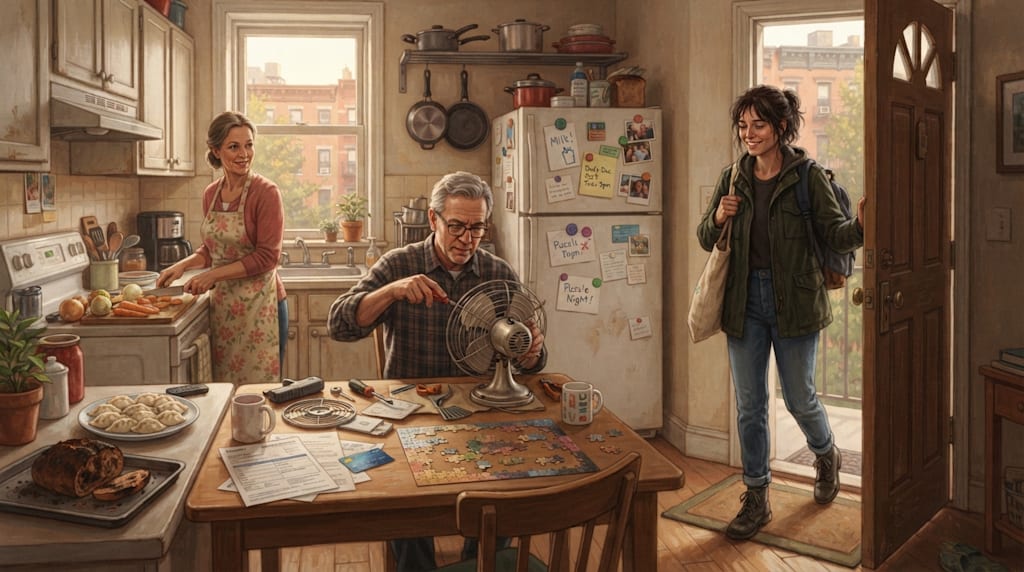
On weekends she did a thousand-piece jigsaw puzzle. Her mother passed by and moved the desk lamp closer. She didn’t ask what use the puzzle was. She didn’t say it was bad for her eyes. Her father watched a ball game on the couch, volume down.
Halfway through, a piece was missing. She lay on the floor looking. Her mother said, “Under the coffee table.” She found it.
No one praised her for sticking with it. No one asked if she could enter it in a contest. When she finished, she took a photo, then took it apart. The next weekend, she started another.
Her parents had their own lives. Her mother went to square dancing. Her father went fishing. Her mother bought a new dress and twirled in front of the mirror. Her father said, “Looks good.” Her mother said, “It was expensive.” Her father said, “Then buy bait two fewer times.”
They didn’t put all their hopes on her. When she called home, her mother said, “I have to go. I’m going dancing.” Her father said, “I haven’t put my fishing rod away.”
She hung up and tossed her phone onto the couch.
Her mother once stuffed a book into her bag called My Body, My Own. Her father once forwarded a video about labor contracts. They didn’t avoid money. Her mother said, “Don’t split credit card payments. The interest is high.” Her father said, “For a rental contract, read the deposit clause. Take photos.”
The first time she dated, her mother said, “Condoms aren’t a bad thing. They’re the bottom line.” Her father coughed on the other end and said, “Your mother is right.”
She didn’t feel ashamed.
At twenty-eight, she had a boyfriend. He was always late. He said she didn’t dress well. He said, “Only I can put up with you.” She brought it up three times. He said, “You’re too sensitive.”
She thought of the fridge note at home: last one out locks the door.
She packed her things and called a moving company. He said, “Why can’t you wait for me to change?” She said, “I don’t want to wait anymore.”
She didn’t wait for evidence awful enough.
After the breakup, she went home. The door was unlocked. Her father was fixing the fan. Her mother was chopping vegetables. Her mother said, “Wash your hands. Eat.” There were dumplings in the freezer. She ate a plate.
Her father asked, “Does the fan still rattle?” She said, “Yes.” He kept turning the screw.
Later she changed jobs, took a pay cut, and went to learn to make bread. Her mother asked, “Is the money enough?” She said, “Enough.” Her father said, “If it’s not, say so.”
She got up at five every day. Her hands had burns and blisters. On the weekend she went home. Her mother popped the blisters and put on medicine. Her father said, “Where’s the bread?” She took out a burnt one. Her father took a bite and said, “Try again tomorrow.”
She nodded. She put the bread in a bag and went back the next day.
The door was unlocked. The dumplings were in the freezer. The fan still rattled.
About the Creator
Jin
Writer of reamstories
https://reamstories.com/jin
Enjoyed the story? Support the Creator.
Subscribe for free to receive all their stories in your feed. You could also become a paid subscriber, letting them know you appreciate their work.
Comments
There are no comments for this story
Be the first to respond and start the conversation.