grief
Losing a family member is one of the most traumatic life events; Families must support one another to endure the five stages of grief and get through it together.
The Last Cup of Chai
He wasn’t cold, or cruel, or absent. He was just...quiet. The kind of man who believed love didn’t need to be spoken if it was shown. He built our home brick by brick. He brought groceries every Sunday like clockwork. He always filled up the gas tank in my mom’s car before she asked. But he never said “I love you.” Not once.
By Habibullahabout a year ago in Families
Letter to my Uncle. Content Warning.
She didn't do anything wrong... Everything that we were told she said or did... lies... She wasn't keeping him away from us... He wanted to stay away for awhile, because he wanted to know that they could make it on their own. He hated the way that you spoke (still speak) about her, about his best friend (and Best Man.) You don't really even want to be in their wedding, on his side... You are his father, and you aren't even sure you want to be on his side... I stepped up and was proud to be on hers, and when they had to switch me to his, I was perfectly fine with it. I'm starting to believe that the reason he hasn't shopped for his suit yet, is because you're the one stalling...
By Mara Edwardsabout a year ago in Families
Some Days, I Still Hear His Feet Running Down the Hall
There are mornings when the silence in this house is so complete, it feels almost violent. It’s been nearly three years since Daniel died, and yet—some days—I still hear his feet running down the hall. Not in a haunted way, not in a ghost story sense. But like muscle memory—how your arms remember the weight of something long gone. I’ll be making coffee, watching the light pour through the kitchen window, and suddenly, it’s there: that rapid, pattering thunder of bare feet against wood, his little gasping laugh chasing behind. I used to hate that sound, if I’m being honest. It meant he’d snuck out of bed early. Again. It meant a whole morning of redirected emails, Cheerios spilled across the floor, and forgotten socks. Daniel had the boundless energy of a summer storm—chaotic, beautiful, and impossible to contain. Now, I would give everything I own, everything I’ve become, just to hear that sound for real. It was a Thursday when the call came. I remember because Thursdays were always Daniel’s favorite. “Almost Friday!” he’d shout before school, pumping his tiny fists in the air. But that Thursday, there was no fist pump. Just the quiet, sleepy kiss he planted on my cheek, and then the door swinging shut behind him as he ran to catch the bus. It was a car accident. A teenage driver. A moment’s distraction. That’s all it took. The universe doesn’t ask for permission to ruin you. The hours that followed—the hospital, the police, the white walls, the way the doctor wouldn’t meet my eyes—those have blurred into a haze of sound and color. But what I remember vividly is the sound of the nurse’s shoes squeaking as she walked away. It was the first time I noticed the silence in my life. Grief is a shapeshifter. It changes form every day. Some days it’s loud and cruel—shoving photos into your hands, letting you remember everything just to take it all away again. Other days, it’s soft, a low ache, a hollowness in your chest that makes breathing feel like work. Everyone grieves differently, they told me. I grieved in silence. I stopped playing music in the house. I stopped baking his favorite banana bread. I even stopped using the hallway light he used to insist had to stay on all night. What was the point? But the house didn’t agree with my silence. It kept whispering him back to me in small, terrible ways. I’d open the closet and find his little Spider-Man hoodie, still with his scent. I’d vacuum and find one of his toy blocks wedged under the couch. Once, I opened a book and a piece of construction paper fluttered out—his last drawing: a crooked rocket ship blasting off into a sky of yellow crayon stars. And sometimes, the house would give me those phantom sounds. Running feet. A tiny giggle. The creak of his door. They never scared me. They hurt, but they didn’t scare me. I started seeing a therapist after nearly a year. I didn’t go because I wanted to move on—I hated that phrase—I went because I was disappearing. I wasn’t sleeping. I wasn’t living. And in one of our sessions, I finally said it out loud: “I still hear him. I hear him running down the hall.” My therapist didn’t flinch. She just asked, “Does it comfort you or scare you?” “Both,” I said. “Mostly comfort. But it’s like… the comfort has teeth.” It’s strange, the things you learn to live with. The spaces grief carves out in your life don’t stay empty. They become part of you, and eventually, they stop bleeding. Now, I keep the hallway light on again. I bake the banana bread, not because he’ll eat it, but because I like the smell, and I imagine he would too. I even read his old favorite book out loud sometimes. Just to the walls. To the air. To whatever part of him still lingers here. And when I hear the running feet again—always brief, always soft—I don’t cry like I used to. I smile. Because some days, in this quiet house, in this scarred but beating heart, I still hear my son. And in those moments, he's not gone. Not really. He’s just around the corner, running down the hall.
By Azmat Roman ✨about a year ago in Families
I Keep Setting the Table for Three. There Are Only Two of Us Now
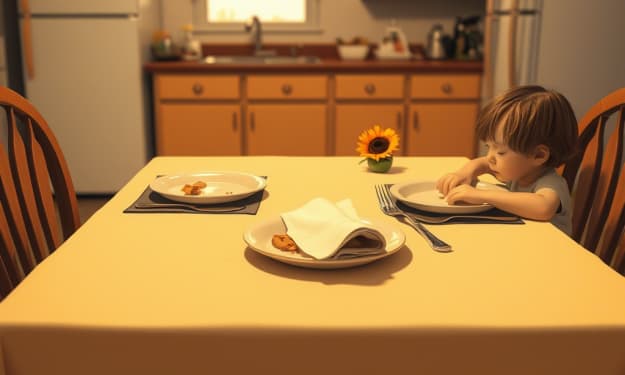
Every evening at six, I pull out the chairs, one by one, from the old oak dining table. It’s a simple act, mechanical by now. Fork, knife, spoon. Napkin folded in half. Water glasses. I place the plates carefully – one for me, one for Emma, and then… the third. It happens without thought. My hands, it seems, remember what my heart won’t let go of. Emma never says anything, but her eyes flicker toward the third plate each time. Sometimes she looks away quickly, pretending not to notice. Sometimes, she stares at it for a moment too long. We both eat quietly, chewing through our silence more than the food. It’s been six months. Six months since we lost Daniel. He was ten. Bright-eyed, full of mischief, a constant flurry of questions and motion. He used to sit in that very seat, fidgeting with his fork, drumming the table with his fingers, humming off-key while waiting for dinner. He used to complain about vegetables and sneak extra rolls when he thought we weren’t looking. The chair hasn’t moved from its place. His cup – the one with the faded cartoon lion – still sits in the cupboard. I know exactly where it is. I can’t bring myself to throw it out. Just like I can’t stop setting his place at the table. Emma is only twelve. Too young to have grief folded into her bones. Too young to be this quiet, this careful. I hear her muffled cries at night, but when I knock gently, she always says, “I’m fine, Dad.” Then she’ll ask me something like, “Can I stay up a little longer?” or “Did Mom like sunflowers?” Changing the subject as fast as the pain creeps in. She misses her brother in ways she can’t say. And I miss my son in ways I can’t bear. The doctors said it was quick. An undetected heart condition. One moment, he was running down the soccer field, hair flying, cheeks flushed. The next, he was on the ground, motionless, as coaches screamed and parents surged forward. He was gone before I even made it to the hospital. In the weeks after, I stopped doing everything. I forgot to shave. I didn’t eat. Emma would try to make toast, or heat canned soup, but sometimes she just went hungry, waiting for me to notice. One night, she set the table herself. It was messy – forks upside down, napkins crumpled – but there were three plates. She didn’t say it out loud, but I understood. She missed the noise. The way our family used to feel full. Complete. Warm. So I started cooking again. Small meals at first. Pasta, grilled cheese, soup from scratch. Nothing fancy, just something warm to put on our tongues. Something to fill the space. I didn’t plan to keep setting his place, but every time I reached for two plates, my hands reached for three. And now, it’s a ritual. A quiet rebellion against forgetting. People say grief gets easier. That time dulls the edges. But they don’t tell you how it hides in the ordinary things – the smell of his shampoo in the hallway, the soft curve of his handwriting on a notebook we forgot to throw away, a tiny sock stuck behind the dryer. They don’t tell you that sometimes you’ll laugh, and feel guilty for it. Or that the guilt will become its own kind of grief. Emma asked me last week, “Do you think it’s weird that we still set his place?” I shook my head. “No. I think it’s love.” She didn’t answer, but the next night, she put out his favorite cup. Tonight, like every night, we sat down to eat. I passed the carrots. She passed the bread. The third plate stayed untouched, but it wasn’t empty. It held memory. Presence. The shape of what once was. And when Emma reached for the salt, she looked at that third plate and smiled – just a little. It broke my heart and healed it at the same time. There are only two of us now. But sometimes, it still feels like three. And maybe, for now, that’s enough.
By Azmat Roman ✨about a year ago in Families
I Didn't Cry at the Funeral. I Cried in the Laundry Room.
Everyone kept watching me at the funeral. Eyes skimmed over my stiff posture and dry cheeks like they were waiting for a crack, a single shiver of emotion to make it all feel real. My mother had just died, and I stood at the edge of the casket like a stone monument—unmoving, unreadable. I didn’t cry. They whispered about it later, I’m sure. “In shock,” some probably said. “Cold,” others might have thought. I heard someone mutter something about how grief looks different for everyone, but even that was laced with disappointment, like they were cheated of a spectacle they had come prepared to witness. I stayed composed, hugging the same people over and over. My aunt with trembling lips. My cousin, mascara-streaked and hollow-eyed. Friends of the family who clung to me with a kind of desperate affection that felt like a performance. I smiled, nodded, thanked them. Then I went home. It wasn’t until three days later, standing in the small laundry room of my mother’s house—my house now—that I crumbled. The dryer buzzed. That’s what started it. Just a mundane, everyday sound. The hum cut off, and I reached in to pull out the clothes I had forgotten to take out the day before. Warm fabric. A tangle of socks. One of her cardigans. That’s when it happened. It was pale blue, the kind of soft wool she wore during long, sleepy Sundays. I used to tease her about dressing like someone’s grandmother. She would laugh and say, “Well, I am someone’s mother, and that’s just one cardigan away.” I pressed it to my face, and that was it. I didn’t just cry. I sobbed. The kind of grief that takes over your whole body, that makes your chest ache and your knees weak. I slid down against the washing machine and let the cardigan smother my face, muffling the sounds that poured out of me. The thing no one tells you about grief is that it’s quiet when it wants to be. It doesn’t always announce itself at the big, dramatic moments. Sometimes, it sneaks up on you in between laundry cycles. Sometimes it waits until you’re alone, where no one is grading your performance. At the funeral, I was too busy being her daughter. The role. The mask. The one people expected to hold it together, say the right words, offer the appropriate number of tears—not too much, not too little. People don’t like chaos at funerals; they like decorum. I gave it to them. I gave them my silence. But in the laundry room, there was no one to impress. Just the faint scent of lavender detergent, the click of a slowly cooling machine, and a blue cardigan that smelled like her. It wasn’t just the sweater. It was the realization that no one was ever going to wear it again. That there would be no more sleepy Sundays, no more late-night cups of tea, no more calls to ask if she remembered that recipe for butternut squash soup. She would never again laugh at my jokes or gently scold me for leaving wet laundry in the machine too long. I thought about how I had gone through her closet just two days before and packed things into boxes like I was sorting through someone else’s life. Neat stacks, donation piles. Mechanically deciding what stayed and what went. I didn’t cry then either. Maybe I was saving it for the laundry room. There’s something so violently human about grief catching us off guard. We imagine it will come in waves we can predict, like tide charts of mourning. But really, it’s more like a rogue wave—it hits hard and without warning. When I emerged from the laundry room, cardigan clutched against my chest, my face red and swollen, I felt lighter somehow. Like grief had loosened its grip on my ribs just enough for me to breathe again. I still haven’t told anyone about that moment. Not because I’m ashamed of it, but because it feels like it was just for me. A sacred collapse. The kind of mourning that doesn’t need an audience or a eulogy. It just needed warmth, memory, and a safe place to fall apart. Some people mark their grief in tears and tombstones. I marked mine in laundry. And that’s okay. Because grief doesn’t follow rules. It follows love. And love—well, it tends to linger in the smallest, most ordinary corners of our lives. Even in a laundry room.
By Azmat Roman ✨about a year ago in Families
She Only Lived Eight Years. But She Taught Me Everything.
I still remember the way her laugh echoed through our tiny house — bright, unfiltered, and bubbling with life. Emma had a way of making the ordinary seem magical. A cracked sidewalk became a hopscotch course. A broken crayon became a reason to invent new colors. And a rainy day? That was just an invitation for a pillow fort. She was only eight when she left us. But in those eight years, she taught me more about love, strength, and grace than I had learned in the thirty-two years before she was born. --- Emma came into our world with a full head of black hair and eyes so wide they seemed to drink in the entire room. She didn’t cry much as a baby — not out of stoicism, I think, but curiosity. She was always watching, absorbing. Even as a toddler, she had this strange old-soul wisdom wrapped in a giggling, mischievous shell. Her mother, Dana, always said Emma was the best parts of both of us: Dana’s empathy, my stubborn optimism, and a thousand things we didn’t know how to take credit for. She was kind without being fragile, clever without being proud. She made friends with the shy kids in class. She named worms on the sidewalk and whispered encouragements to the goldfish at PetSmart. Then came the cough. It started as a dry tickle in her throat. We thought it was just a late-season cold. But then came the fevers. The fatigue. The bruises on her legs. I remember sitting in that pale hospital room, the walls whispering nothing good, as the doctor spoke a phrase I still can’t say without my chest tightening: “Acute lymphoblastic leukemia.” Our world — so full of pillow forts, bedtime stories, and sidewalk chalk — suddenly collapsed under fluorescent lights and IV poles. --- The next three years were a whirlwind. Chemotherapy. Bone marrow tests. Remissions and relapses. Hope that swelled and broke like waves on the shore. Through it all, Emma stayed… Emma. When she lost her hair, she painted smiley faces on her scalp with washable marker. When her legs grew too weak to run, she invented new board games and held tournaments with her stuffed animals. She called her IV pole “Stanley” and insisted he be dressed in seasonal accessories — Halloween hats, tinsel, bunny ears. She hated being pitied. She didn’t want whispered apologies or sad eyes. She wanted stories. Jokes. Life. One night, after a particularly rough round of treatment, I sat beside her hospital bed and cried. She reached out with her tiny hand, placed it on mine, and said, “It’s okay to be sad, Daddy. But don’t let sad be the only thing you feel.” I wrote that down. I still carry it in my wallet. --- She died on a Tuesday morning. It was quiet. The sun was just beginning to creep through the window blinds, catching the strands of the dreamcatcher she made in art therapy. Dana and I sat on either side of her, holding hands, whispering stories from when she was well — the time she tried to adopt a snail, the time she gave away her birthday cupcakes because “some kids looked like they needed a good day.” And then… she was gone. --- Grief is a strange thing. It doesn’t arrive all at once. It comes in flashes — the empty chair at breakfast, the sudden memory sparked by a cartoon she used to love. I remember standing in the shampoo aisle months later and breaking down because I saw the bottle she used and realized I’d never need to buy it again. But through all of that, I kept hearing her words. “Don’t let sad be the only thing you feel.” --- So I started a foundation in her name. We fund comfort kits for pediatric patients. We donate books to children’s hospitals. Every year on her birthday, we send handmade cards to kids battling cancer — just like Emma used to make. And I started living again. Not just existing, but living — chasing joy, being present, loving deeply and loudly and unapologetically. Because that’s how Emma lived, even on her worst days. She taught me how to be still when everything is spinning. She taught me how to find light in shadowed places. She taught me how to say goodbye without closing my heart. --- Emma only lived eight years. But she taught me everything. She taught me that life isn’t measured in years — it’s measured in moments, in kindness, in laughter, in the way you make others feel. She taught me that even the smallest people can leave the biggest footprints. And she taught me, most of all, that even when someone’s gone… love doesn’t leave with them. It stays. And it teaches. Every day.
By Azmat Roman ✨about a year ago in Families
What I Lost When My Son Died (And What I Refuse to Let Go)
When my son died, the world didn’t stop turning—but mine did. I remember the exact moment I got the call. It was a Sunday, late afternoon. I was folding laundry, thinking about dinner, planning the next week in my head. Then my phone rang, and everything I thought I knew—everything that felt solid—crumbled in seconds. My son was gone. He was twenty. Too young to leave this world, too full of life and plans and potential. One moment he was here, and the next, he wasn’t. And just like that, I became a parent with no child to parent. What I lost when my son died goes beyond what anyone can see or touch. I lost a piece of my soul. I lost the rhythm of my days, the purpose in my steps. I lost the person who made me a mother, who called me “Mom” with a voice that could undo any bad day. I lost the person who taught me patience, who challenged me, who reminded me—every single day—what love could look like when it was raw, messy, and unconditional. I lost the small things: the texts that came at odd hours, the inside jokes no one else understood, the way he’d leave half-empty coffee cups around the house. I even lost the arguments about curfews and responsibilities—the kind of things that once felt exhausting, and now I’d give anything to have back. And I lost the future. The man he would have become. The dreams he didn’t get to chase. The family he didn’t get to build. I grieve not only who he was, but who he didn’t get the chance to be. There’s a silence in the house now, even when it’s full of people. It’s not just the absence of his voice—it’s the absence of his energy, his presence, his laughter. The silence after loss is not empty; it’s heavy. It echoes. But amid all this, there is something I refuse to let go of. I refuse to let go of his memory—not the sanitized version people try to package into sympathy, but the real boy, the real man, with all his flaws and brilliance. I refuse to let go of the stories that made him who he was—the time he got lost on his way home from school because he was chasing butterflies, or how he once stayed up all night to finish building a model airplane just because he didn’t want to quit. I refuse to let go of the love. The love that started the moment I saw two lines on a pregnancy test. The love that grew with each scraped knee, each birthday candle, each tear-filled conversation. The love that didn’t die when he did. Grief doesn’t end love. If anything, it deepens it. It makes it sharper, more sacred. It turns every memory into something holy, something I hold in trembling hands. Some people are afraid to mention his name, as if speaking it might hurt me. But silence hurts more. I want to talk about him. I want to remember him out loud. I want the world to know that he lived, that he mattered, that he changed me in ways I’m still discovering. I also refuse to let go of hope—not the kind that pretends everything is fine, but the kind that allows room for sorrow and still believes in the possibility of healing. Not moving on, but moving forward—with him in my heart. Hope looks different now. It’s quieter, more fragile. It comes in the form of watching the sunrise and remembering how much he loved mornings. It’s found in a song on the radio, a quote in a book, a dream that feels like a visit. It’s knowing that love, somehow, stretches beyond life and death. There are still days when I can’t breathe under the weight of this grief. Days when I curl into the ache and let it wash over me. But there are also days when I smile—really smile—because something reminded me of him. And in those moments, I feel him near. What I lost when my son died is immeasurable. But what I refuse to let go of—the love, the memories, the connection that even death can’t sever—is what keeps me going. He is gone, but he is still mine. And I will carry him with me, always.
By Azmat Roman ✨about a year ago in Families