
Four Workers, Ten Dependents: The Population Math That Breaks Family Budgets
Birth rates make headlines. Pensions, rent, childcare, and shaky jobs decide whether families can afford another child.
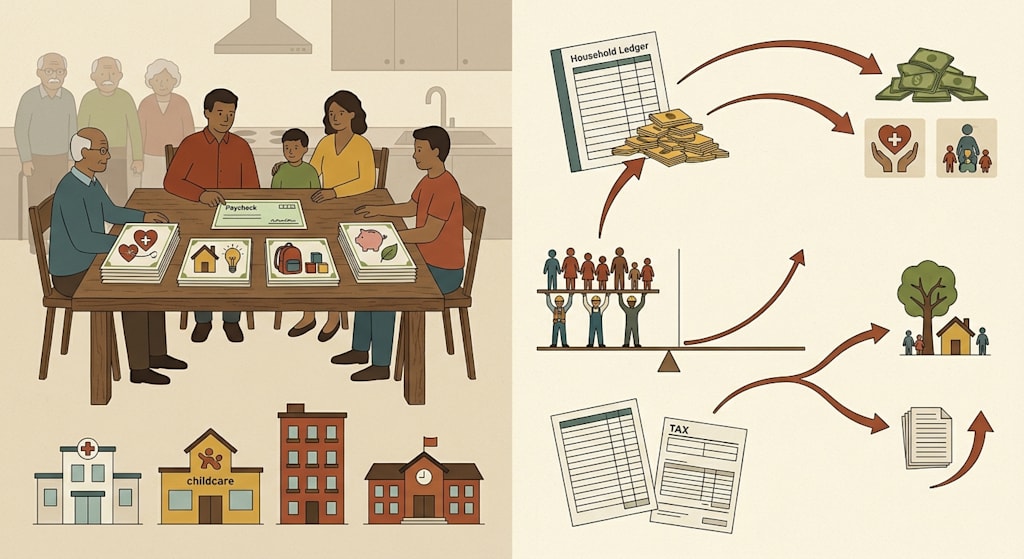
A household with four grandparents, two working adults, and one child does not need a demographic model to feel the pressure. The monthly paycheck splits into four piles: pension top-ups and medical bills for the old, mortgage and utilities, childcare and school fees, and a reserve for the next emergency. When one pile grows, another shrinks. Fertility is usually the pile that disappears.
The population debate should move away from totals. The ratio matters. Eight workers supporting ten dependents is a tight budget. Four workers supporting ten dependents is a different system: pension and health spending are rigid, the tax base is narrower, and care time is scarcer. Aging is a hospital appointment, a wheelchair ramp, a daughter taking leave. Fewer births mean fewer future workers, a smaller tax base, weaker demand, and more risk concentrated in each family.
The two trends stack. Elderly people without adequate safety nets sit above a generation carrying mortgages, education costs, and care obligations. Below them, fertility is suppressed by cash flow and uncertainty. Industrialization, urbanization, and rising education are irreversible. No serious policy can reverse them by pushing women back into the home or by pretending science and schooling are optional. The levers are family fiscal burden, public service supply, employment expectations, and intergenerational distribution.
Real estate shows the trap. During rapid urbanization, rural migrants contributed land tax and land finance. Young labor was the fuel. Now the fuel is thinner, and the debt remains. At the household level, the easiest item to cut is a second or third child. Housing cannot be dropped. Elderly parents cannot be abandoned. Education cannot be skipped. A job cannot be treated as optional. So fertility absorbs the adjustment.
The policy menu has five plain measures.
Income tax by household. If a family has more children or elderly dependents, it gets a larger deduction. Childcare costs can be deducted too.
Cash from pregnancy through school. Money goes directly into the family’s bank account. Poor and rural families get a higher tier.
Housing and childcare. Families with more children get tax and provident-fund breaks when buying or renting. Public rental housing is prioritized for low-income families with children. Cheap childcare slots are built in larger numbers to push down prices.
Social insurance floor. Gig workers can access maternity and childcare benefits. Child subsidies are not counted as household income.
Enterprise linkage. Firms that offer parental leave and run childcare get tax credits and subsidies.
These are the right directions. The new content is limited. Household income tax is useful for a specific case: two children, one high earner, one full-time caregiver. Joint filing can level the tax burden. But the benefit goes mainly to upper-middle-income urban families, perhaps a minority of formal wage earners, roughly the top tenth in many cities. In cities like Shanghai, where registered fertility is below Korea’s, the tax break is visible but narrow. Most households pay little income tax. The measure helps, but it is not the main engine. If adopted, it should be optional, capped, and designed not to discourage the second adult from working.
Cash subsidies have wider reach. Extend them beyond age three, perhaps to age six, then adjust with birth numbers. Direct transfer matters. Money that passes through several hands is delayed, diluted, and hard to verify. Index the amount to consumer prices, or inflation eats it in two years. Tilt toward low-income families not because they “like children” but because the base is large and the marginal effect is strong. The same amount buys more security there.
Housing has few new ideas. Execution is the issue. Where is the public rental flat? Is it near work and school? Who gets it, and is the queue public? Public services should follow the person, not the hukou or the property deed. A young worker who pays taxes and social insurance in a city should be able to enroll a child in school and apply for basic housing. If welfare is tied to home ownership, policy is forcing young people to buy a house, pay land tax, and postpone children.
Social insurance for gig workers fits the labor market. Delivery riders, drivers, livestreamers, and platform workers have no employer contribution. Maternity money must come from fiscal transfers, platform contributions, or individual premiums. There is no fourth source. Enterprise linkage needs the same caution. If parental leave and childcare costs fall entirely on the employer, firms will hire fewer women of childbearing age. Costs must be pooled through social insurance, auditable, and resistant to gaming.
All of this runs into employment expectations. Families do not look at a one-time subsidy. They look at income over the next three years. A gig worker with orders this month and none next month will not change a three-year decision because of a baby bonus. More stable work, better initial distribution, shorter working hours, and more total employment do more than a one-off payment. If fertility falls more slowly, that is already a result.
The funding question is the central one. If subsidies come from indirect taxes and borrowing, and indirect taxes are regressive, low- and middle-income families pay first and receive part back. Redistribution is weaker than the headline. Asset taxes, inheritance taxes, and direct returns of state-owned capital dividends to residents and social insurance would fit intergenerational fairness better. The difficulty is concrete: valuation, capital flight, local tax bases, trusts and gifts. A more realistic package raises the share of direct taxes, transfers state capital income to social insurance and child investment, reviews spending, and publishes the budget. Without that, subsidies become a one-time painkiller.
Most industrial economies face the same fork: leave a sound economy to the next generation, or roll the debt forward and trust the next generation’s wisdom. The first path requires market clearing and tax reform now, with visible short-term costs. France’s 2023 pension reform and the recent fights over public spending are attempts to bend the debt curve down. The politics are brutal. The second path is easier: borrow, consume now, and let the future pay. Debt can be useful or destructive depending on where it goes. Money into children, education, childcare, housing, and employment is an intergenerational investment. Money into asset bubbles, low-efficiency infrastructure, and protecting existing distribution is an intergenerational transfer upward. If resources go to those closest to money, debt stays with the collective, and there are fewer descendants, the next generation’s wisdom has less to work with.
The short-term test is family cash flow and childcare supply. The medium-term test is employment expectations and the return to labor. The long-term test is fiscal fairness between generations and whether public services are anchored to people. The test is the monthly bank statement, the public rental flat that is actually available, the childcare slot that costs less than a fifth of a paycheck, and the job that lasts beyond the next quarter.
About the Creator
Jin
Writer of reamstories
https://reamstories.com/jin
Enjoyed the story? Support the Creator.
Subscribe for free to receive all their stories in your feed. You could also become a paid subscriber, letting them know you appreciate their work.
Comments
There are no comments for this story
Be the first to respond and start the conversation.