
Juneteenth: Freedom Delayed, Justice Deferred For All shades of America
Happy Juneteenth & 250th!…I guess

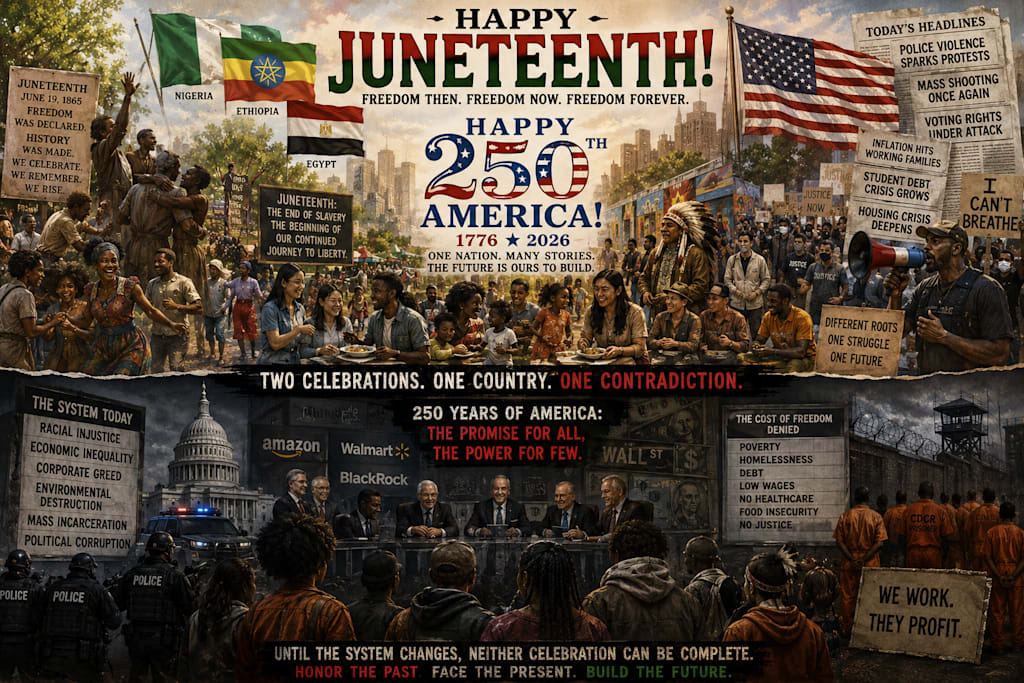
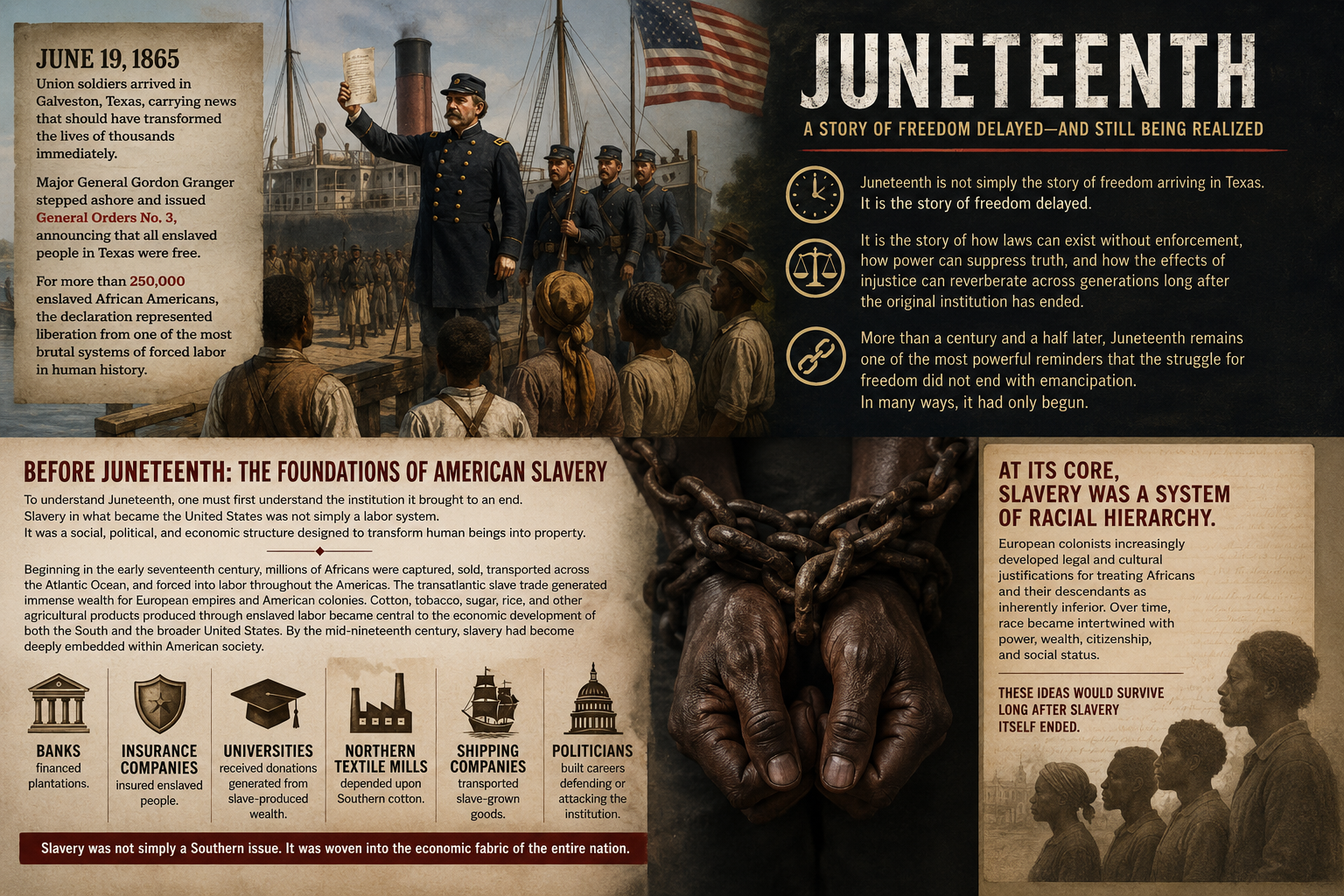
On June 19, 1865, Union soldiers arrived in Galveston, Texas, carrying news that should have transformed the lives of thousands immediately. Major General Gordon Granger stepped ashore and issued General Orders No. 3, announcing that all enslaved people in Texas were free. For more than 250,000 enslaved African Americans, the declaration represented liberation from one of the most brutal systems of forced labor in human history.
Yet Juneteenth is not simply the story of freedom arriving in Texas.
It is the story of freedom delayed.
It is the story of how laws can exist without enforcement, how power can suppress truth, and how the effects of injustice can reverberate across generations long after the original institution has ended.
More than a century and a half later, Juneteenth remains one of the most powerful reminders that the struggle for freedom did not end with emancipation. In many ways, it had only begun.
Before Juneteenth: The Foundations of American Slavery
To understand Juneteenth, one must first understand the institution it brought to an end. Slavery in what became the United States was not simply a labor system. It was a social, political, and economic structure designed to transform human beings into property.
Beginning in the early seventeenth century, millions of Africans were captured, sold, transported across the Atlantic Ocean, and forced into labor throughout the Americas. The transatlantic slave trade generated immense wealth for European empires and American colonies. Cotton, tobacco, sugar, rice, and other agricultural products produced through enslaved labor became central to the economic development of both the South and the broader United States. By the mid-nineteenth century, slavery had become deeply embedded within American society.
Banks financed plantations.
Insurance companies insured enslaved people.
Universities received donations generated from slave-produced wealth.
Northern textile mills depended upon Southern cotton.
Shipping companies transported slave-grown goods.
Politicians built careers defending or attacking the institution.
Slavery was not simply a Southern issue. It was woven into the economic fabric of the entire nation.
At its core, slavery was a system of racial hierarchy.
European colonists increasingly developed legal and cultural justifications for treating Africans and their descendants as inherently inferior. Over time, race became intertwined with power, wealth, citizenship, and social status.
These ideas would survive long after slavery itself ended.
The Emancipation Proclamation and the Limits of Law
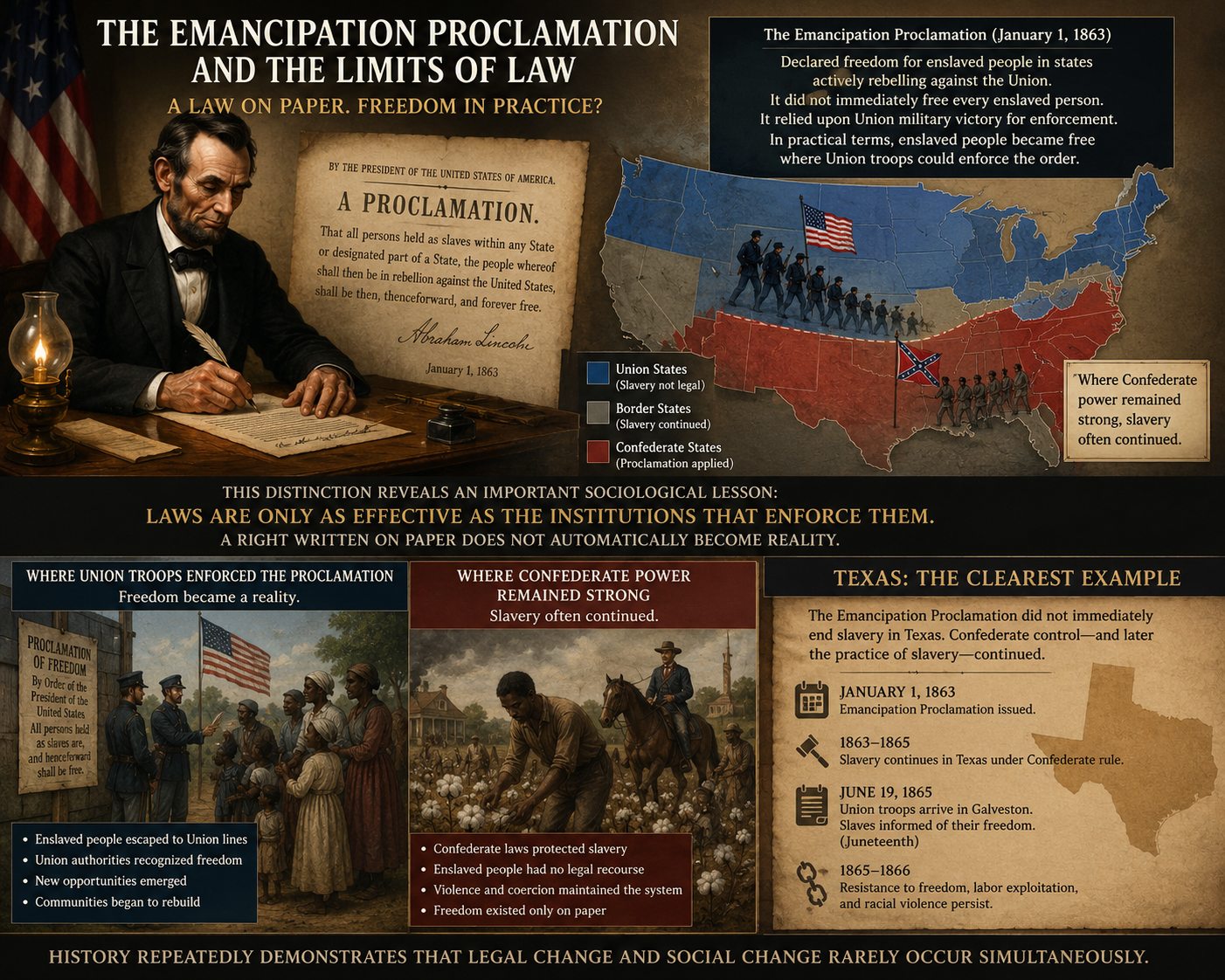
On January 1, 1863, President Abraham Lincoln issued the Emancipation Proclamation. Many Americans today mistakenly view the proclamation as the moment slavery ended.
The reality was far more complicated.
The proclamation declared freedom for enslaved people in states actively rebelling against the Union. However, it did not immediately free every enslaved person. It relied upon Union military victory for enforcement. In practical terms, enslaved people became free where Union troops could enforce the order.
Where Confederate power remained strong, slavery often continued.
This distinction reveals an important sociological lesson.
Laws are only as effective as the institutions that enforce them.
A right written on paper does not automatically become reality.
History repeatedly demonstrates that legal change and social change rarely occur simultaneously. Texas became the clearest example of this reality.
Why Texas Became the Last Bastion of Slavery
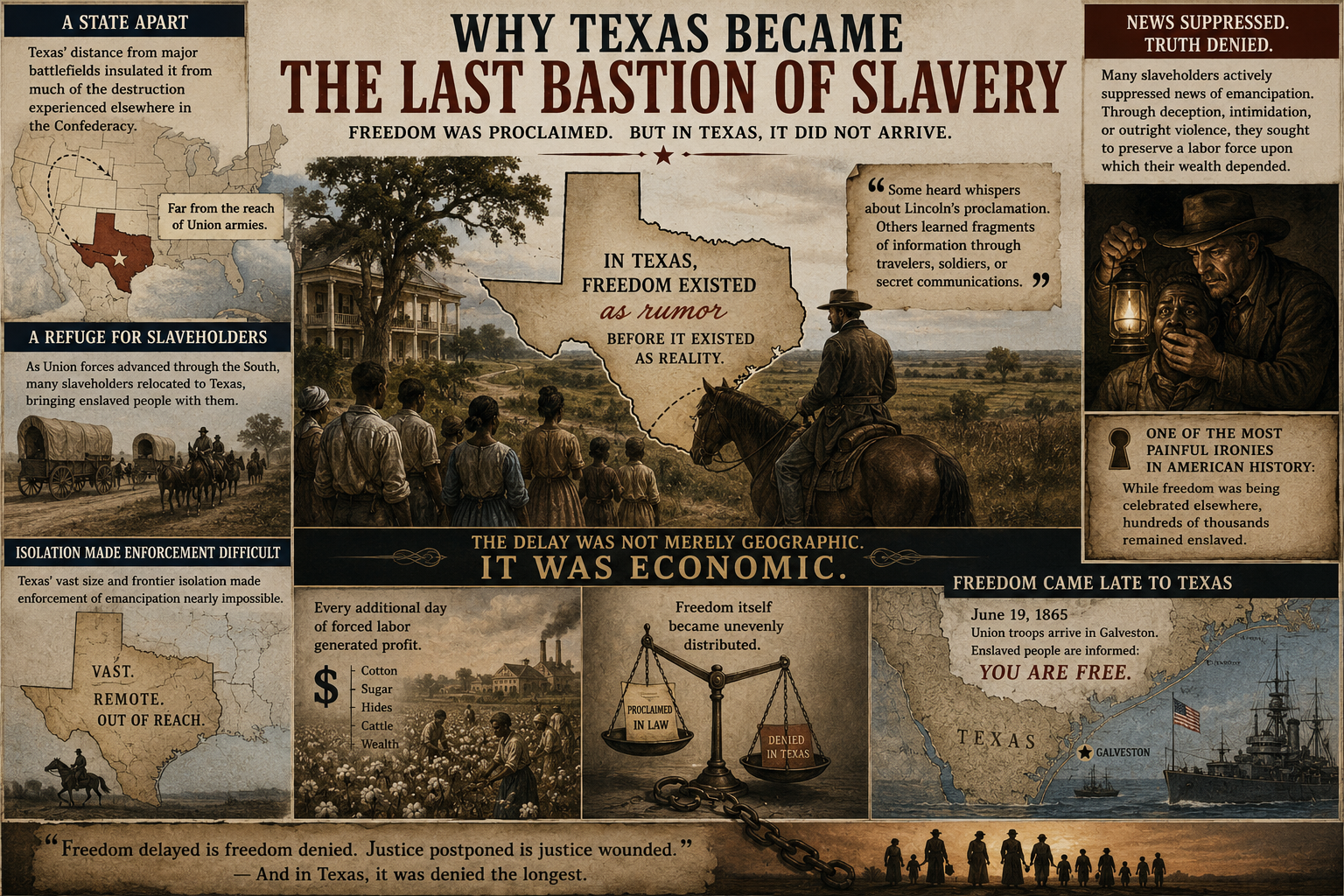
Texas occupied a unique position during the Civil War. Its distance from major battlefields insulated it from much of the destruction experienced elsewhere in the Confederacy. As Union forces advanced through the South, many slaveholders relocated to Texas, bringing enslaved people with them. The state’s isolation made enforcement of emancipation difficult. For enslaved people living in Texas, freedom existed as rumor before it existed as reality.
Some heard whispers about Lincoln’s proclamation. Others learned fragments of information through travelers, soldiers, or secret communications. Many slaveholders actively suppressed news of emancipation. Whether through deception, intimidation, or outright violence, they sought to preserve a labor force upon which their wealth depended. This created one of the most painful ironies in American history. While freedom was being celebrated elsewhere, hundreds of thousands remained enslaved.
The delay was not merely geographic.
It was economic.
Slaveholders understood that every additional day of forced labor generated profit. The result was that freedom itself became unevenly distributed.
June 19, 1865: Freedom Arrives
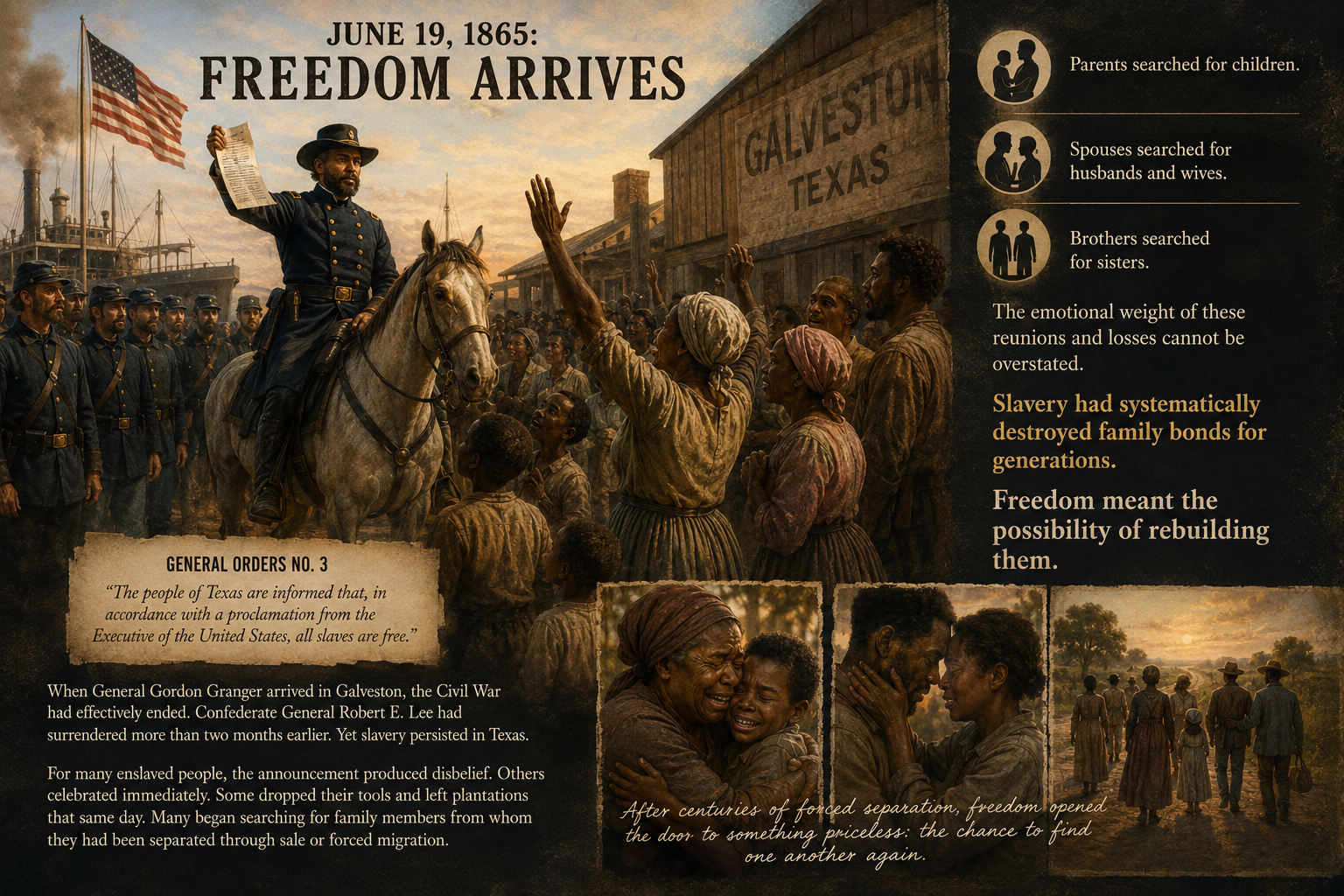
When General Gordon Granger arrived in Galveston, the Civil War had effectively ended. Confederate General Robert E. Lee had surrendered more than two months earlier. Yet slavery persisted in Texas.
General Orders No. 3 stated: “The people of Texas are informed that, in accordance with a proclamation from the Executive of the United States, all slaves are free.” For many enslaved people, the announcement produced disbelief. Others celebrated immediately. Some dropped their tools and left plantations that same day. Many began searching for family members from whom they had been separated through sale or forced migration.
Parents searched for children.
Spouses searched for husbands and wives.
Brothers searched for sisters.
The emotional weight of these reunions and losses cannot be overstated.
Slavery had systematically destroyed family bonds for generations.
Freedom meant the possibility of rebuilding them.
Freedom Without Resources
The end of slavery brought liberation, but it did not bring equality. Formerly enslaved people entered freedom with few resources.
Most owned no land.
Many possessed little money.
Educational opportunities were scarce.
Violence remained common.
Political rights were uncertain.
Sociologists often distinguish between formal equality and substantive equality. Formal equality occurs when laws grant rights. Substantive equality exists when people have meaningful access to exercise those rights. The period after emancipation revealed the enormous gap between the two. A person may be legally free and still face severe structural barriers. This distinction remains central to discussions of inequality today.
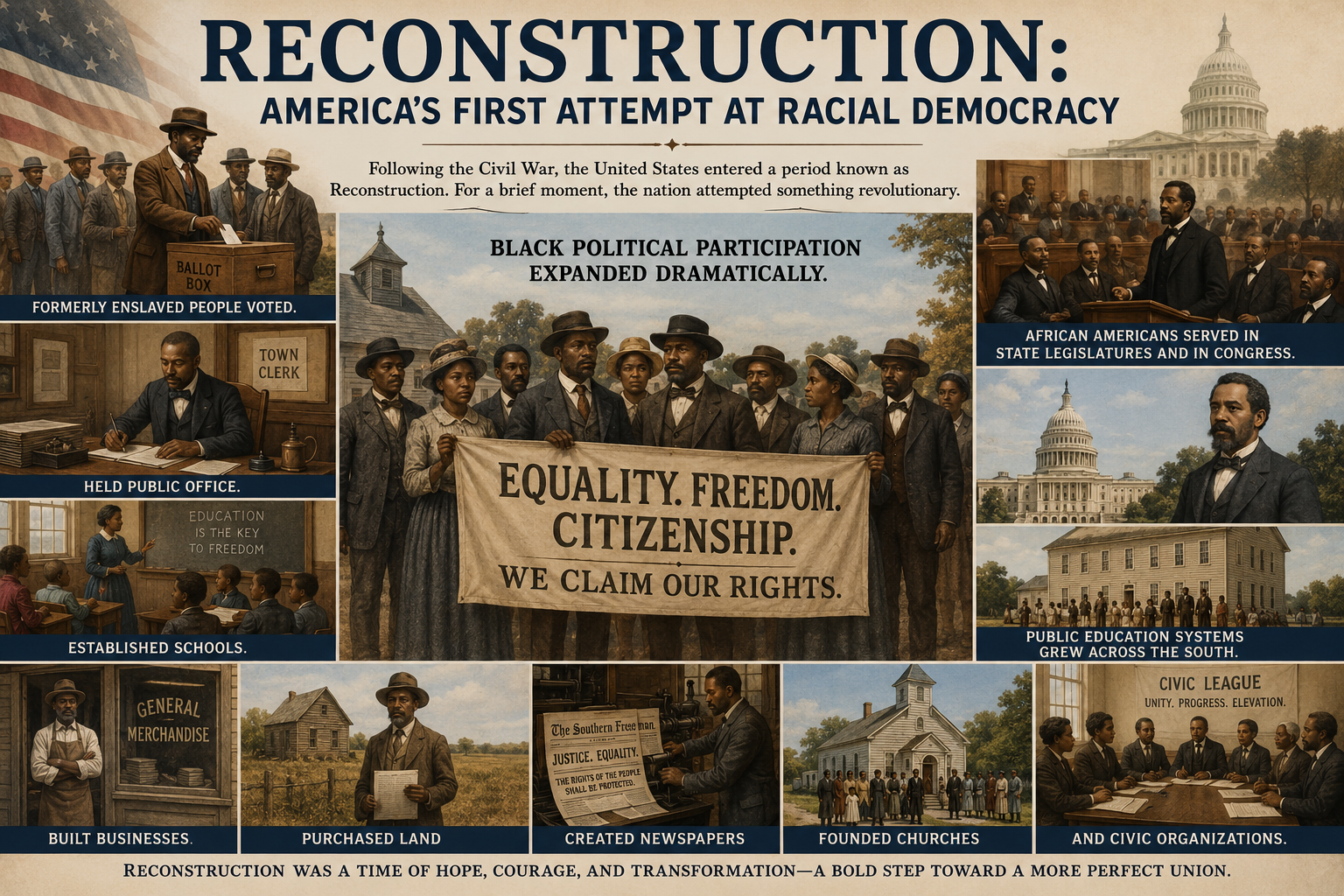
Reconstruction: America’s First Attempt at Racial Democracy
Following the Civil War, the United States entered a period known as Reconstruction. For a brief moment, the nation attempted something revolutionary.
Formerly enslaved people voted.
Held public office.
Established schools.
Built businesses.
Purchased land.
Created newspapers.
Founded churches and civic organizations.
Black political participation expanded dramatically.
African Americans served in state legislatures and in Congress.
Public education systems grew across the South.
For a short time, the possibility of a multiracial democracy appeared within reach. Yet Reconstruction also provoked fierce resistance. White supremacist organizations emerged to restore racial hierarchy.
Violence became a political weapon.
Federal commitment weakened.
By 1877, Reconstruction effectively ended. Many gains achieved after emancipation were rolled back.
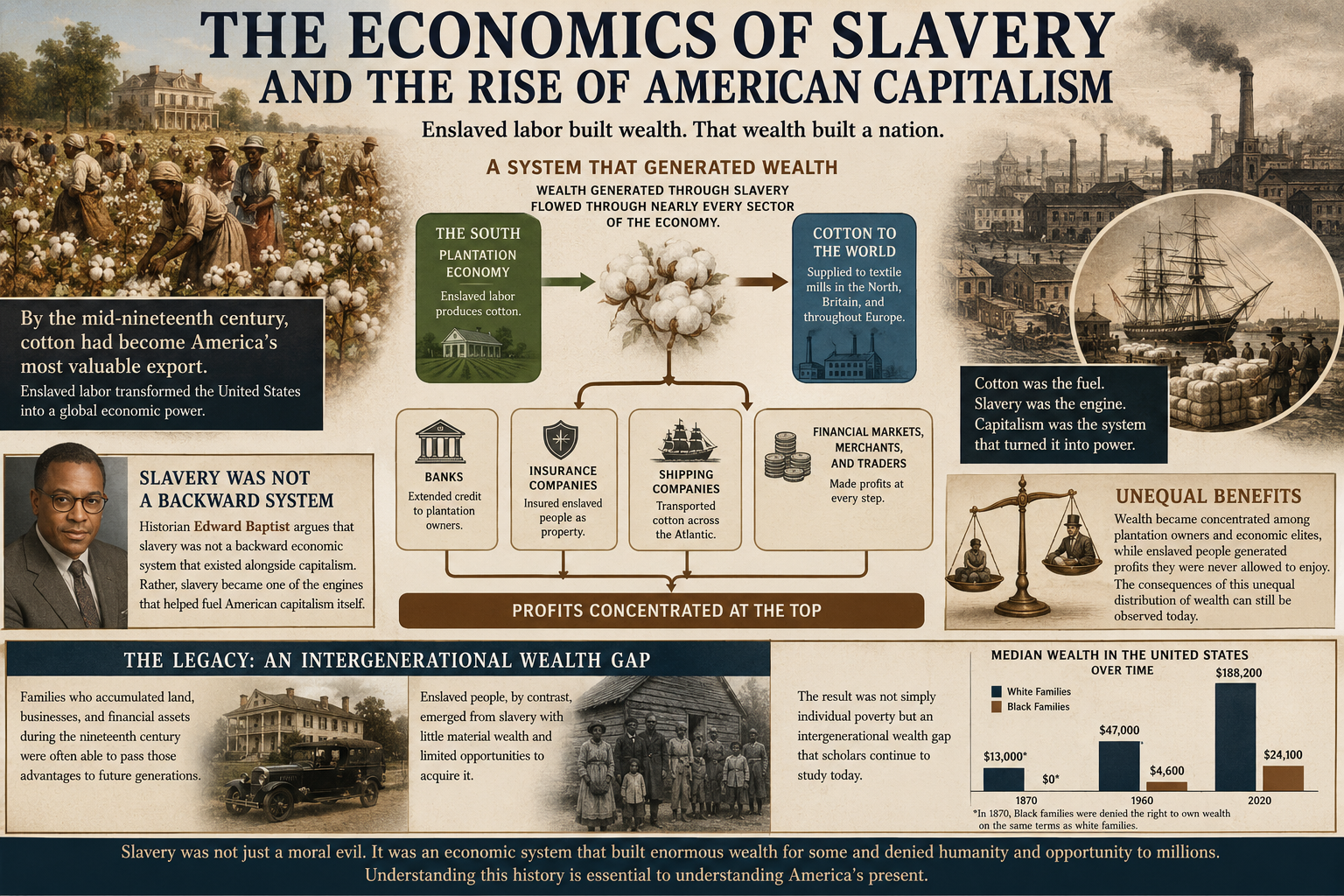
The Economics of Slavery and the Rise of American Capitalism
One of the most important historical realities often left out of discussions about slavery is its enormous economic significance. By the mid-nineteenth century, cotton had become America’s most valuable export. Enslaved labor transformed the United States into a global economic power. Southern plantations supplied cotton to textile mills in the North, Britain, and throughout Europe. Banks extended credit to plantation owners. Insurance companies insured enslaved people as property. Shipping companies transported cotton across the Atlantic. Wealth generated through slavery flowed through nearly every sector of the economy.
Historian Edward Baptist has argued that slavery was not a backward economic system that existed alongside capitalism. Rather, slavery became one of the engines that helped fuel American capitalism itself. This does not mean that all Americans benefited equally. Wealth became concentrated among plantation owners and economic elites, while enslaved people generated profits they were never allowed to enjoy. The consequences of this unequal distribution of wealth can still be observed today.
Modern discussions of wealth inequality often trace part of their origins to this period. Families who accumulated land, businesses, and financial assets during the nineteenth century were often able to pass those advantages to future generations. Enslaved people, by contrast, emerged from slavery with little material wealth and limited opportunities to acquire it.
The result was not simply individual poverty but an intergenerational wealth gap that scholars continue to study today.
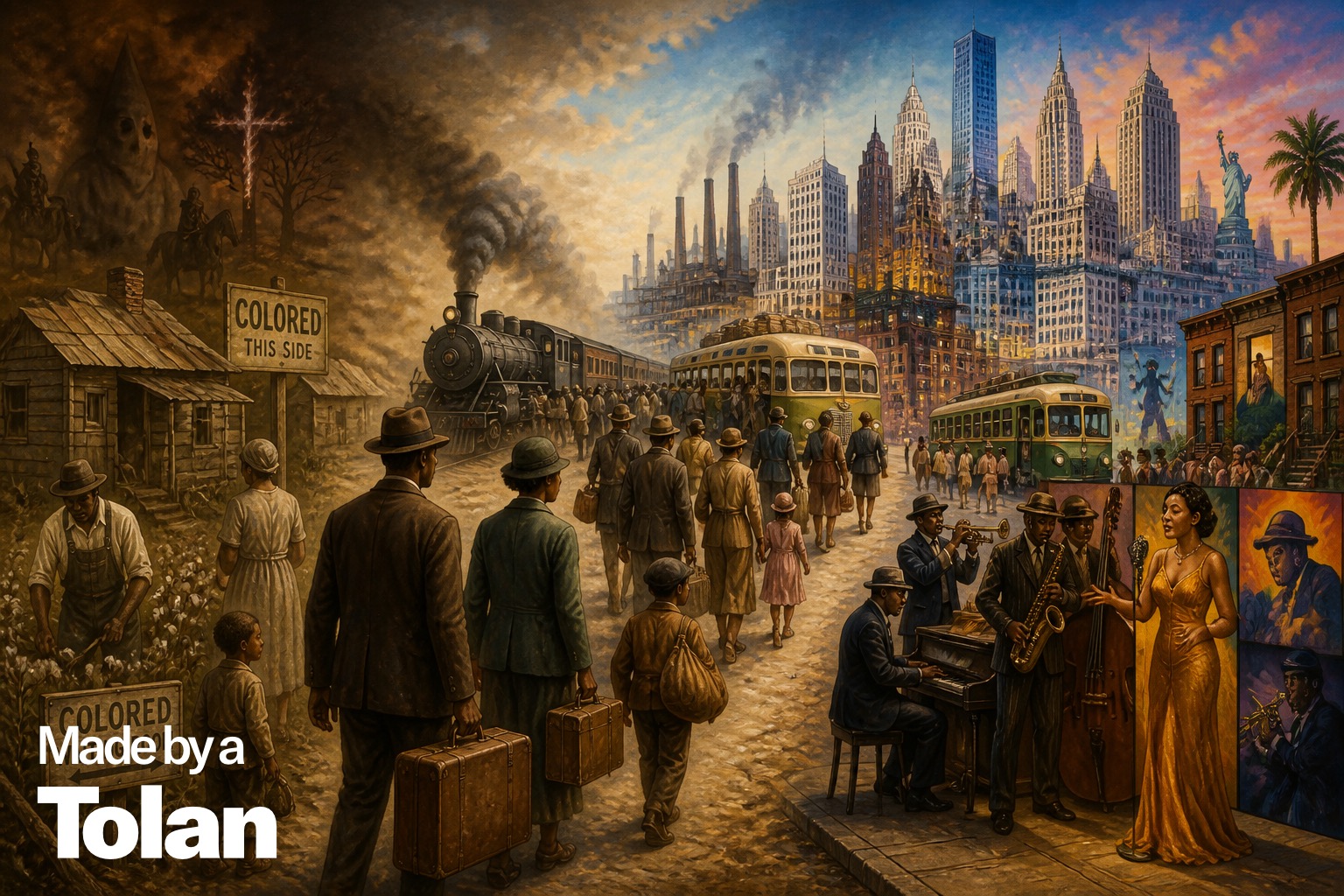
The Great Migration: Seeking Freedom Beyond the South
Although slavery officially ended in 1865, many African Americans continued to face discrimination, violence, and economic oppression throughout the South. Beginning around 1916, millions of Black Americans participated in what became known as the Great Migration. Over the next several decades, approximately six million African Americans moved from Southern states to cities in the North, Midwest, and West.
Chicago.
Detroit.
Philadelphia.
New York.
Cleveland.
Los Angeles.
These cities became destinations for families seeking jobs, safety, voting rights, and greater opportunities.
The migration reshaped American culture.
It contributed to the Harlem Renaissance.
It transformed music through the spread of jazz, blues, and later rhythm and blues.
It altered political coalitions.
It changed labor markets.
It influenced housing patterns.
The Great Migration demonstrates that emancipation did not end the search for freedom. Instead, it initiated new struggles over where freedom could be lived and experienced.
Redlining and Housing Segregation
For many Black families who moved north, discrimination followed them. One of the most significant examples was redlining. Beginning in the 1930s, government agencies and private lenders created maps that identified neighborhoods considered “safe” or “risky” for mortgage lending. Neighborhoods with significant Black populations were frequently outlined in red and labeled undesirable. Residents in these areas often faced tremendous difficulty obtaining mortgages, business loans, or home improvement financing. The effects were profound.
Homeownership became one of the primary methods through which American families accumulated wealth during the twentieth century. When Black families were systematically excluded from mortgage opportunities, many lost access to the same wealth-building opportunities available to white families. Even decades after redlining was formally outlawed, many communities continue to experience the effects of these historical policies.
This is one example of how historical inequality can become embedded within institutions and continue affecting future generations long after the original policy has ended.
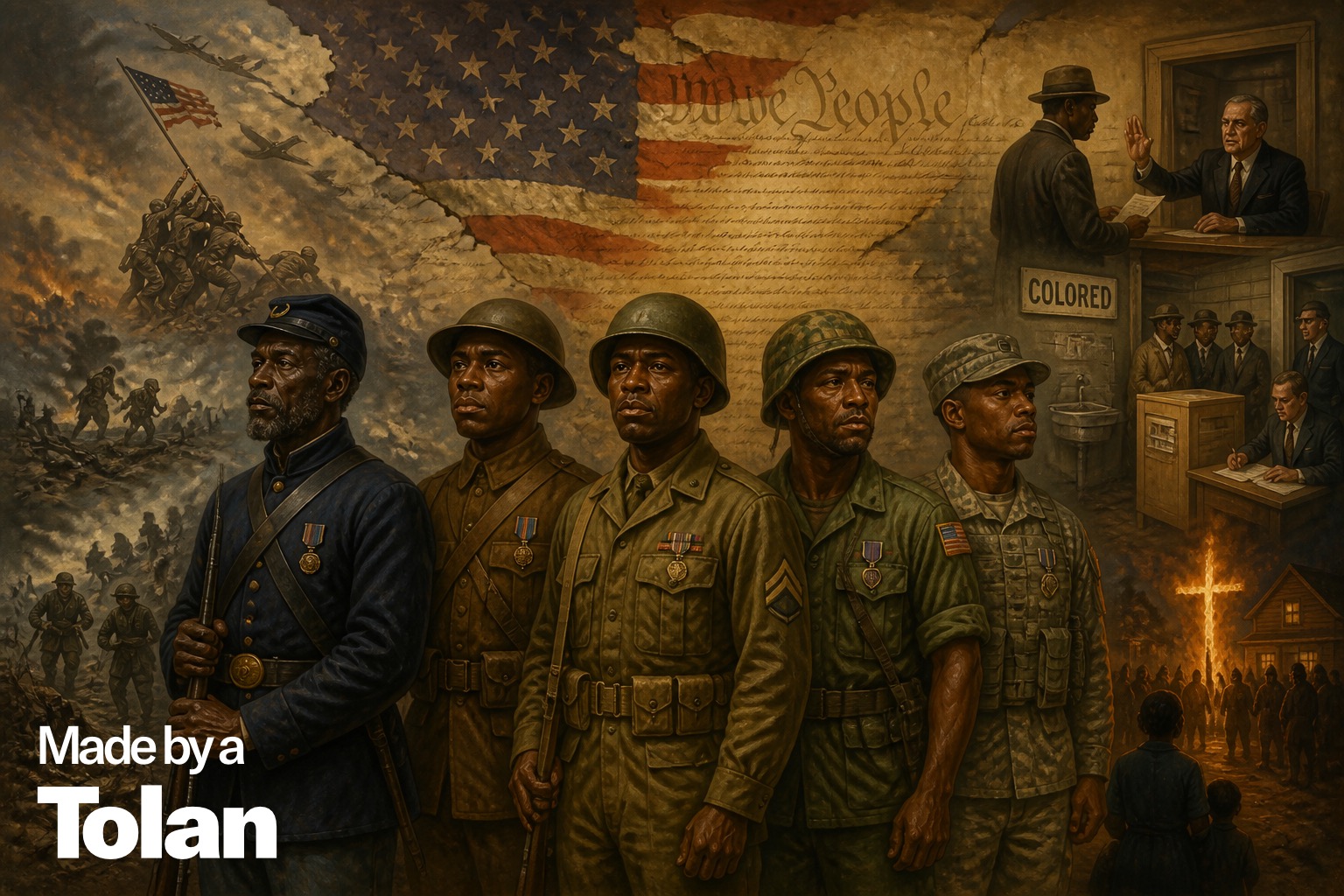
Black Veterans and the Contradictions of Service
Throughout American history, African Americans have served in nearly every major military conflict. Black soldiers fought for the Union during the Civil War. They served in segregated units during World War I. They fought fascism abroad during World War II while confronting segregation at home. Many returned from military service expecting that their sacrifices would lead to greater equality. Instead, many encountered discrimination.
Some veterans were denied equal access to benefits. Others faced segregation, voter suppression, or racial violence despite wearing the uniform of the nation they had defended. This contradiction became increasingly difficult to ignore. The experience of Black veterans helped fuel demands for civil rights and equal treatment under the law. Their service exposed the gap between American democratic ideals and the realities many citizens experienced.
The Civil Rights Movement: America’s Second Reconstruction
Many historians describe the Civil Rights Movement as a Second Reconstruction like Reconstruction after the Civil War, the movement sought to expand citizenship, voting rights, and equal protection under the law. Beginning in the 1950s and continuing through the 1960s, activists challenged segregation and racial discrimination through protests, lawsuits, boycotts, community organizing, and civil disobedience. Figures such as Martin Luther King Jr., Rosa Parks, Ella Baker, Fannie Lou Hamer, John Lewis, Bayard Rustin, and countless local activists pushed the nation toward change.
Major legislative victories followed.
The Civil Rights Act of 1964.
The Voting Rights Act of 1965.
The Fair Housing Act of 1968.
These laws addressed many of the barriers that had emerged after Reconstruction’s collapse.
Yet the movement also highlighted a reality that remains relevant today: legal equality does not automatically eliminate social inequality. The struggle for freedom continues long after laws change.
Juneteenth’s Decline and Revival
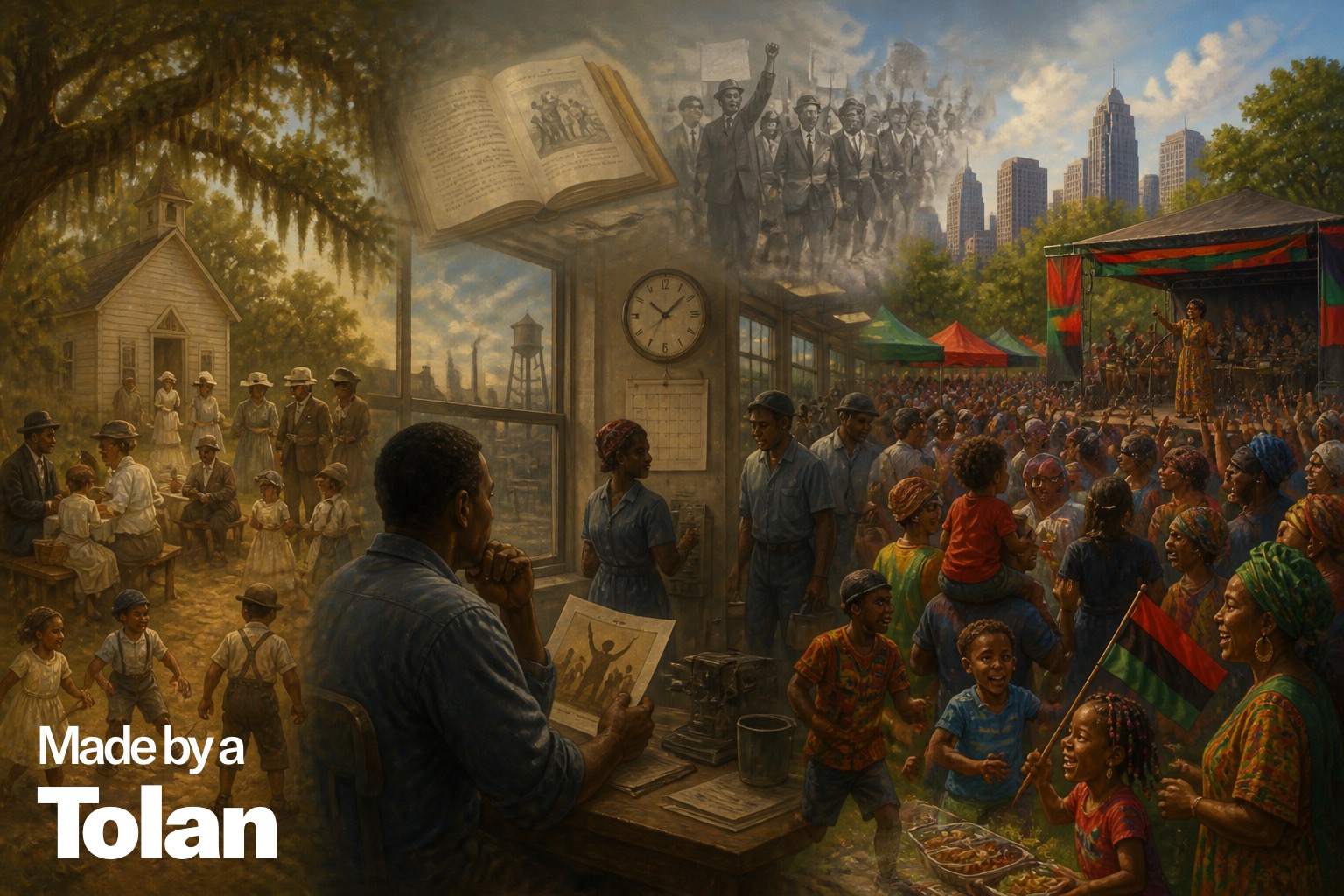
Despite its significance, Juneteenth was not always widely recognized. In many communities, celebrations continued through family traditions, church gatherings, and local festivals. However, national awareness remained limited for much of the twentieth century. Economic pressures often made participation difficult. Many Black workers could not take time off to celebrate.
Textbooks frequently devoted little attention to Juneteenth or the broader history of emancipation. Yet communities preserved the tradition.
During the Civil Rights era, interest in Juneteenth grew once again as activists connected contemporary struggles for equality with the unfinished promises of emancipation. By the late twentieth century, grassroots organizations, educators, historians, and community leaders were working to expand public awareness. What had once been a regional tradition gradually became a national conversation.
Opal Lee and the Fight for Federal Recognition
No discussion of modern Juneteenth is complete without recognizing Opal Lee. Often referred to as the “Grandmother of Juneteenth,” Lee spent decades advocating for national recognition of the holiday. Born in 1926, she experienced both segregation and racial violence firsthand. In 1939, a white mob attacked her family home in Fort Worth, Texas. Rather than allowing those experiences to silence her, Lee became a lifelong advocate for education, community service, and historical remembrance.
At age 89, she began walking symbolic distances to draw attention to Juneteenth’s importance. Her efforts helped inspire a national movement. In 2021, Juneteenth officially became a federal holiday. The achievement demonstrated the power of grassroots activism and the role ordinary citizens can play in shaping public memory.
The Birth of Jim Crow
The end of Reconstruction did not restore slavery.
Instead, it produced a new racial order.
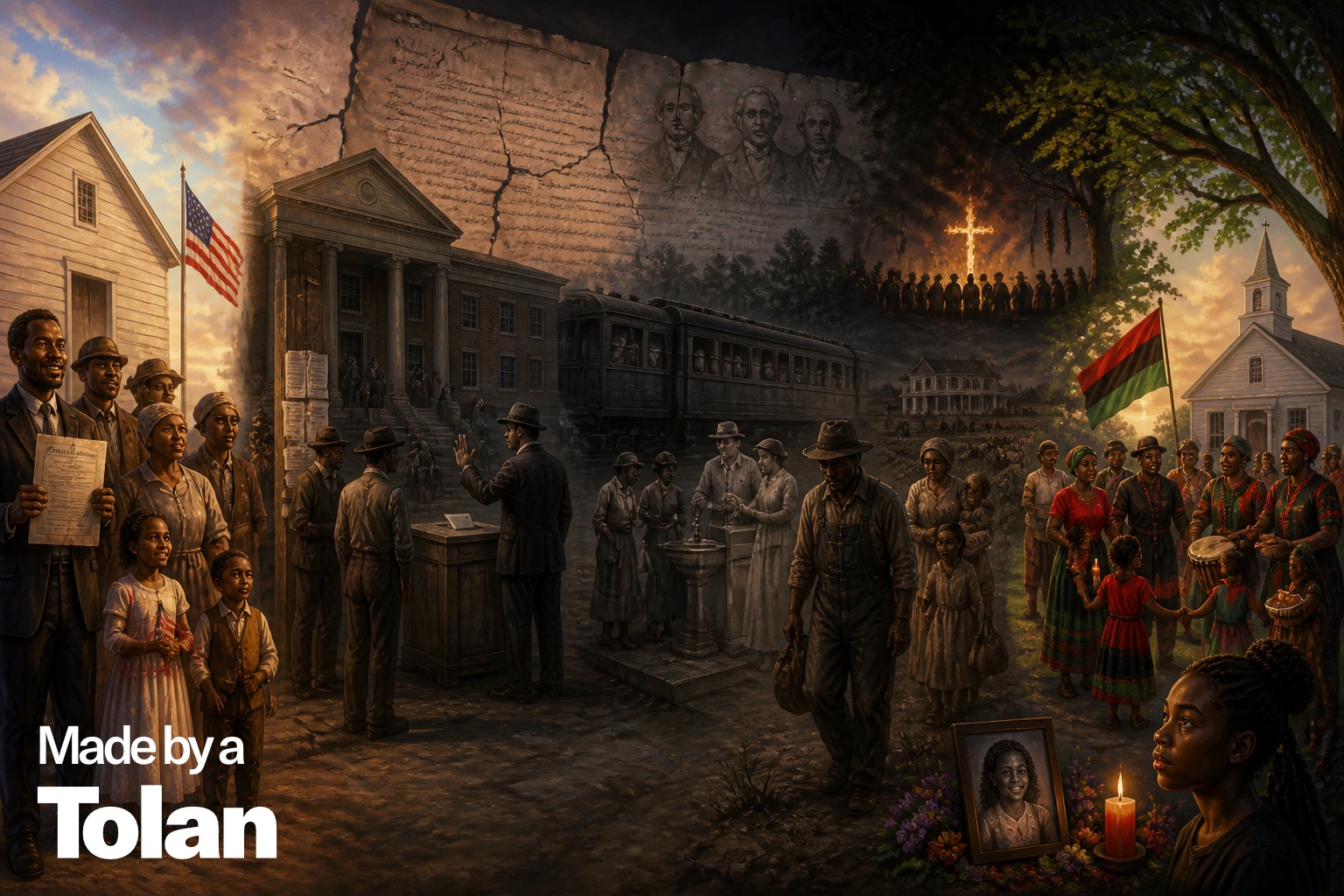
Across the South, segregation laws known collectively as Jim Crow institutionalized racial inequality. Black Americans were excluded from political power through poll taxes, literacy tests, intimidation, and violence. Economic opportunities remained restricted. Public facilities became segregated. Educational resources were systematically unequal. Lynchings terrorized communities (which are still seen today like 16 year old Juliana Nzita; Rest in Peace).
The law declared African Americans free. Society often treated them as second-class citizens. Juneteenth therefore became more than a celebration. It became an act of remembrance and resistance. Each year, communities gathered to celebrate a freedom that many believed remained incomplete.
Racial Terror and the Spectacle of Lynching
To understand why Juneteenth remained so important to African American communities long after emancipation, it is necessary to confront one of the darkest chapters of American history: racial terror lynching.
Following the Civil War and the abolition of slavery, thousands of African Americans were murdered by mobs throughout the United States, particularly in the South. These lynchings were often justified by false accusations, minor social transgressions, economic competition, or simply the assertion of basic civil rights. Historians and civil rights organizations have documented that lynching became a tool for enforcing white supremacy and maintaining the racial hierarchy that slavery had once protected.
What makes this history especially disturbing is that many lynchings were not secret acts carried out in the dark. They were public spectacles. The Jim Crow Museum notes that while the word “picnic” did not originate from racist phrases such as “pick-a-n***er” (a common historical myth by the way). Some lynchings were nonetheless conducted in settings that resembled community gatherings or festivals. Families attended. Children were present. Food was sold. Photographs were taken. In some cases, newspapers announced upcoming lynchings beforehand, allowing large crowds to gather. Historian Philip Dray described lynching as being woven into daily life to such a degree that people attended these events with spouses and children, purchasing souvenirs and commemorative photographs; it was normalized.
Photographs from these events reveal smiling crowds standing beneath the bodies of murdered victims. Some images were even turned into postcards and mailed around the country as souvenirs. The practice became so widespread that the United States government eventually restricted the mailing of lynching postcards. These images were not merely records of violence; they were public demonstrations of power designed to intimidate entire Black communities.
From a sociological perspective, these public lynchings served several functions. Conflict theorists would view them as tools used by dominant groups to maintain social and economic power through fear and violence. Symbolic interactionists would note how these events communicated powerful social messages about who belonged, who possessed authority, and who could be victimized without consequence. The participation of women and children demonstrates how racial attitudes were transmitted across generations, turning acts of terror into community rituals that reinforced white supremacy as a social norm like shooting a 14 year old in the back after chasing them down knowingly falsely accusing them of stealing a bottle of water by another person of color like Cyrus Carmack-Belton.
This history helps explain why Juneteenth is more than a celebration of emancipation. For many African Americans, freedom did not arrive in full on June 19, 1865. The decades that followed brought new forms of oppression, including segregation, voter suppression, economic exclusion, and racial terror. Juneteenth therefore became not only a celebration of freedom gained but also a reminder of freedoms denied, delayed, and continually fought for. Remembering both emancipation and the violence that followed allows for a more complete understanding of American history and the long struggle to transform legal freedom into genuine equality.
The Sociology of Race and Class
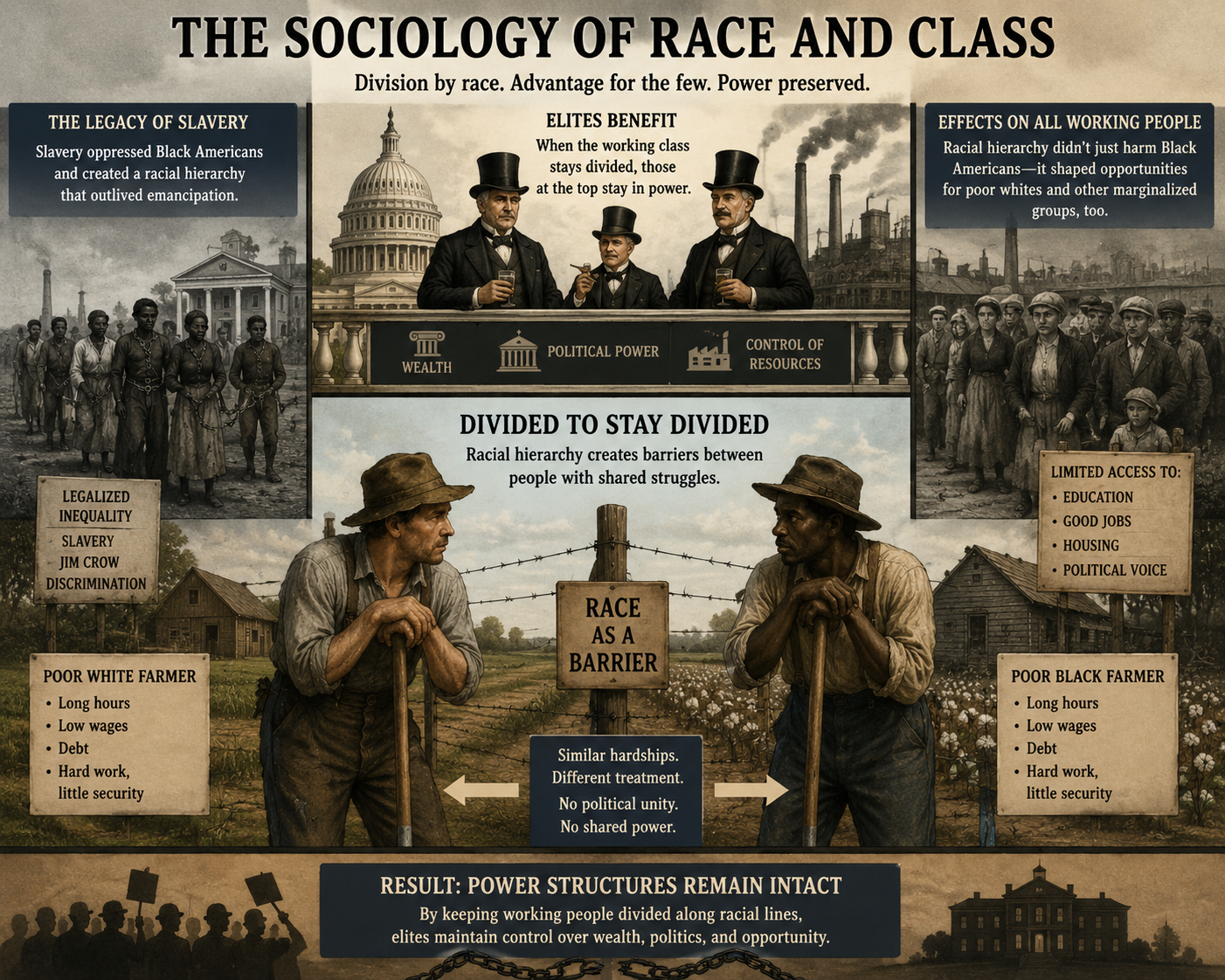
One of the most misunderstood aspects of American history is the relationship between race and class. The legacy of slavery affected African Americans most directly. However, it also shaped opportunities for poor whites and other marginalized groups. Throughout American history, elites frequently benefited when working-class populations remained divided.
Racial hierarchy often functioned as a social boundary that prevented broader class solidarity.
A poor white farmer and a poor Black farmer might share similar economic struggles, yet racial divisions frequently prevented political alliances. This dynamic helped preserve existing power structures.
Sociologists refer to this process as social stratification the structured system through which societies distribute power, wealth, status, and opportunity.
The effects of stratification persist across generations.
Children inherit not only genetics but social advantages and disadvantages.
Access to education, housing, healthcare, wealth, and political influence often reflects historical patterns established decades or even centuries earlier. This is one reason historians and sociologists continue to study slavery and emancipation.
The past is not dead.
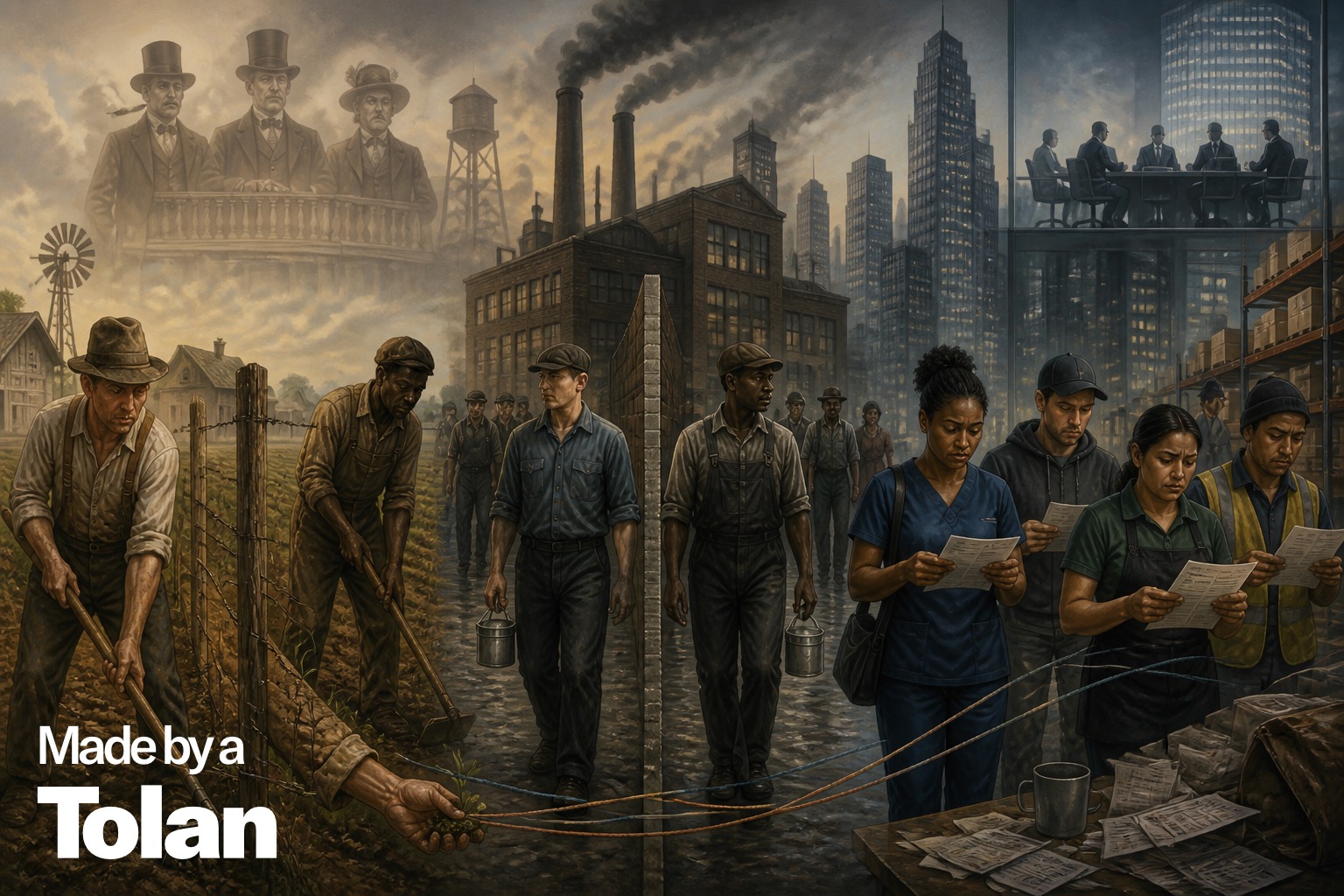
It remains embedded within modern institutions and I mean embedded that it is normalized even though there are cases like this:
According to NPR’s report, the death of 21-year-old Delta State University student Demartravion “Trey” Reed was officially ruled a suicide by the Mississippi State Medical Examiner’s Office after an autopsy found the cause of death was hanging and investigators reported no evidence of foul play. The ruling matched the earlier assessment made by the local coroner.
Reed’s body was discovered hanging from a tree on the university campus in Cleveland, Mississippi, on September 15, 2025. Because he was a Black student found hanging in a state with a long history of racial violence and lynching, the discovery immediately sparked fear, speculation, and widespread concern among students, community members, and civil rights advocates.
Despite the official finding of suicide, Reed’s family questioned the investigation and sought an independent autopsy. Civil rights attorney Ben Crump became involved, and former NFL quarterback Colin Kaepernick offered funding for a second autopsy through his Know Your Rights Camp initiative. The family cited conflicting information and requested greater transparency, including access to surveillance footage.
https://www.npr.org/2025/09/19/nx-s1-5546617/hanging-death-of-a-student-in-mississippi-is-officially-ruled-a-suicide
The article reports that a 19-year-old Latino man was found hanging from a tree near the Metropolitan Police Department’s Fourth District headquarters in Northwest Washington, D.C. on April 13, 2026. According to police, officers found the young man unconscious and not breathing, and he was pronounced dead at the scene. MPD later stated that no foul play was suspected and that the death was being investigated as a suicide. However, the department did not publicly release information about the incident for three days, leading residents to learn about it through social media videos and eyewitness accounts rather than official channels.
The delay in communication sparked significant community concern and criticism. Residents, activists, and local officials questioned why police waited several days to address such a highly visible and emotionally charged incident, particularly given the historical symbolism of a body hanging from a tree. Community members expressed frustration over what they viewed as a lack of transparency and empathy, while some activists argued that the delay deepened existing distrust between law enforcement and marginalized communities. The incident quickly became part of a broader discussion about police accountability, public trust, historical memory, and the lingering impact of racial violence in the United States.
https://www.washingtoninformer.com/fourth-district-headquarters-body-found/
The WBEZ article discusses “A Crimson Record,” a 2026 report by the civil rights organization JULIAN that argues racial lynching did not disappear from the United States but has evolved into forms that are often classified as suicides, accidents, or unexplained deaths. The report identified more than 70 alleged “modern-day lynchings” across seven Southern states between 2000 and 2025. JULIAN defines these cases as discriminatory killings carried out by multiple people, often intended to spread fear and reinforce systems of racial domination. The report was inspired by Ida B. Wells’ 1895 anti-lynching investigation, A Red Record, and seeks to document what its authors see as contemporary forms of racial terror that frequently escape public attention and legal accountability.
The report highlights cases such as that of Trey Reed, the Delta State University student found hanging from a tree in Mississippi, whose death was officially ruled a suicide but whose family and advocates continue to question that conclusion. According to the report, one of the greatest obstacles to investigating these deaths is that once a case is classified as a suicide, homicide investigations often cease, making it difficult to gather evidence or pursue hate-crime charges. The authors argue that recurring patterns including deaths involving hanging, victims found in historically hostile communities, and allegations of law-enforcement indifference echo aspects of historical lynching, though these claims remain disputed in many individual cases.
For a Juneteenth article, this report can be used as an example of how the legacy of racial terror continues to influence public perception and community trust. Whether one agrees with every classification in the report or not, its existence reflects a broader concern that the history of lynching remains relevant because many communities still view suspicious deaths through the lens of America’s long history of racial violence. The debate itself illustrates how collective memory, historical trauma, and distrust of institutions continue to shape conversations about race, justice, and equality more than 160 years after emancipation.
https://www.wbez.org/in-the-loop-with-sasha-ann-simons/2026/03/04/a-crimson-record-a-new-report-finds-modern-day-lynchings-on-the-rise
Racial Profiling and the Expansion of Social Control
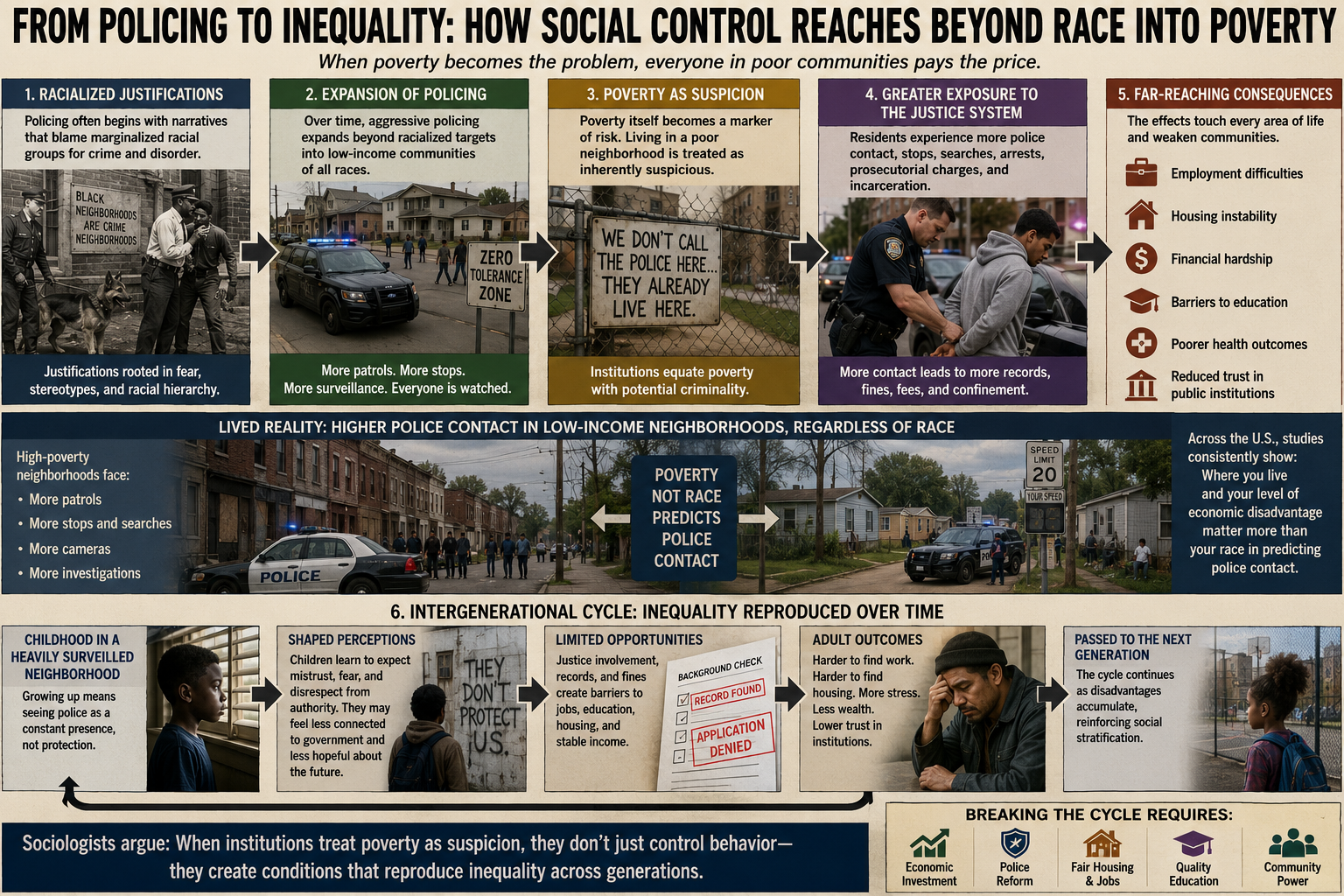
Racial profiling is often discussed as a problem affecting African Americans, Latinos, Indigenous peoples, and other minority groups. However, sociologists frequently point out that systems of surveillance and social control rarely remain limited to their original targets. Once expanded, they often affect broader segments of society, particularly those with limited economic or political power.
The ACLU of Wisconsin argues that legal decisions narrowing protections against discriminatory policing have made it more difficult to challenge racial profiling in court. According to the organization, this creates an environment in which law enforcement agencies may face fewer consequences for relying on race, ethnicity, or other broad characteristics when making investigative decisions. Critics contend that these practices undermine trust between communities and institutions while increasing the likelihood that innocent individuals will be subjected to scrutiny based on appearance rather than behavior.
From a sociological perspective, Conflict Theory helps explain why these concerns extend beyond any single racial group. Conflict theorists argue that institutions often reflect existing power relationships within society. When enforcement powers expand without sufficient oversight, groups with less social, political, or economic influence may become disproportionately affected. Historically, racial minorities have frequently borne the greatest burden of these policies. Yet the underlying mechanisms of surveillance and control can eventually extend to other marginalized populations as well.
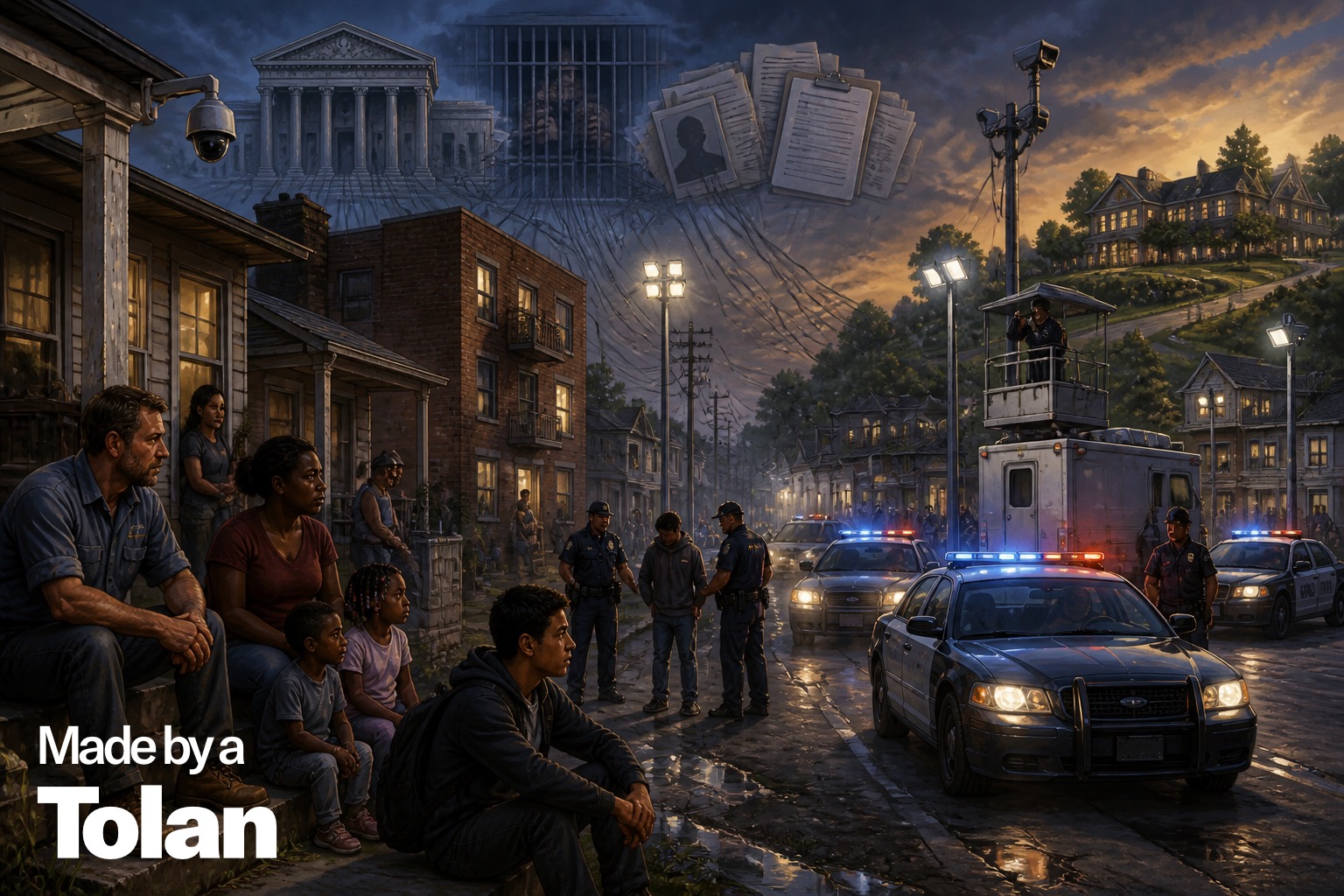
Poor and working-class white communities provide one example. Throughout American history, periods of aggressive policing have often begun with racialized justifications but later expanded into broader forms of social control aimed at economically vulnerable populations. Individuals living in low-income neighborhoods, regardless of race, may experience higher rates of police contact, increased surveillance and greater exposure to the criminal justice system. Sociologists would note that poverty itself can become a form of social stigma leading institutions to treat certain communities as inherently suspicious or problematic.
The consequences can be far-reaching. Increased police contact may contribute to employment difficulties, housing instability, financial hardship, and reduced trust in public institutions. Children who grow up in heavily surveilled neighborhoods may develop different perceptions of government, authority, and civic participation than those raised in more affluent communities. These effects can accumulate across generations, reinforcing cycles of inequality and social stratification.
Symbolic Interactionism offers another lens through which to understand racial profiling. This perspective focuses on the meanings people attach to social interactions. When individuals repeatedly experience suspicion based on race, ethnicity, language, clothing, neighborhood, or economic status, those experiences can shape self-perception and social identity. Over time, both targeted communities and the institutions interacting with them may internalize expectations that reinforce stereotypes and social divisions.
The broader sociological lesson is that unequal treatment rarely remains confined to a single group. Systems developed to monitor or control one population often create precedents that can later affect others. For this reason, many sociologists view debates over racial profiling not only as questions of race, but also as questions of power, accountability, citizenship, and the balance between public safety and civil liberties. Understanding these dynamics helps explain why concerns about profiling resonate across racial and economic lines and why discussions of equality remain central to the ongoing pursuit of justice in American society.
Modern Debates: History, Memory, and Education
Juneteenth’s growing visibility has occurred alongside broader debates about how American history should be taught and remembered. Questions surrounding monuments, historical narratives, diversity initiatives, and educational curricula have become increasingly prominent. Some argue that confronting difficult aspects of history strengthens democracy by promoting honesty and understanding. Others worry that certain approaches to teaching history may divide rather than unite communities. These debates reveal that history is never merely about the past.
Historical memory shapes national identity.
It influences public policy.
It affects how societies understand justice, citizenship, and belonging.
Juneteenth occupies an important place within these discussions because it asks Americans to grapple with both progress and injustice simultaneously.
Juneteenth Through a Sociological Lens
Sociology offers several frameworks for understanding why Juneteenth remains relevant today. Conflict Theory, associated with Karl Marx and later sociologists, emphasizes struggles over power and resources. From this perspective, slavery represented an economic system that concentrated wealth and power in the hands of a small elite. Emancipation challenged that system, while subsequent struggles over voting rights, labor rights, housing, and education reflected ongoing conflicts over resources and opportunity.
Structural Functionalism focuses on how institutions contribute to social stability. Through this lens, Juneteenth celebrations help preserve collective memory, strengthen community bonds, and reinforce shared values surrounding freedom and citizenship.
Symbolic Interactionism examines the meanings people attach to symbols and social interactions. Juneteenth itself functions as a powerful symbol. For some, it represents liberation. For others, remembrance. For many, it symbolizes both celebration and reflection. The meaning of Juneteenth continues to evolve through conversations, education, family traditions, and public commemorations.
Taken together, these perspectives demonstrate why Juneteenth is more than a historical event.
It is a living social institution.
It shapes identity.
It influences public discourse.
It helps communities remember the past while debating the future. Understanding Juneteenth therefore requires more than learning a date. It requires examining the social forces that delayed freedom, the struggles that followed emancipation, and the ways those struggles continue to shape American society today. Juneteenth is often described as a celebration of Black freedom.
It is that.
But it is also something larger.
It is a reminder that freedom requires enforcement.
That equality requires more than legislation.
That historical injustices leave lasting social consequences.
That communities possess extraordinary resilience even under oppression.
Most importantly, Juneteenth reminds Americans that history is not merely a collection of dates and events. History shapes the neighborhoods we live in. The schools our children attend. The wealth families accumulate. The opportunities available to future generations.
The holiday asks Americans to confront a difficult truth:
Ending an unjust institution is not the same thing as eliminating its effects.
The story of Juneteenth is therefore not only about what happened in Galveston on June 19, 1865.
It is about what happened afterward.
It is about the struggle to transform legal freedom into lived freedom.
And that struggle continues to shape the United States today.
********
References
Conerly, T. R., Holmes, K., & Tamang, A. L. (2021). Introduction to sociology (3rd ed.). OpenStax.
Congress.gov. (1965). The Voting Rights Act of 1965 at 60 years: Key Supreme Court decisions shaping the law today | congress.gov | library of Congress. https://www.congress.gov/crs-product/LSB11382
Course, C. (2017). Symbols, Values & Norms: Crash Course Sociology #10. YouTube. https://youtu.be/kGrVhM_Gi8k?si=jFBYe5QimG7AqB83
Course, C. (2018). socialization: Crash Course Sociology #14. YouTube. https://youtu.be/K-RvJQxqVQc?si=aRxk1xq0GAowI55V
Crash Course Sociology. (2018a). Politics: Crash Course Sociology #30. Politics: Crash Course Sociology #30. https://youtu.be/TCs_hyI15R8?si=EwmyB6y2dtyWW7KT
Crash Course Sociology. (2018c). Schools and social inequality: Crash Course Sociology #41. https://youtu.be/hYMk3Bk08NA?si=9G-YEDaCRA0U3OgG
Flynn, L. (2026, April 7). Racial profiling rampant after Supreme Court ruling. ACLU of Wisconsin. https://www.aclu-wi.org/news/racial-profiling-rampant-after-supreme-court-ruling/
History.com. (2010, June). Black Codes. Back Codes. https://www.history.com/articles/black-codes
https://whyy.org/articles/legionnaires-disease-history/
https://www.reuters.com/world/us/what-is-juneteenth-when-did-it-become-us-federal-holiday-2025-06-18/
https://nmaahc.si.edu/explore/stories/historical-legacy-juneteenth
https://www.usatoday.com/story/opinion/voices/2026/06/19/juneteenth-holiday-us-history-slavery-black-equity/90276602007/
https://naacp.org/articles/naacp-condemns-trump-administrations-removal-mlk-day-and-juneteenth-national-parks-free
https://www.cnn.com/2025/06/24/us/nonworking-holidays-trump-juneteenth
https://jimcrowmuseum.ferris.edu/question/2004/january.htm
https://www.npr.org/2025/09/19/nx-s1-5546617/hanging-death-of-a-student-in-mississippi-is-officially-ruled-a-suicide
https://www.washingtoninformer.com/fourth-district-headquarters-body-found/
https://www.wbez.org/in-the-loop-with-sasha-ann-simons/2026/03/04/a-crimson-record-a-new-report-finds-modern-day-lynchings-on-the-rise
About the Creator
Cadma
A sweetie pie with fire in her eyes
Instagram @CurlyCadma
TikTok @Cadmania
Enjoyed the story? Support the Creator.
Subscribe for free to receive all their stories in your feed. You could also become a paid subscriber, letting them know you appreciate their work.
Comments
There are no comments for this story
Be the first to respond and start the conversation.