Science
EARTHQUAKES
Earthquakes: Nature's Unpredictable Fury Introduction: Earthquakes, the relentless force of nature that can strike without warning, have fascinated and terrified humanity throughout history. These ground-shaking events are a result of the Earth's complex and dynamic geological processes. This article will delve into the science of earthquakes, their causes, effects, and the crucial measures we can take to mitigate their impact.
By deenadhayalan3 years ago in Earth
What if Uranus collided with Earth?
Certainly, here's an expanded version of the scenario where Uranus collides with Earth, with a minimum of 600 words: Imagine a world where everything seems normal. The sky is clear, and the Earth is spinning as it always has. It's been 30 days since Uranus first made its appearance in the night sky. Initially, it seemed as though our Moon had found an unusual celestial partner. But then, scientists and astronomers came to understand that something much larger was heading our way - a celestial catastrophe that would forever change the fate of our planet.
By Dilraj Zaildar3 years ago in Earth
A Journey to the End of the Universe
Our Universe is of an immense and inconceivable scale, marked by at least 70 sextillion stars, creating islands of light within the vast darkness. There are more stars in our Universe than there are grains of sand on every beach on Earth, a number so absurd it defies human understanding. Yet, in this universe filled with cosmic landmarks, there's an irony in the fact that concentrated matter is sparse and scattered.
By Sanele Mbokazi3 years ago in Earth
Unveiling the Mystery of Theia: A Journey to the Earth's Core
Chapter 1: The Enigma of Lunar Origins The story of our Moon's origin is one that has puzzled scientists for generations. How did our celestial companion come into existence? For years, researchers have explored various theories and hypotheses to unlock the secrets of lunar formation. Among these, the "giant impact hypothesis" has stood out as the most compelling explanation. This theory suggests that the Moon was born from the cataclysmic collision between Earth and a mysterious lost planet known as Theia, which was roughly the size of Mars. In this chapter, we delve into the giant impact hypothesis, exploring the role of Theia and the lingering mysteries that have shrouded this celestial event.
By Raiana Jalal Oyishee3 years ago in Earth
Question your existence?
Have you ever gazed upon the night sky and contemplated the vastness of the universe? Thought about your place within this cosmic expanse? Join us on a journey from our home on Earth to the far reaches of the cosmos as we delve into the mind-bending scales that will undoubtedly prompt you to question your existence.
By Sophia Hayes3 years ago in Earth
Thomas Kenneth Mattingly II: A Hero's Journey Through the Cosmos
Introduction The world lost a true American hero on April 27, 2023, when Thomas Kenneth Mattingly II, an iconic figure in the realm of space exploration, passed away at the age of 87. His name will forever be etched in history, thanks to his pivotal role in ensuring the safe return of the Apollo 13 crew following a catastrophic explosion that jeopardized their lunar mission. NASA's announcement of his passing sent ripples of sorrow across the globe, but it also served as a poignant reminder of Mattingly's profound impact on human spaceflight.
By Raiana Jalal Oyishee3 years ago in Earth
A Lost City of Giants?
Unearthing the Enigmatic: Lost City of Giants in Ethiopia In a recent archaeological excavation in Harlaa, Ethiopia, a team led by Timothy Insoll from the Institute of Arabic and Islamic Studies at the University of Exeter made a startling discovery - a long-lost city believed to have once been inhabited by giants. This remarkable find has not only rekindled local legends but also revealed intriguing insights into the city's historical significance.
By Sophia Hayes3 years ago in Earth
NASA's Lucy Spacecraft: Unveiling the Binary World of Dinkinesh and the Path to Jupiter's Trojans
Introduction In the boundless expanse of space, NASA's Lucy spacecraft continues its extraordinary journey, unveiling hidden celestial wonders and pushing the boundaries of our understanding of the solar system. On November 1, Lucy marked a significant milestone as it embarked on its first close encounter with an asteroid, revealing a remarkable secret about the small main belt asteroid Dinkinesh. Dinkinesh, it turns out, is not alone in its cosmic travels; it is part of a binary system. This discovery, combined with the successful testing of Lucy's terminal tracking system, provides a tantalizing glimpse of the mission's ultimate objective: to explore the enigmatic Jupiter Trojan asteroids. In this in-depth exploration, we will delve into the intricate details of Lucy's historic flyby, examine the significance of Dinkinesh's binary nature, and discuss the broader implications for future missions.
By Raiana Jalal Oyishee3 years ago in Earth
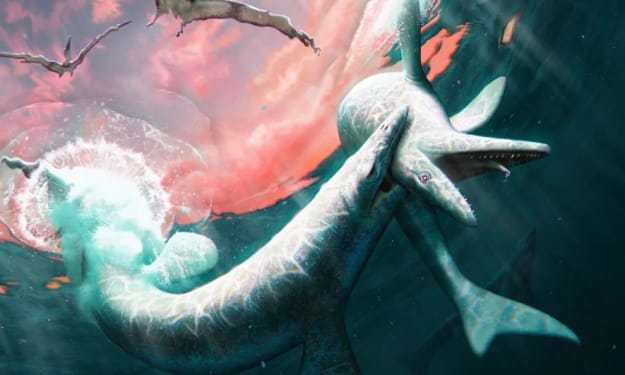
The Enigmatic Jormungandr Walhallaensis: Unveiling a Sea Monster from Norse Myth and Its Prehistoric Counterpart
The legends of Norse mythology are replete with epic tales of gods, giants, and mythical creatures. Among these legends, one of the most iconic is that of Jormungandr, the colossal sea serpent known as the Midgard Serpent, believed to be the offspring of the trickster god Loki. According to the ancient Norse tales, Jormungandr was so immense that it could encircle the entire globe. While the realm of mythology may seem far removed from the world of science, it has intriguingly inspired the naming of a newly discovered species of prehistoric marine reptile. This article delves into the fascinating story of Jormungandr Walhallaensis, a recently described mosasaur species, and explores the mysteries it unravels about ancient sea monsters and evolution.
By Raiana Jalal Oyishee3 years ago in Earth
Recently recognized species could reveal insight into the advancement of ancient 'ocean beasts'
A gigantic ocean snake from Norse legend that was fathered by the comedian god Loki and became sufficiently large to circle the globe is presently the namesake for an alternate sort of "beast" — a newfound type of enormous, meat-eating marine reptile known as a mosasaur, which lived around a long time back.
By Kamrul Monir Mojumder3 years ago in Earth